
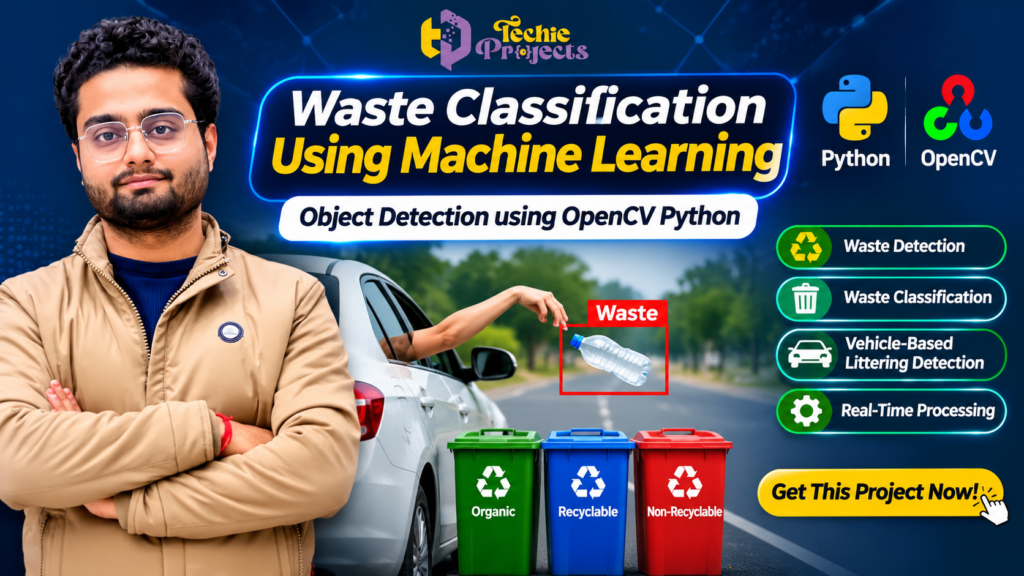
Waste Classification Using Machine Learning is an excellent academic project for students interested in artificial intelligence, Python programming, and computer vision. This project demonstrates how intelligent detection techniques can help identify waste-related activities and explore practical solutions for environmental monitoring.
🚀 Looking to purchase a Waste Classification Using Machine Learning project for your final-year engineering submission? Get a practical Python and OpenCV-based project from Techie Projects that demonstrates object detection, waste identification, and vehicle-based littering detection. Instead of spending weeks struggling with datasets, Python implementation, OpenCV configurations, and machine learning integration, get professional project assistance and start working on your academic project with greater confidence.
🌍 Waste management is becoming an important challenge in modern cities. People throwing plastic bottles, wrappers, and other waste materials from moving vehicles contribute to environmental pollution. This project explores how computer vision and machine learning can help identify waste disposal activities and support smarter waste monitoring solutions.
Purchase the Waste Classification Using Machine Learning Project from Techie Projects and explore the practical implementation of object detection using Python and OpenCV.
Whether you are pursuing B.Tech, M.Tech, BCA, MCA, or a computer science diploma, this project offers an interesting opportunity to understand machine learning, image processing, object detection, and real-world environmental applications.
📞 Contact Techie Projects for Project Enquiries
Interested in purchasing the Waste Classification Using Machine Learning Project? Contact us to enquire about package availability, pricing, source code, documentation, installation guidance, and technical support options.
💬 WhatsApp Enquiry: Chat with Techie Projects
📱 Contact Number: +91 94600 60699
🌐 Official Website: www.techieprojects.com
📸 Instagram: Follow Techie Projects
🎓 Project Areas: Robotics, Machine Learning, Arduino, Deep Learning, Artificial Intelligence, and Android App.
✅ Request Project Details: Share your engineering branch, preferred features, and technical requirements to enquire about the most suitable available package.
🚀 Ready to get started? Click here to enquire on WhatsApp and mention Waste Classification Using Machine Learning Project.
Package contents, prices, hardware availability, and support options should be confirmed before purchase.
🎬 Watch the Waste Classification Using Machine Learning Project Demo
Explore the working demonstration of this project to understand how object detection techniques can identify waste-related activities in a vehicle-based littering scenario.
The demonstration helps students understand the project concept, detection process, application workflow, and practical use of computer vision.
🌍 What Is Waste Classification Using Machine Learning?
Waste Classification Using Machine Learning is a computer vision-based project that explores how artificial intelligence can identify and classify waste-related objects through image or video analysis.
Traditional waste monitoring methods often depend on manual observation, CCTV monitoring, and public reporting. These methods can be difficult to manage across large areas.
With machine learning and object detection, software systems can analyze visual information and identify objects of interest.
This project focuses on detecting waste disposal activities associated with moving vehicles. It demonstrates how a computer vision system can identify a waste object, such as a plastic bottle, when it is thrown from a vehicle.
The system uses Python and OpenCV-based computer vision techniques to demonstrate the detection workflow.
The main purpose is to explore how technology can contribute to environmental monitoring and smart waste management.
🎯 Objectives of the Waste Classification Project
The major objectives of this project include:
- To develop a machine learning-based waste detection solution.
- To explore object detection using Python and OpenCV.
- To identify waste-related objects from visual input.
- To demonstrate vehicle-based littering detection.
- To understand real-time video processing concepts.
- To explore the role of artificial intelligence in environmental protection.
- To develop practical knowledge of computer vision applications.
- To demonstrate how automated monitoring can support waste management.
⚙️ Key Features of the Waste Classification Using Machine Learning Project
One important advantage of Waste Classification Using Machine Learning is its practical application in smart environmental monitoring. By combining object detection and image processing, students can explore how automated systems identify waste objects and analyze visual information from different environments.
The project demonstrates several interesting features related to computer vision and waste monitoring.
1. 🚗 Vehicle-Based Littering Detection
One of the main features is vehicle-based littering detection.
The project explores how a computer vision system can identify waste disposal activities involving moving vehicles.
This concept is useful for understanding how visual monitoring can support environmental awareness and waste management.
2. 🔍 Object Detection Using OpenCV
Object detection is an important component of computer vision.
OpenCV provides image and video processing functionality that developers can use to build visual detection applications.
In this project, OpenCV is used as part of the object detection workflow.
Students can understand how video frames are processed and how objects can be identified within visual input.
3. 🤖 Machine Learning Integration
Machine learning helps computers identify patterns from data and make predictions based on learned information.
The project introduces students to machine learning concepts through a practical environmental monitoring application.
It provides an opportunity to understand how machine learning can be integrated into object detection solutions.
4. 🎥 Video-Based Monitoring
Video processing is an important feature in computer vision applications.
The project demonstrates a vehicle-based waste monitoring scenario using visual input.
Students can explore frame processing and understand how video information can be analyzed.
5. ♻️ Waste Identification
Waste identification is an important part of environmental monitoring.
The project focuses on recognizing waste-related objects and demonstrating how object detection can be applied to waste management scenarios.
6. ⚡ Real-Time Processing Concepts
Real-time processing is useful in applications where visual information needs to be analyzed continuously.
This project introduces students to the concepts involved in processing video input and identifying objects during monitoring.
Actual detection speed depends on the hardware, model, and implementation.
7. 📊 Environmental Monitoring Application
The project demonstrates how artificial intelligence and computer vision can be explored for environmental protection.
It provides a practical academic example of applying software development techniques to a real-world problem.
🧠 How Does Waste Classification Using Machine Learning Work?
Understanding the project workflow is important for students who want to learn how computer vision applications operate.
The general workflow can be explained through the following steps.
Step 1: Video or Image Input
The system receives visual input through an image or video source.
The input contains the vehicle and surrounding road environment.
Step 2: Frame Processing
The video is processed into individual frames for analysis.
OpenCV provides functionality for reading and processing these frames.
Step 3: Object Detection
The object detection component analyzes the visual information to identify relevant objects.
Depending on the implemented detection model, objects such as vehicles and waste items can be detected.
Step 4: Waste Activity Identification
The system explores the relationship between vehicle movement and waste disposal activity.
This stage demonstrates how computer vision can be used to identify potentially relevant littering events.
Step 5: Detection Output
The system displays the detection results to help users understand the identified objects and activities.
Step 6: Result Analysis
The generated output can be used to understand how object detection contributes to environmental monitoring.
Important: Automated detection is not proof of a person’s identity or a legal violation. Any real-world enforcement application would require reliable verification, appropriate data handling, and human review.
💻 Technologies Used in Waste Classification Using Machine Learning
Python plays an important role in developing Waste Classification Using Machine Learning applications. With libraries such as OpenCV and compatible machine learning frameworks, developers can build image processing workflows, analyze video frames, and experiment with intelligent object detection models.
This project introduces students to important technologies used in artificial intelligence and computer vision.
1. Python Programming Language
Python is widely used in machine learning, artificial intelligence, automation, and computer vision.
Its readable syntax and extensive libraries make it suitable for developing practical machine learning applications.
2. OpenCV
OpenCV is an open-source computer vision library.
It provides functionality for:
- Image processing.
- Video processing.
- Image transformation.
- Object detection workflows.
- Frame extraction.
- Visual analysis.
3. Machine Learning
Machine learning enables software systems to learn patterns from data.
It is widely used in object classification, prediction, detection, and intelligent automation.
4. Computer Vision
Computer vision allows computers to process and understand visual information.
It is used in applications such as:
- Face recognition.
- Vehicle detection.
- Object tracking.
- Waste detection.
- Industrial inspection.
- Smart surveillance.
5. Image and Video Processing
Image and video processing techniques help prepare visual input for analysis.
These techniques are important for building computer vision applications.
🏗️ Applications of Waste Classification Using Machine Learning
The use of Waste Classification Using Machine Learning in smart cities provides an interesting opportunity for research and development. Such systems can support environmental monitoring initiatives by helping identify littering activities and improving awareness about responsible waste disposal.
The concepts demonstrated by this project can be explored in several environmental applications.
1. Smart City Waste Monitoring
Smart cities can explore computer vision technologies to monitor public spaces and identify waste-related activities.
2. Roadside Littering Detection
Visual monitoring systems can help identify potential roadside littering events.
3. Environmental Protection
Automated waste monitoring can support environmental awareness and cleaner public spaces.
4. Smart Surveillance Systems
Computer vision can be integrated into surveillance applications to identify specific visual events.
5. Waste Management Research
Students and researchers can explore how machine learning techniques can contribute to modern waste management solutions.
6. Intelligent Transportation Monitoring
Vehicle-based visual monitoring can be combined with other smart transportation technologies for research and development.
🎓 Benefits for Final-Year Engineering Students
Students working on Waste Classification Using Machine Learning can gain practical knowledge of computer vision, machine learning algorithms, Python programming, and object detection. These concepts are valuable for students planning careers in artificial intelligence and software development.
The Waste Classification Using Machine Learning Project is an interesting choice for students who want to explore artificial intelligence and computer vision through a practical application.
1. Practical Machine Learning Experience
Students can understand how machine learning concepts are applied to environmental monitoring and object detection.
2. Learn Python and OpenCV
The project introduces students to Python programming and OpenCV-based image and video processing.
3. Understand Real-World Problems
Instead of working only on theoretical examples, students can explore a practical environmental problem.
4. Improve Technical Knowledge
Students can learn about object detection, video processing, computer vision, and machine learning workflows.
5. Useful for Academic Demonstrations
The project provides a visual demonstration of how an intelligent detection system can operate.
6. Build a Technical Portfolio
Understanding and extending this project can help students demonstrate practical knowledge of computer vision and Python development.
7. Explore Future Research Opportunities
Students can extend the project with advanced detection models, improved classification techniques, and additional environmental monitoring features.
🏫 Who Can Purchase This Project?
This project is suitable for students interested in artificial intelligence, machine learning, Python, and computer vision.
B.Tech Computer Science Engineering (CSE): Students looking for machine learning and computer vision projects.
B.Tech Information Technology (IT): Students interested in intelligent monitoring and software development.
M.Tech Students: Students exploring advanced machine learning and image processing concepts.
BCA Students: Students interested in Python-based application development.
MCA Students: Students looking for practical machine learning and computer vision applications.
Diploma Computer Engineering Students: Students interested in developing an innovative academic project.
🛒 Why Purchase Your Project from Techie Projects?
Choosing the right project provider can make your academic development journey easier.
Techie Projects provides project-related solutions across different technology domains for engineering and computer application students.
1. Multiple Project Domains
Explore project solutions in:
- Artificial Intelligence.
- Machine Learning.
- Deep Learning.
- Python Development.
- Computer Vision.
- Image Processing.
- Data Science.
- Data Analytics.
- Web Development.
- Android Application Development.
- Internet of Things.
- Natural Language Processing.
2. Project Demonstration
Explore the available project demonstration to understand the application concept and functionality before purchasing.
3. Technical Assistance
Discuss your implementation requirements, project details, and available technical assistance with our team.
4. Academic Project Support
Get assistance in understanding project functionality and technical concepts for your academic work.
5. Project Customization Discussion
Discuss your college requirements and possible project modifications with the Techie Projects team.
6. Multiple Academic Project Options
Whether you are interested in Python, machine learning, deep learning, web development, or computer vision, Techie Projects offers solutions across multiple domains.
💻 Software and Hardware Requirements
The following are general development requirements. Exact specifications depend on the project implementation and detection model.
Software Requirements
- Programming Language: Python.
- Computer Vision Library: OpenCV.
- Operating System: Windows 10/11.
- Development Environment: Python-compatible IDE.
- Additional Libraries: As required by the implementation.
- Machine Learning Framework: As required by the detection model.
Hardware Requirements
- Processor: Intel Core i3 or higher.
- RAM: 4 GB minimum; 8 GB recommended.
- Storage: 500 GB HDD or SSD.
- Graphics: Integrated graphics or compatible dedicated GPU, depending on the model.
- Input: Keyboard and mouse.
- Camera or Video: For video-based testing.
🚀 Future Scope of Waste Classification Using Machine Learning
The project concept offers several opportunities for future development.
Students can extend the existing application by exploring the following features:
- Advanced YOLO-based waste detection.
- Automatic vehicle tracking.
- Waste classification into plastic, paper, metal, and other categories.
- Number plate recognition as a separate research module.
- Real-time CCTV integration.
- Cloud-based detection result storage.
- Smart city monitoring dashboards.
- Automated environmental reporting.
- Mobile application integration.
- Improved detection accuracy using larger and more diverse datasets.
These enhancements can make the project more advanced and provide opportunities for further research.
💡 Recommended Projects from Techie Projects
Interested in more machine learning and computer vision projects? Explore these related project ideas:
- Vehicle Detection and Counting System – Detect and count vehicles using computer vision.
- Pothole Detection System – Identify road potholes using image processing and machine learning.
- Garbage Detection System – Identify garbage in images and video streams.
- Helmet Detection System – Detect helmet usage using object detection.
- Number Plate Detection System – Explore vehicle number plate recognition.
- Smart Waste Management System – Develop an intelligent waste monitoring solution.
- Real-Time Object Detection with Voice Output – Identify objects and generate voice-based output.
🌐 Explore more projects: www.techieprojects.com
❓ Frequently Asked Questions (FAQs)
1. What is Waste Classification Using Machine Learning?
It is a computer vision-based project that demonstrates how machine learning and object detection can identify waste-related objects and support waste monitoring.
2. Which programming language is used in this project?
Python is used for implementing the project.
3. Is OpenCV used in this project?
Yes. OpenCV is used for image and video processing in the object detection workflow.
4. Can B.Tech students purchase this project?
Yes. B.Tech CSE, IT, and related engineering students can contact Techie Projects to enquire about purchasing this project.
5. Is this project suitable for MCA and BCA students?
Yes. Students interested in Python, machine learning, and computer vision can explore this project.
6. Does the project detect waste thrown from moving vehicles?
The project is designed around a vehicle-based littering detection scenario. Ask our team about the exact detection functionality included in the available version.
7. Can I get the project source code?
Contact Techie Projects to confirm source code availability, project package details, and delivery options.
8. Can I get technical assistance?
Contact our team to discuss the technical assistance available with the project.
9. Can the project be extended with YOLO?
YOLO-based object detection can be explored as a possible enhancement, depending on the existing implementation and project requirements.
10. How can I purchase this project?
You can contact Techie Projects through WhatsApp at +91 94600 60699 to discuss pricing, availability, and project requirements.
If you are searching for a practical Waste Classification Using Machine Learning project for your final-year submission, Techie Projects can help you explore the available project package. Contact our team to discuss source code availability, implementation details, pricing, and technical assistance.
🛒 Get Your Waste Classification Using Machine Learning Project Now!
Are you ready to develop an innovative final-year engineering project based on artificial intelligence and computer vision?
Don’t waste your valuable academic time struggling with Python configurations, OpenCV errors, object detection implementation, and machine learning integration without a clear development plan.
Purchase the Waste Classification Using Machine Learning Project from Techie Projects and take the next step toward your academic project journey.
Get in touch with our team to discuss project pricing, source code availability, implementation details, and technical assistance.
🎯 Get This Project Now!
📞 Contact / WhatsApp: +91 94600 60699
🌐 Website: www.techieprojects.com
📸 Instagram: @pythonprojects_
Techie Projects – Your Destination for AI, Machine Learning, Python, Computer Vision, and Final-Year Engineering Projects.
Academic note: Students should understand the implementation, make their own contributions, and follow their institution’s academic integrity and project submission requirements.

