
Introduction
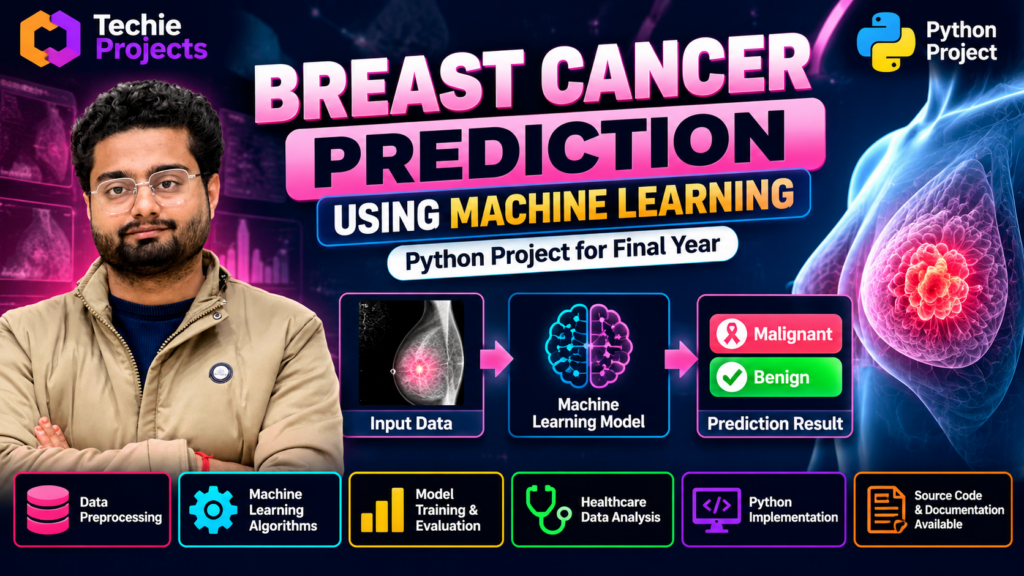
Breast cancer prediction using machine learning is an educational AI project that demonstrates how machine learning algorithms can analyze structured medical datasets and classify records into predefined categories. Developed using Python, this project introduces students to data preprocessing, feature selection, model training, and classification.
This project is suitable for B.Tech, B.E., Computer Science, Artificial Intelligence, and Data Science students who want to explore a healthcare-related machine learning application for their final-year project.
If you are looking for a breast cancer prediction project with Python source code, Techie Projects can help you enquire about project availability, implementation details, and customization options for your academic requirements.
🎬 Breast Cancer Prediction Using Machine Learning – Project Demo Video
Explore the project demonstration to understand how a Python-based machine learning application processes input data and produces a classification result. The demonstration can help you understand the application workflow, user interface, and output generated by the implemented model.
This project provides a practical way to explore how data-driven classification works in a healthcare-related educational application.
🎯 Project Overview
The main objective of breast cancer prediction using machine learning is to demonstrate the use of classification algorithms on a suitable dataset. The application processes selected input features and uses a trained model to produce a predicted category.
Project details:
- Project Name: Breast Cancer Prediction Using Machine Learning
- Programming Language: Python
- Domain: Machine Learning and Healthcare Data Analysis
- Project Type: Final-Year Engineering Project
- Input: Supported dataset features or application inputs
- Output: A model-generated classification
- Tools: Python and compatible machine learning libraries
The exact algorithm, input fields, interface, and included features depend on the project implementation.
🧠 Key Features of the Project
1. Dataset Preprocessing
The application can prepare the dataset for machine learning by handling required formatting, feature selection, and data transformation.
2. Machine Learning Classification
A trained classification model processes the selected features and predicts a category based on patterns learned from the training data.
3. Model Training and Evaluation
Students can explore how a model is trained and evaluated using suitable metrics, such as accuracy, precision, recall, F1-score, and a confusion matrix, where supported by the implementation.
4. Python-Based Development
Python provides access to tools for data analysis, machine learning, visualization, and application development.
5. Educational User Interface
Depending on the supplied version, the project may provide an interface for entering supported values and viewing model output.
6. Customization Opportunities
Students can discuss possible changes to the interface, dataset, model, visualizations, or documentation according to their academic requirements.
⚙️ How Does Breast Cancer Prediction Using Machine Learning Work?
A typical implementation follows these steps:
- Dataset collection: Use a suitable dataset intended for machine learning research and education.
- Data preprocessing: Prepare the data and select relevant features.
- Dataset splitting: Separate data into training and testing sets using an appropriate strategy.
- Model training: Train a selected classification algorithm on the training data.
- Model evaluation: Evaluate performance on held-out data using suitable metrics.
- Prediction: Pass supported input features to the trained model.
- Result display: Display the model’s classification output through the application interface.
The actual workflow depends on the algorithm and dataset used in the project.
💻 Algorithms and Technologies Used
Logistic Regression
Logistic regression is a commonly used classification algorithm that estimates the probability of a class based on input features.
Decision Tree
A decision tree learns a sequence of feature-based decisions to assign a record to a predicted category.
Random Forest
Random forest combines multiple decision trees and aggregates their predictions. It can be explored as an alternative classification approach.
Python Libraries
Depending on the implementation, the project may use:
- Python: Main programming language.
- Pandas: Dataset handling and analysis.
- NumPy: Numerical operations.
- Scikit-learn: Model training, preprocessing, and evaluation.
- Matplotlib or Seaborn: Optional data visualizations.
- Streamlit or Tkinter: Optional application interface.
Confirm which algorithms and libraries are actually included in your project before advertising them as implemented features.
🖥️ Software and Hardware Requirements
Software Requirements
- Python
- VS Code, PyCharm, or another compatible IDE
- Required Python libraries
- A supported dataset
- A compatible operating system
Hardware Requirements
- Desktop computer or laptop
- Adequate RAM and storage for the selected dataset and libraries
- Internet access for initial setup, if required
The precise requirements depend on the implementation and included dependencies.
🎓 Applications of the Project
This educational project can help students explore:
- Healthcare data analysis
- Binary classification
- Medical dataset experimentation
- Machine learning model evaluation
- Feature selection and preprocessing
- Python-based predictive modeling
- Artificial intelligence research and learning
The project demonstrates machine learning concepts. It is not a clinically validated diagnostic system and must not be used to diagnose breast cancer or guide medical treatment.
✅ Advantages of the Project
- Provides practical experience with machine learning classification.
- Introduces data preprocessing and feature engineering.
- Demonstrates model training and evaluation.
- Uses Python and widely used data science tools.
- Offers a foundation for comparing different algorithms.
- Can support academic presentations and technical demonstrations.
🚀 Future Scope
Possible extensions include:
- Comparing multiple classification algorithms.
- Adding model evaluation visualizations.
- Improving data preprocessing and feature selection.
- Developing a more user-friendly interface.
- Adding model comparison reports.
- Documenting the effect of different training and testing strategies.
- Exploring explainability methods to understand model predictions.
Any extension should be evaluated carefully, particularly when working with healthcare-related data.
🛒 Purchase Breast Cancer Prediction Using Machine Learning Project
Are you searching for a breast cancer prediction using machine learning project with Python source code for your final-year engineering project?
Techie Projects helps students explore Python, machine learning, deep learning, and computer vision projects. Contact our team to enquire about the availability of this project, package details, source code, documentation, and possible customization.
What can you enquire about?
- Python source code availability
- Implemented machine learning algorithm
- Dataset and preprocessing details
- Setup and execution instructions
- Project documentation and demonstration support
- Customization options for academic requirements
- Current pricing and delivery details
Please confirm the actual package contents, supported features, and included services with our team before placing an order.
Contact Techie Projects
- 📲 Call/WhatsApp: +91-9460060699
- 🌎 Website: www.techieprojects.com
- 📺 Instagram: @pythonprojects_
Have a specific requirement? Send us a WhatsApp message to discuss the project and available customization options.
❓ Frequently Asked Questions
1. What is breast cancer prediction using machine learning?
It is a machine learning application that analyzes selected dataset features and predicts a category based on patterns learned from training data.
2. Which programming language is used?
Python is commonly used because it supports data preprocessing, classification algorithms, model evaluation, and application development.
3. Is this project suitable for final-year engineering students?
It can be suitable for Computer Science, Artificial Intelligence, and Data Science students, subject to their institution’s project requirements.
4. Which algorithms can be used?
Depending on the implementation, algorithms may include logistic regression, decision trees, random forests, or other suitable classification models.
5. Can I purchase the project source code?
Contact Techie Projects to confirm source code availability, current pricing, included files, documentation, and support.
6. Can the project be customized?
Customization may be possible depending on the existing implementation. Contact the team to discuss your requirements and confirm feasibility.
7. Can this project diagnose breast cancer?
No. This is an educational machine learning project, not a clinically validated diagnostic tool. Its predictions must not replace professional medical evaluation.
🎓 Explore Related Projects
Explore these related project ideas in machine learning, healthcare data analysis, and deep learning:
- Brain Tumor Detection Using Machine Learning
- Brain Stroke Prediction Using Machine Learning
- Diabetes Prediction Using Machine Learning
- Heart Disease Prediction Using Machine Learning
- Skin Cancer Detection Using Machine Learning
- Breast Cancer Classification Using Deep Learning
Explore more ideas in our Machine Learning Projects, Deep Learning Projects, and Python Projects collections.
Use verified individual project URLs when linking specific project names.
Conclusion
Breast cancer prediction using machine learning is a useful educational project for understanding classification, data preprocessing, model training, and evaluation using Python. It gives engineering students a practical introduction to machine learning through a healthcare-related dataset.
If you want to explore this project for your final-year engineering work, contact Techie Projects to enquire about source code availability, implementation details, and customization options.