
🚀 Introduction
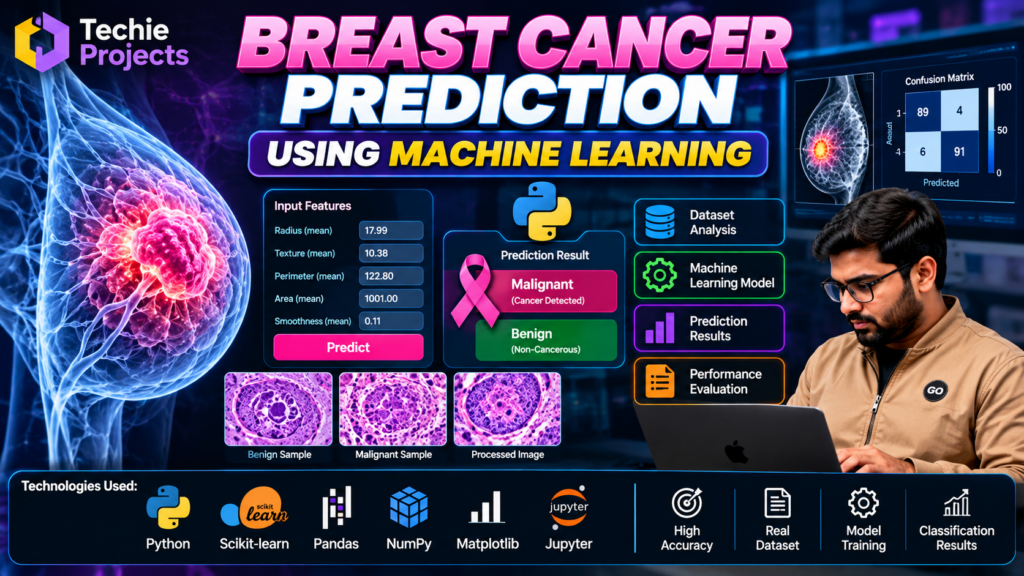
Breast cancer prediction using machine learning is a Python-based educational project that demonstrates how artificial intelligence can analyze a labeled dataset and classify records into predicted categories. This project is suitable for B.Tech, BCA, MCA, and computer science students interested in machine learning, healthcare analytics, and final-year engineering projects.
The breast cancer prediction using machine learning project covers essential concepts such as data preprocessing, model training, classification, and performance evaluation. It can help students understand how machine learning algorithms work and how to build a practical Python application for academic demonstration.
If you are looking for a final-year project with source code and implementation guidance, contact Techie Projects to discuss availability, included deliverables, and customization options.
🎬 Breast Cancer Prediction Using Machine Learning – Project Demo Video
Explore the project demonstration to see how the application works, how input data is processed, and how the trained model produces a classification result. The demo can help you understand the project workflow before deciding whether it suits your academic requirements.
🧠 What Is Breast Cancer Prediction Using Machine Learning?
Breast cancer prediction using machine learning is an educational application that uses classification algorithms to identify patterns in a labeled dataset. The model learns from example records and predicts a class for new inputs based on the features it has been trained to recognize.
Depending on the implementation, the project may use numerical measurements from a suitable dataset and algorithms available through Python’s machine learning ecosystem.
This project demonstrates the technical process of building and evaluating a classification model. It is not a clinically validated medical system and must not be used to diagnose cancer or make treatment decisions.
✨ Key Features of the Project
The breast cancer prediction using machine learning project can include the following features, depending on the selected implementation:
- 🐍 Python implementation: Develop a practical application using Python.
- 📊 Dataset processing: Prepare and organize data for machine learning.
- 🤖 Classification model: Train a model to classify supported input records.
- 🔍 Prediction interface: Display the model’s predicted class for user-provided inputs.
- 📈 Performance evaluation: Evaluate results using suitable classification metrics.
- 🖥️ User interface: Present input fields and results through the interface included in the chosen version.
- 🛠️ Customization options: Adapt the project to academic requirements where supported.
🎯 Project Objectives
The main objectives of this project are:
- Understand supervised machine learning and classification.
- Learn how to preprocess and analyze a labeled dataset.
- Train a machine learning model using Python.
- Evaluate model performance with appropriate metrics.
- Develop an application that demonstrates the prediction workflow.
- Explore the role of artificial intelligence in healthcare-related academic research.
💻 Technologies Used
The following technologies may be used in the project, depending on its implementation:
- Programming language: Python
- Data processing: Pandas and NumPy
- Machine learning: Scikit-learn
- Data visualization: Matplotlib and Seaborn, if required
- User interface: Streamlit, Flask, or Tkinter, depending on the version
- Development tools: VS Code or Jupyter Notebook
Confirm the exact libraries and software requirements for the package before installation.
⚙️ How the Project Works
📂 Step 1: Dataset Collection
A suitable labeled dataset is selected for educational model development. The dataset is reviewed to understand its features, labels, and data quality.
🧹 Step 2: Data Preprocessing
The data is prepared for training. This stage may include handling missing values, checking data types, selecting features, and scaling numerical values where appropriate.
🤖 Step 3: Model Training
A classification algorithm is trained on the prepared training dataset. The selected algorithm depends on the project implementation and dataset characteristics.
📊 Step 4: Model Evaluation
The trained model is evaluated using appropriate validation methods. Metrics such as precision, recall, F1-score, and a confusion matrix can help explain its strengths and limitations.
🔎 Step 5: Prediction
The application processes supported input features and passes them to the trained model. The interface displays the resulting predicted class.
🖥️ Step 6: Result Demonstration
Students can use the application to demonstrate the workflow and explain the technical implementation during their project presentation.
🎓 Why Choose This Project for Your Final Year?
The breast cancer prediction using machine learning project combines Python programming, data analysis, and artificial intelligence in one academic topic.
It can be a useful choice for students who want to:
- 📚 Learn practical machine learning concepts.
- 💡 Understand classification and model evaluation.
- 🐍 Build experience with Python libraries.
- 🎤 Demonstrate a working application during a project presentation.
- 🔬 Explore healthcare analytics as an educational research area.
- 🛠️ Discuss potential extensions and improvements to an existing implementation.
Choose a project version that matches your institution’s guidelines and your ability to explain its methodology and results.
🛠️ Software and Hardware Requirements
💿 Software Requirements
- Python 3.x with compatible dependencies
- Pandas and NumPy
- Scikit-learn
- VS Code, Jupyter Notebook, or another compatible development environment
- Additional libraries required by the selected interface
🖥️ Hardware Requirements
- A laptop or desktop computer
- 8 GB RAM recommended for a comfortable development experience
- Adequate storage for the dataset, code, and dependencies
Actual requirements may vary according to the dataset size and application design.
🌟 Advantages of the Project
- Provides hands-on experience with machine learning.
- Demonstrates a complete data-to-prediction workflow.
- Introduces model evaluation and performance reporting.
- Can be extended with additional algorithms or visualizations.
- Offers a practical topic for academic presentations and technical discussions.
🚀 Future Scope
The project can be extended for further learning by adding:
- 📈 Comparison of multiple classification algorithms.
- 📊 Interactive charts for dataset exploration.
- 🧪 Cross-validation and more detailed performance reports.
- 🖥️ An improved web-based interface.
- 🔍 Feature importance analysis to explain model behavior.
- 📋 Better documentation of dataset limitations and evaluation methodology.
Any extension involving real medical use would require appropriate clinical validation, expert oversight, and relevant regulatory review.
🎓 Explore Related Projects
Interested in more machine learning and healthcare-related project ideas? Explore these topics:
- Brain Tumor Detection Using Machine Learning
- Brain Stroke Detection Using Machine Learning
- Skin Cancer Detection Using Machine Learning
- Diabetes Prediction Using Machine Learning
- Heart Disease Prediction Using Machine Learning
- Medical Image Classification Using Deep Learning
Visit Techie Projects to explore available project categories and related implementations.
🛒 Get the Breast Cancer Prediction Project
Looking for a breast cancer prediction using machine learning project with Python for your final-year academic work?
Techie Projects can help you enquire about project availability, source code, setup requirements, documentation, and customization options. Contact us before purchasing to confirm exactly which deliverables are included in your selected package.
📲 Contact Techie Projects
- 📲 Call/WhatsApp: +91-9460060699
- 🌎 Website: www.techieprojects.com
- 📺 Instagram: @pythonprojects_
Need a customized version? Contact us with your preferred technology stack, interface requirements, and academic specifications to discuss possible customization.
❓ Frequently Asked Questions
💻 1. Which programming language is used in this project?
Python is the primary programming language in the proposed implementation.
🎓 2. Is this project suitable for B.Tech final-year students?
It may be suitable for B.Tech, BCA, MCA, and computer science students, subject to their institution’s guidelines and project requirements.
📦 3. Can I purchase the source code?
Contact Techie Projects to confirm source-code availability, package details, and pricing before placing an order.
🛠️ 4. Can the project be customized?
Customization may be possible depending on the selected package and technical requirements. Discuss the changes with Techie Projects before purchasing.
⚕️ 5. Can this project diagnose breast cancer?
No. This is an educational machine learning project, not a clinically validated diagnostic tool. It must not replace medical evaluation or professional healthcare advice.
📝 Conclusion
The breast cancer prediction using machine learning project offers students an opportunity to explore Python programming, classification algorithms, data preprocessing, and model evaluation through a practical academic application.
Whether you are preparing a final-year engineering project or exploring healthcare-related artificial intelligence, this topic can help you develop your understanding of machine learning workflows.
🎯 Ready to explore this project? Contact Techie Projects to check availability, confirm deliverables, and discuss customization options before purchasing.