
Hospital Management System Project in Python
Introduction
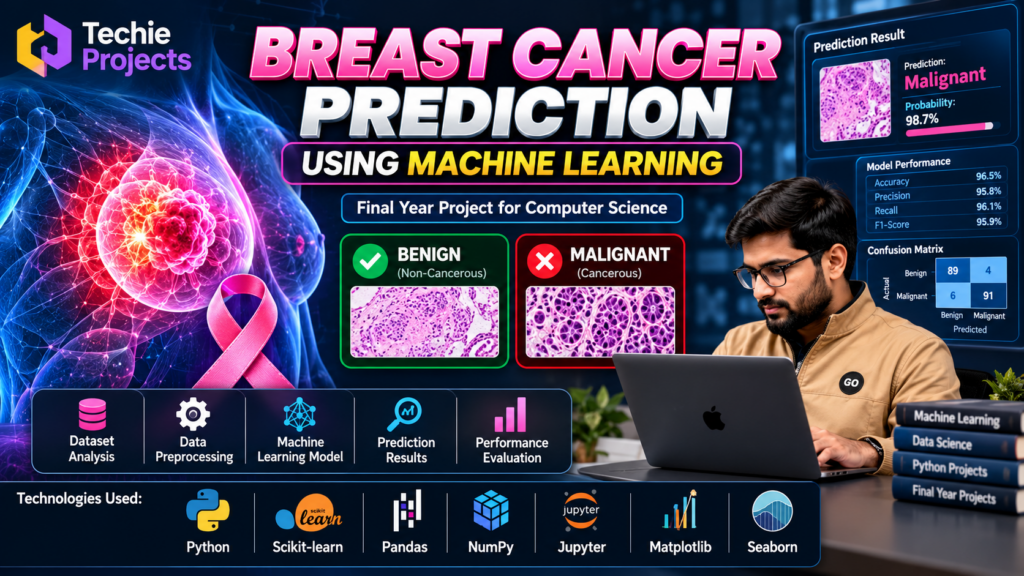
The breast cancer prediction using machine learning project is a Python-based healthcare analytics project designed to demonstrate how machine learning algorithms can analyze medical datasets and classify breast cancer cases into benign or malignant categories. This project is suitable for B.Tech Computer Science Engineering (CSE), Artificial Intelligence, Data Science, and Machine Learning students looking for a practical final-year project.
Using Python and machine learning techniques, students can explore data preprocessing, feature analysis, model training, prediction, and performance evaluation. It is an excellent learning opportunity for understanding how AI can support research in healthcare analytics.
🎓 Looking for a ready-made project with source code and implementation support? Techie Projects can help you explore project availability and customization options for your academic requirements.
🎬 Breast Cancer Prediction Using Machine Learning – Project Demo
Explore how a breast cancer prediction system can process input features and generate a model-based classification result. The project demonstration can help you understand the application workflow, user interface, and prediction process.
Watch the project demo to learn how the Python application works and how machine learning is applied to a healthcare-related problem.
🧠 What Is Breast Cancer Prediction Using Machine Learning?
Breast cancer prediction using machine learning involves training a computer model on a labelled dataset containing relevant features. The trained model learns patterns in the data and predicts a class for new input samples.
In this academic project, the model can be developed using Python libraries such as Pandas, NumPy, and Scikit-learn. Depending on the implementation, classification algorithms may include Logistic Regression, Decision Tree, Random Forest, or Support Vector Machine (SVM).
The project is intended for educational and research purposes. Its predictions are not a substitute for medical diagnosis, professional evaluation, or clinical testing.
🎯 Objectives of the Project
The main objectives of this breast cancer prediction using machine learning project are:
- To understand the application of machine learning in healthcare analytics.
- To preprocess and analyze a labelled dataset.
- To train a classification model using Python.
- To predict benign or malignant classes from supported input features.
- To evaluate the model using suitable performance metrics.
- To develop a simple interface for demonstrating predictions.
- To understand the limitations of machine learning in medical applications.
⚙️ Key Features
1. Dataset Processing
Prepare and clean the dataset by handling missing values, checking feature types, and organizing the data for model training.
2. Machine Learning Classification
Train a suitable classification algorithm to learn patterns from the available dataset.
3. Prediction Interface
Depending on the implementation, users can enter supported feature values and view the model’s predicted class.
4. Model Evaluation
Evaluate performance using metrics such as accuracy, precision, recall, F1-score, and a confusion matrix. Results depend on the dataset, preprocessing, and model configuration.
5. Python Implementation
Use common Python data science libraries to build and test the application.
🔄 How Does the Project Work?
The general workflow for a breast cancer prediction using machine learning system includes the following steps:
- Dataset collection: Obtain a suitable labelled dataset for educational experimentation.
- Data preprocessing: Clean the dataset and prepare relevant input features.
- Feature selection: Identify the features used by the chosen model.
- Model training: Train a classification algorithm on the training data.
- Model testing: Evaluate predictions using data not used during training.
- Performance evaluation: Review suitable metrics rather than relying only on accuracy.
- Prediction: Use the trained model to classify supported input samples.
- Result display: Present the output through a console or graphical interface, depending on the implementation.
💻 Technologies Used
The exact technology stack depends on the project version. A typical implementation may use:
- Programming language: Python
- Data processing: Pandas and NumPy
- Machine learning: Scikit-learn
- Data visualization: Matplotlib or Seaborn
- User interface: Tkinter, Flask, or Streamlit, if included
- Development environment: VS Code, PyCharm, or Jupyter Notebook
Confirm the included libraries and interface before selecting a particular project version.
📋 Software and Hardware Requirements
Software Requirements
- Python 3
- Required Python libraries
- A compatible code editor or IDE
- A supported dataset
- Windows, Linux, or another compatible operating system
Hardware Requirements
- Standard laptop or desktop computer
- Recommended 4 GB RAM or more
- Sufficient storage for the dataset, source code, and dependencies
Requirements may vary depending on the selected implementation.
📊 Advantages of the Project
- Demonstrates a practical machine learning classification workflow.
- Helps students understand data preprocessing and model evaluation.
- Combines Python programming with a real-world research topic.
- Can be extended with visualization and a web-based interface.
- Provides opportunities to learn about model limitations, bias, and responsible AI.
🚀 Future Scope
Students can extend the breast cancer prediction using machine learning project by adding:
- Comparison of multiple classification algorithms.
- Feature importance visualization.
- Cross-validation and hyperparameter tuning.
- A dashboard for exploring dataset statistics.
- A web interface for educational demonstrations.
- Model explainability tools to help interpret predictions.
- Testing on separate datasets to investigate generalization.
Any medical use would require appropriate clinical validation, privacy safeguards, and expert oversight.
🎓 Who Can Choose This Project?
This project may be suitable for:
- B.Tech CSE and IT students.
- Artificial Intelligence and Machine Learning students.
- Data Science students.
- Final-year engineering students.
- Students learning Python classification algorithms.
- Researchers developing educational healthcare analytics prototypes.
🛒 Get the Breast Cancer Prediction Project from Techie Projects
Need help developing your final-year project? Techie Projects offers engineering project options for students who want to explore practical implementations of Python, machine learning, and AI applications.
Contact us to ask about the availability of the breast cancer prediction using machine learning project, source code, documentation, demonstration, installation guidance, and customization options. Confirm the deliverables and support included in your selected package before purchasing.
📲 Call/WhatsApp: +91-9460060699
🌎 Website: www.techieprojects.com
📺 Instagram: @pythonprojects_
Share your course, project requirements, preferred technology, and submission deadline so we can discuss a suitable option.
🎓 Explore Related Projects
Students interested in healthcare analytics, machine learning, and computer vision may also explore these project ideas:
- Brain Tumor Detection Using Machine Learning
- Brain Stroke Detection Using Machine Learning
- Skin Cancer Detection Using Machine Learning
- Diabetes Prediction Using Machine Learning
- Heart Disease Prediction Using Machine Learning
- Medical Image Classification Using Deep Learning
Explore more options through the Machine Learning Projects and Deep Learning Projects collections on Techie Projects.
❓ Frequently Asked Questions
1. What is a breast cancer prediction using machine learning project?
It is an educational project that trains a machine learning model to classify labelled data into categories such as benign and malignant using supported features.
2. Which programming language is used?
Python is commonly used, together with data processing and machine learning libraries such as Pandas, NumPy, and Scikit-learn.
3. Is this project suitable for final-year engineering students?
Yes. It can be a suitable academic project for CSE, IT, AI, ML, and Data Science students, depending on their course requirements and the implementation scope.
4. Can I customize the project?
Customization may be possible depending on the selected version. Contact Techie Projects to discuss interface changes, algorithm comparisons, additional visualizations, or other requirements.
5. Does the prediction replace a doctor’s diagnosis?
No. This project is an educational prototype and should not be used to diagnose or make treatment decisions. Medical diagnosis requires qualified healthcare professionals and appropriate clinical evaluation.
6. How can I enquire about the source code?
Visit https://techieprojects.com/ or contact Techie Projects through https://wa.me/919460060699 to ask about availability, pricing, documentation, and support.
✅ Conclusion
The breast cancer prediction using machine learning project offers a practical way to explore Python, data preprocessing, classification algorithms, and model evaluation through a healthcare analytics example. It can help engineering students build their understanding of machine learning while learning why responsible testing and careful interpretation matter.
If you are looking for a project for your final-year submission, contact Techie Projects to discuss source code availability, implementation details, and customization options for your requirements.