
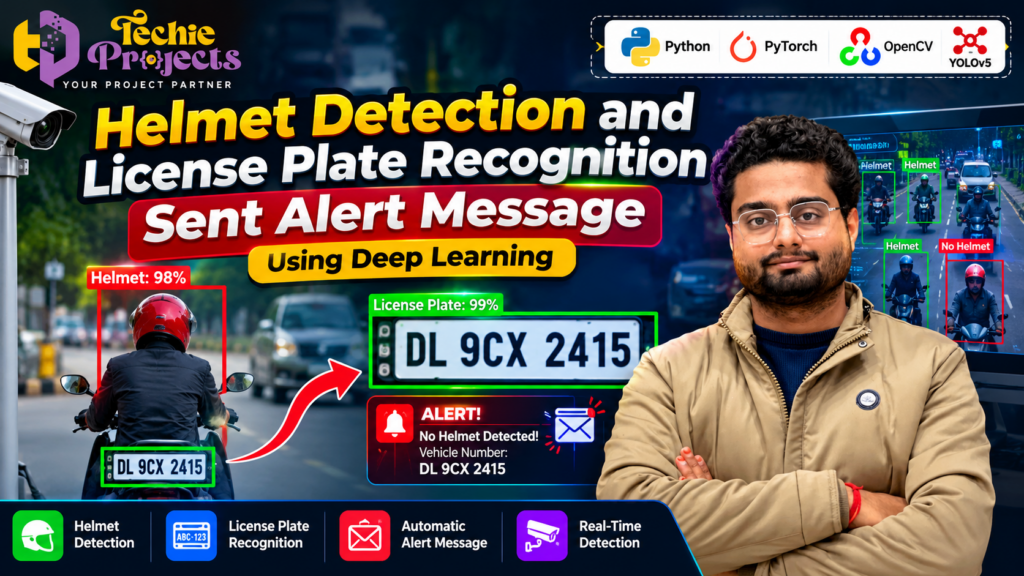
🚀 Looking for an impressive AI, machine learning, or computer vision project for your engineering degree? The Helmet Detection and License Plate Recognition Using Deep Learning project from Techie Projects is designed for students who want to explore real-time object detection, automatic number plate recognition, and intelligent traffic safety monitoring in one practical application. Instead of spending weeks troubleshooting complex code and integrating different models, you can enquire about a project package that helps you understand the implementation, prepare your project documentation, and demonstrate its working features.
This project combines helmet detection, vehicle number plate extraction, and automated alert messages to identify potential traffic safety violations. It is a useful learning opportunity for B.Tech, M.Tech, MCA, BCA, and computer science students interested in artificial intelligence, Python programming, deep learning, and image processing.
🎓 Get your project details, source code availability, documentation options, and technical support information from Techie Projects before placing your order.
📲 Contact Techie Projects for Project Details
Interested in purchasing the Helmet Detection and License Plate Recognition project? Contact us to discuss the available package, installation requirements, features, and delivery options.
- 📱 WhatsApp: Enquire About This Project
- 🌐 Website: Techie Projects
- 📸 Instagram: Follow Techie Projects
- ☎️ Contact Number: +91 94600 60699
🎬 Helmet Detection and License Plate Recognition – Project Demo
Explore the project demonstration to understand how computer vision can detect motorcycle riders, identify helmet usage, extract vehicle registration numbers, and generate alerts for detected violations.
The demonstration helps you understand the project’s workflow and visualize how different computer vision components work together in a practical application.
Watch the embedded project demonstration on this page to explore the detection interface and its major features.
🔍 What Is Helmet Detection and License Plate Recognition Using Deep Learning?
Helmet Detection and License Plate Recognition Using Deep Learning is a computer vision application that analyzes images or video frames to detect motorcycle riders, identify helmet usage, and recognize vehicle registration numbers.
The system can combine an object detection model with optical character recognition (OCR) to process visual information. When a rider is classified as not wearing a helmet, the application can associate the detected rider with a vehicle number plate and generate an alert, depending on the implemented workflow.
This project brings together multiple important technologies:
- 🤖 Artificial intelligence and deep learning
- 👁️ Computer vision and image processing
- 🐍 Python programming
- 🏍️ Motorcycle and helmet detection
- 🔢 License plate detection and text extraction
- 🔔 Automated alert generation
The project is suitable for academic demonstrations and experimentation with intelligent transportation systems. Its actual performance depends on the trained models, image quality, camera angle, lighting, and system configuration.
🎯 Objectives of the Project
The primary objective is to develop a system that demonstrates how AI can assist in monitoring helmet compliance and extracting vehicle registration information.
The main objectives include:
- Detect motorcycles and riders in images or video streams.
- Identify whether a rider is wearing a helmet.
- Locate the vehicle’s license plate.
- Extract readable registration characters from the plate.
- Generate an alert when a potential helmet violation is detected.
- Display detection results through a graphical interface or monitoring screen.
- Explore the practical use of deep learning in traffic safety applications.
These objectives help students understand how separate AI components can be integrated into one application.
🚀 Benefits of Helmet Detection and License Plate Recognition
The Helmet Detection and License Plate Recognition project combines two important computer vision tasks in one application. It helps students understand how deep learning models can identify helmet usage and how OCR technology can extract vehicle registration numbers from images.
Key benefits include:
- 🪖 Helmet Detection: Identify riders who may not be wearing helmets.
- 🔢 License Plate Recognition: Extract readable registration numbers from detected plates.
- 🔔 Automated Alerts: Display alerts for potential helmet violations.
- 👁️ Computer Vision Learning: Explore object detection, image processing, and OCR.
- 🎓 Academic Demonstration: Present an integrated AI application for engineering project work.
⚙️ Key Features of the Helmet Detection Project
🪖 1. Helmet Detection Using Deep Learning
The system analyzes images or video frames to identify riders and determine whether a helmet is visible. An object detection model, such as a suitable YOLO variant, can identify trained classes and return bounding boxes with confidence scores.
This feature introduces students to object detection, model inference, image annotation, and confidence thresholds.
🏍️ 2. Rider and Vehicle Detection
The application can detect relevant objects such as motorcycles, riders, and helmets, depending on the model’s training classes.
Detecting multiple objects in a single frame helps demonstrate how a computer vision system can interpret a traffic scene instead of processing only one isolated object.
🔢 3. License Plate Detection
The license plate detection component identifies the region containing a vehicle’s registration plate. The detected region can then be cropped and prepared for text extraction.
Detection accuracy can vary when the plate is small, tilted, dirty, blurred, or partially obstructed.
🔠 4. Automatic Number Plate Recognition
After detecting the plate, an OCR engine can read its visible characters and produce a text result.
Depending on the implementation, this process may involve grayscale conversion, resizing, thresholding, noise reduction, and OCR configuration. The extracted number should be checked because OCR can misread similar-looking characters.
🔔 5. Automated Alert Messages
When the system identifies a potential no-helmet violation, it can display an alert containing the available detection information.
An alert may include:
- Violation status
- Detected vehicle number, when readable
- Detection timestamp, if implemented
- Confidence information, if available
- A captured image or frame, if supported
External SMS, email, or messaging notifications require the appropriate integration and configuration. They should not be assumed to be included unless confirmed in the selected project package.
🖥️ 6. Graphical User Interface
A graphical interface can make the application easier to operate and demonstrate. Depending on the version, it may display video frames, detected objects, license plate text, and alert information.
A well-organized interface also makes it easier to explain the system during an academic presentation or project viva.
📹 7. Image and Video Processing
The system can process supported images or video streams to demonstrate detection under different conditions. Real-time camera support depends on the implementation, hardware, and model performance.
Students can experiment with different input videos and observe how lighting, camera movement, and object size affect the results.
🧠 Technologies Used in the Project
The following technologies may be used in a typical implementation. Confirm the exact libraries and versions included in the package before purchasing.
🐍 Python
Python is the main programming language because of its extensive ecosystem for artificial intelligence, computer vision, and data processing.
🎯 YOLO Object Detection
A YOLO-family model can be used to detect riders, helmets, motorcycles, and license plates when the corresponding classes are supported by the trained model.
The exact model version should be verified against the project’s actual implementation.
👁️ OpenCV
OpenCV supports image loading, frame extraction, image resizing, color conversion, drawing bounding boxes, and video processing.
🔤 OCR Technology
An OCR engine, such as EasyOCR or Tesseract, can extract text from detected license plate regions. The selected engine depends on the project’s implementation.
🧮 NumPy
NumPy supports numerical operations and array processing used throughout many computer vision workflows.
🖥️ Tkinter or Another GUI Framework
A graphical interface can be developed using Tkinter or another suitable framework, depending on the supplied application.
🔄 How Does the Project Work?
The project follows a sequence of image processing, object detection, plate recognition, and alert generation.
Step 1: Input Image or Video
The system receives an image, a recorded video, or a supported camera stream.
Step 2: Frame Processing
The input is prepared for model inference. This can include resizing, frame extraction, and other preprocessing operations.
Step 3: Helmet Detection
The object detection model identifies relevant objects and predicts their locations and classes. The application then determines whether the detected rider is classified as wearing a helmet.
Step 4: License Plate Localization
The system identifies the license plate region associated with the detected vehicle, where supported by the implementation.
Step 5: Number Plate Text Extraction
The cropped plate is passed to an OCR engine to extract the visible registration characters.
Step 6: Violation Assessment
The application evaluates the detection result to identify a potential helmet violation. Correctly associating a rider, motorcycle, and plate is an important technical challenge, particularly in crowded scenes.
Step 7: Alert Generation
If the implemented conditions are satisfied, the application displays an alert and the available vehicle information.
Step 8: Result Display
The interface presents the processed frame, detection boxes, recognized text, and alert status where these features are supported.
🛠️ How to Develop a Helmet Detection and License Plate Recognition System
Developing a Helmet Detection and License Plate Recognition system involves integrating object detection with license plate text extraction. Python provides libraries and tools for implementing these components.
The development process generally includes:
- Collecting suitable images or video samples.
- Preparing the data and selecting compatible detection models.
- Detecting riders and helmet-related objects.
- Locating vehicle license plates.
- Extracting plate characters using OCR.
- Displaying potential violation alerts.
- Testing the system under different lighting and camera conditions.
Students can study each stage to understand how a complete computer vision application works. The final accuracy depends on the training data, model configuration, image quality, and association between the detected rider and vehicle.
🎓 Why Should Students Choose This AI Project?
The Helmet Detection and License Plate Recognition project offers an opportunity to explore multiple technical concepts in a single application.
📚 Practical Learning
Students can learn how object detection, OCR, and video processing work together. The project is useful for understanding the relationship between individual machine learning components and a complete application.
💻 Source Code Learning
If source code is included in the selected package, students can study the program structure, modify parameters, test different inputs, and understand the implementation.
Ask Techie Projects to confirm the source code format, dependencies, and included modules before purchasing.
📄 Project Documentation
Academic projects often require a report describing the problem statement, objectives, methodology, system architecture, implementation, results, and limitations.
Documentation availability and customization options should be confirmed before ordering.
🎤 Viva and Presentation Preparation
The project provides several technical topics for discussion, including object detection, confidence scores, OCR, image preprocessing, false detections, and system limitations.
Understanding these concepts helps students explain their work more confidently during demonstrations and viva examinations.
🧪 Experimentation Opportunities
Students can test different video samples, compare detection thresholds, inspect OCR outputs, and evaluate how lighting or camera angles affect performance.
These experiments can also support a more detailed project evaluation.
🛠️ Software and Hardware Requirements
The exact requirements depend on the model, framework, and project version.
Software Requirements
- Operating system: Windows 10/11 or another supported platform
- Programming language: Python
- Computer vision library: OpenCV
- Deep learning framework: As specified by the model implementation
- Object detection model: Supported YOLO variant, if used
- OCR engine: As specified in the project
- Interface framework: Tkinter or another supported GUI
- Additional Python packages: According to the requirements file
Hardware Requirements
- Computer or laptop with a compatible operating system
- Sufficient RAM and storage for Python, dependencies, and model files
- Camera or sample videos, depending on the input mode
- A compatible GPU, if required for faster inference
A dedicated GPU is not necessarily required for every implementation, but processing speed may be lower on a CPU. Confirm the minimum configuration and installation instructions before ordering.
💻 Why Purchase This Helmet Detection and License Plate Recognition Project?
If you need a practical AI project for your engineering coursework, the Helmet Detection and License Plate Recognition project offers an opportunity to explore object detection, Python programming, and OCR in a single application.
Contact Techie Projects to confirm the available source code, installation instructions, project report, demonstration, and technical support options. Reviewing these deliverables before purchasing helps ensure that the project matches your academic requirements.
📲 Enquire now: Contact Techie Projects on WhatsApp
🌐 Website: https://techieprojects.com/
💼 Real-World Applications
🚦 Traffic Safety Monitoring
The project demonstrates how computer vision could assist in identifying potential helmet violations in traffic footage.
🛣️ Smart City Research
It can serve as an educational prototype for exploring intelligent transportation systems and automated traffic monitoring.
🅿️ Vehicle Monitoring
License plate recognition techniques can support experiments involving vehicle identification at parking facilities or controlled entry points.
🏫 Academic Research
Students can use the project as a starting point for research into object detection, OCR accuracy, video analytics, and automated safety monitoring.
🔬 Computer Vision Experiments
The system provides a practical environment for testing detection models, image preprocessing techniques, and text recognition methods.
Important: A student project is not automatically suitable for official traffic enforcement. Real-world deployment requires appropriate validation, privacy safeguards, legal compliance, and human review of potential violations.
📦 What Should You Confirm Before Purchasing?
Before ordering the Helmet Detection and License Plate Recognition project from Techie Projects, ask for a clear list of deliverables.
Depending on the selected package, you may enquire about:
- Project source code and model files
- Installation instructions
- Python dependency or requirements file
- Project report and technical documentation
- Presentation slides, if available
- Sample input images or videos
- Demonstration video
- Code explanation or technical guidance
- Supported operating system and Python version
- Available customization and troubleshooting support
Package contents, delivery timelines, pricing, and support terms should be confirmed directly with Techie Projects before payment.
💰 Get the Helmet Detection Project for Your Academic Work
Looking for a computer vision project that combines object detection, OCR, and automated alerts? The Helmet Detection and License Plate Recognition project is worth considering if these topics align with your academic requirements.
Instead of selecting a project based only on its title, check whether its features match your syllabus, available hardware, and demonstration requirements. Ask for the implementation details so you can understand what the project actually does and prepare to explain its technical workflow.
📲 Enquire Now
Contact Techie Projects to discuss the available project package, source code, documentation, pricing, and technical support options.
- 📲 Call/WhatsApp: +91-9460060699
- 🌎 Website: www.techieprojects.com
- 📺 Instagram: @pythonprojects_
Visit TechieProjects.com to explore more engineering projects, AI applications, Python projects, and computer vision solutions.
❓ Frequently Asked Questions (FAQs)
1. What is the Helmet Detection and License Plate Recognition project?
It is a computer vision application that detects helmet usage and attempts to extract vehicle registration numbers from supported images or video streams.
2. Which programming language is used?
Python is commonly used for this type of project because it supports object detection, image processing, and OCR libraries. Confirm the exact implementation before purchasing.
3. Does the project use YOLO?
A YOLO-family object detection model can be used for helmet and license plate detection. The exact version depends on the supplied implementation.
4. Can the system recognize a number plate automatically?
Yes, when the implementation includes license plate localization and OCR. Recognition accuracy depends on image quality, plate visibility, and the OCR configuration.
5. Does it send an alert when a rider is not wearing a helmet?
The application can display an alert for a detected potential violation. SMS, email, or external messaging notifications depend on the integrations included in the selected package.
6. Is this project suitable for B.Tech and MCA students?
It can be suitable for students studying computer science, artificial intelligence, machine learning, or related disciplines, subject to their institution’s project requirements.
7. Is a GPU required to run the project?
Not always. Some models can run on a CPU, although a compatible GPU may improve inference speed. Check the project’s actual hardware requirements.
8. Can I customize the project?
Customization depends on the available source code, project architecture, and support package. Discuss the changes you need with Techie Projects before ordering.
9. Does the project include a report and presentation?
These items depend on the selected package. Ask Techie Projects to confirm whether a project report, presentation slides, and other documentation are included.
10. How can I purchase this project?
Contact Techie Projects through WhatsApp to enquire about pricing, available deliverables, installation requirements, and support options.
🔗 Explore Related Projects
Explore other project ideas related to artificial intelligence, deep learning, and computer vision on Techie Projects.
- 🚗 Vehicle Detection and Counting System – Explore vehicle detection and traffic analysis.
- 🔢 Automatic Number Plate Recognition System – Focus on license plate localization and OCR.
- 🪖 Helmet Detection System Using Deep Learning – Explore helmet classification and object detection.
- 👤 Face Recognition Attendance System – Study face detection and recognition workflows.
- 🎥 Real-Time Object Detection Using YOLO – Learn how object detection models identify objects in video.
- 🚧 Pothole Detection System – Explore road-condition detection using computer vision.
Visit Techie Projects to explore available project options and related technical resources.
🏁 Conclusion
The Helmet Detection and License Plate Recognition Using Deep Learning project combines object detection, computer vision, OCR, and alert generation in a practical academic application. It provides an opportunity to explore how AI models can process traffic footage, identify potential helmet violations, and extract visible vehicle registration information.
For students seeking a project in Python, artificial intelligence, or computer vision, it can be a valuable learning option when its implementation and deliverables meet their academic requirements.
🎓 Ready to explore this project? Contact Techie Projects to enquire about source code availability, documentation, pricing, installation guidance, and technical support.