
Introduction
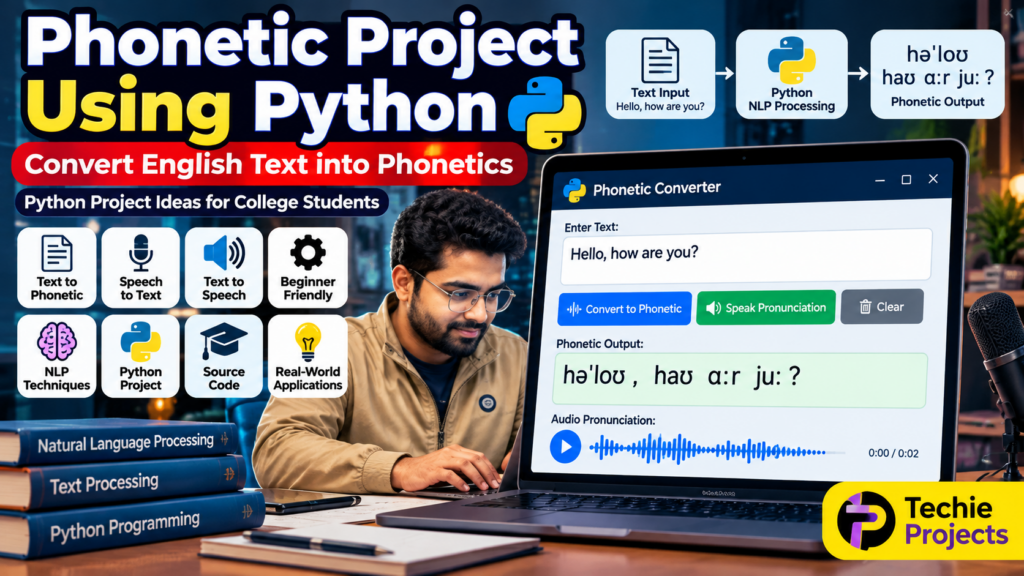
A Phonetic Project Using Python is a practical Python and Natural Language Processing project that focuses on converting English text into its phonetic representation. Phonetics helps represent how words are pronounced rather than simply showing how they are written.
For example, a word such as “cat” can be represented using a phonetic form that helps describe its pronunciation. Such a project can be useful for understanding text processing, pronunciation systems, speech-related applications, and Natural Language Processing.
This project is suitable for B.Tech, BCA, MCA, Computer Science, IT, and engineering students looking for a practical Python project. It can also be extended with text-to-speech, speech recognition, pronunciation assistance, and other NLP features.
🎥 Watch the Phonetic Project Using Python Working Demo
Before selecting or purchasing the project, students can watch the working demo video to understand the project interface, text processing workflow, phonetic conversion, and overall functionality.
The demonstration provides a practical overview of how the project works and how the different components can be integrated into a Python application.
What Is a Phonetic Project?
A phonetic project is a software application that processes text and generates a representation related to the pronunciation of words.
Instead of focusing only on the spelling of a word, the system can analyze the input text and generate phonetic information that can be used by pronunciation-related applications.
Python is well suited for this type of project because it provides libraries and frameworks for:
- Natural Language Processing
- Text processing
- Speech processing
- Pronunciation analysis
- Machine learning
- Text-to-speech applications
The exact phonetic conversion method can depend on the Python libraries and implementation selected for the project.
Objectives of the Phonetic Project Using Python
The main objectives of this project are:
- Convert English text into phonetic representation.
- Understand basic phonetic processing.
- Demonstrate Natural Language Processing concepts.
- Process user-provided text.
- Provide a simple and user-friendly interface.
- Explore pronunciation-related applications.
- Integrate Python NLP libraries.
- Provide a practical project for college students.
- Create a foundation for speech-related applications.
Key Features
The Phonetic Project Using Python can include several useful features.
Text Input
Users can enter English words, sentences, or other supported text into the application.
Phonetic Conversion
The system processes the input and generates the corresponding phonetic representation.
Simple User Interface
A graphical interface can be developed to make the application easy to use.
Pronunciation Support
The project can be extended to provide pronunciation assistance using speech or text-to-speech technologies.
Text Processing
The application can process individual words as well as complete sentences depending on the implementation.
NLP Integration
Natural Language Processing techniques can be integrated to improve text processing and language-related functionality.
Audio Pronunciation
A text-to-speech module can be added to allow users to hear the pronunciation of processed text.
How the Phonetic Project Works
The basic workflow can be divided into several steps.
Step 1: Enter Text
The user enters an English word or sentence into the application.
For example:
Hello, how are you?
Step 2: Process the Input
Python processes the text and passes the input to the phonetic conversion component.
The system identifies the words and processes them according to the selected phonetic method.
Step 3: Generate Phonetic Output
The application generates a phonetic representation of the input.
The output can use a phonetic notation system supported by the selected library or implementation.
Step 4: Display the Result
The generated phonetic output is displayed on the application interface.
Step 5: Optional Pronunciation
A text-to-speech module can be integrated so that users can listen to the pronunciation.
Technologies Used
The project can be developed using:
- Python
- Natural Language Processing
- Text Processing
- Python NLP Libraries
- Tkinter or another GUI framework
- Text-to-Speech libraries
- Speech Processing libraries
The exact technology stack can be customized according to the project requirements.
Python Libraries That Can Be Used
Different Python libraries can be considered depending on the required functionality.
NLTK
NLTK is a popular Natural Language Processing library that can be used for various text-processing tasks.
Text-to-Speech Libraries
Python text-to-speech libraries can be integrated to convert processed text into spoken audio.
Regular Expressions
Regular expressions can be used for text cleaning and preprocessing.
Other NLP Libraries
Additional NLP libraries can be integrated depending on the phonetic conversion method and language-processing requirements.
The final implementation should use libraries that are appropriate for the selected phonetic notation and project scope.
Software Requirements
The basic software requirements may include:
- Python 3.x
- Windows 10/11 or another compatible operating system
- Python IDE such as VS Code, PyCharm, or IDLE
- Required Python libraries
- Internet connection for installing packages when required
Hardware Requirements
The project can run on a standard computer or laptop.
Recommended hardware includes:
- Intel or AMD processor
- Minimum 4 GB RAM
- 8 GB RAM recommended
- 500 GB or more storage
- Keyboard and mouse
- Speakers or headphones for optional pronunciation output
Example Workflow
A simple implementation can follow this workflow:
User Input → Text Preprocessing → Phonetic Conversion → Phonetic Output → Optional Audio Pronunciation
For example:
Input:
Hello
Processing:
Python NLP / phonetic conversion module
Output:
Phonetic representation of the word
The exact output depends on the phonetic system and library used in the implementation.
Applications of Phonetic Projects
Phonetic processing can be useful in several applications.
Language Learning
The system can help students understand how English words are pronounced.
Pronunciation Assistance
Phonetic representations can provide additional information about word pronunciation.
Speech Applications
The project can be extended with speech recognition and text-to-speech functionality.
Educational Software
The system can be used as a learning tool for language and pronunciation.
NLP Applications
Phonetic processing can be incorporated into larger Natural Language Processing applications.
Voice-Based Applications
The project can serve as a foundation for developing voice-enabled applications.
Advantages of the Project
The Phonetic Project Using Python provides several benefits:
- Easy to understand project concept.
- Demonstrates Python programming.
- Introduces NLP concepts.
- Can be developed with a simple interface.
- Can be extended with speech processing.
- Suitable for academic demonstrations.
- Can be customized with additional features.
- Useful for learning text and language processing.
Limitations
The accuracy of phonetic conversion depends on the language, pronunciation rules, dictionary, library, and implementation method used.
Some words may have multiple pronunciations depending on context.
For example, English contains words whose pronunciation can change according to their usage in a sentence. Therefore, a basic phonetic conversion system may not always provide context-aware pronunciation.
The project can be improved by using larger pronunciation dictionaries, language models, or advanced NLP techniques.
Future Scope
The project can be expanded with several advanced features.
Speech Recognition
Users can speak into a microphone and the system can convert speech into text before processing it.
Text-to-Speech
The generated phonetic information can be combined with a text-to-speech system for pronunciation assistance.
Voice-Based Learning
The project can be converted into an interactive language-learning application.
Multiple Language Support
Additional languages can be supported by using suitable pronunciation dictionaries and language-processing resources.
AI-Based Pronunciation Analysis
Machine learning or AI techniques can be added to analyze pronunciation and provide feedback.
Web Application
The Python project can be converted into a web application using frameworks such as Flask or Django.
Mobile Application
The concept can also be extended into a mobile application for language-learning purposes.
Project Ideas You Can Add
Students can extend the project by adding:
- Voice input
- Text-to-speech
- Pronunciation scoring
- Multiple language support
- Word pronunciation dictionary
- Sentence-level phonetic conversion
- Voice-based learning
- User login
- History of converted words
- Pronunciation practice module
- AI pronunciation assistant
- Web-based interface
These additions can make the project more suitable for a larger final-year project.
Is This a Good Final-Year Project?
Yes. The Phonetic Project Using Python can be a good academic project for students interested in Python, NLP, Artificial Intelligence, and speech-related applications.
It demonstrates practical concepts such as text processing, Natural Language Processing, Python programming, user-interface development, and optional speech technologies.
Students can also explain the project’s architecture, workflow, libraries, limitations, and future scope during their project presentation or viva.
🎓 Need Help With Your Final-Year Project?
Looking for a Python, AI, NLP, Machine Learning, Computer Vision, or final-year engineering project?
Techie Projects can help you discuss your project idea, required features, source-code requirements, documentation, and project scope before development.
📲 WhatsApp: +91-9460060699
🌐 Website: www.techieprojects.com
📸 Instagram: @pythonprojects_
Discuss Your Project Requirements Before You Purchase
Students can discuss the required features, technology stack, documentation, customization, and project scope before purchasing or developing the project.
🔗 Explore Related Python Projects
Students interested in similar project ideas can also explore:
- Natural Language Processing Projects
- Python AI Projects
- Speech Recognition Projects
- Text-to-Speech Projects
- Machine Learning Projects
Frequently Asked Questions
What is a phonetic project using Python?
A phonetic project using Python processes English text and generates a phonetic representation related to pronunciation.
Is this project suitable for B.Tech students?
Yes. It can be developed as a Python or NLP project for B.Tech, BCA, MCA, Computer Science, and IT students.
Can text-to-speech be added?
Yes. A text-to-speech module can be integrated so users can listen to the pronunciation.
Can speech recognition be added?
Yes. Speech recognition can be added to allow users to provide input using their voice.
Can this project be converted into a web application?
Yes. The Python application can be extended into a web application using frameworks such as Flask or Django.
Can AI be added to the project?
Yes. AI or machine learning techniques can be added for advanced pronunciation analysis, language learning, and voice-based features.
Can the project support multiple languages?
Yes, provided suitable pronunciation resources and language-processing methods are available for the required languages.
Conclusion
The Phonetic Project Using Python is a practical project that demonstrates how Python and Natural Language Processing can be used to process text and generate pronunciation-related information.
The project provides students with an opportunity to learn Python programming, NLP, text processing, and optional speech technologies while developing a practical academic application.
With features such as text-to-speech, speech recognition, pronunciation scoring, multilingual support, and AI-based pronunciation analysis, the project can be expanded into a more advanced language-learning and speech-processing system.