
Introduction
Smoke recognition using deep learning is an AI-based project that uses image processing and deep learning techniques to identify smoke in images or video frames. This project is suitable for B.Tech, B.E., Computer Science, Information Technology, Artificial Intelligence, and Data Science students looking for a practical final-year engineering project.
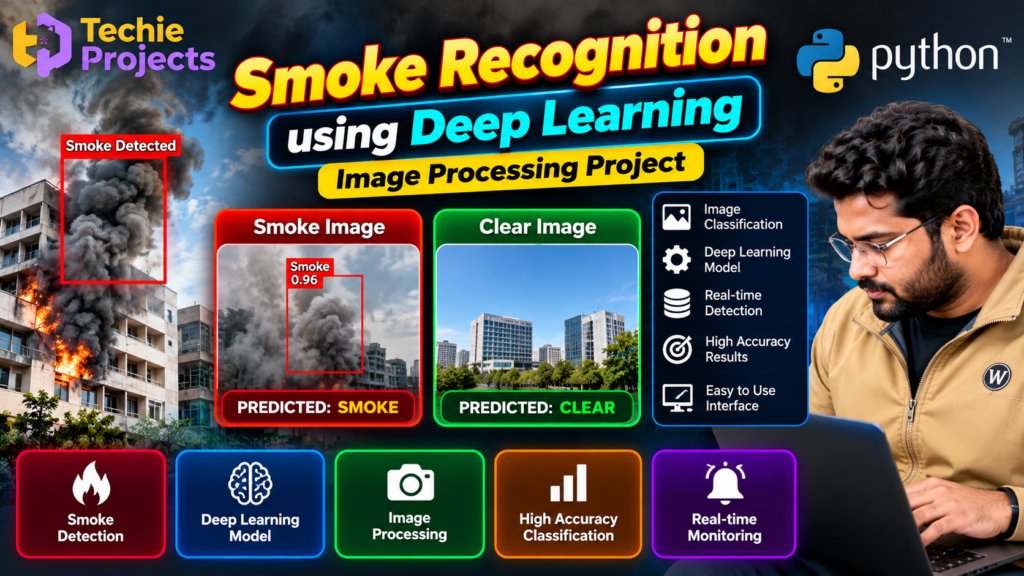
The Smoke Recognition Using Deep Learning project demonstrates how Python and computer vision can be used to analyze visual data and classify scenes as smoky or clear, depending on the trained model and available dataset. It provides an opportunity to learn about image preprocessing, model training, image classification, and AI-based detection systems.
At Techie Projects, students can explore this project as a learning and development opportunity, understand its workflow, and inquire about project source code and customization options for their academic requirements.
🎬 Smoke Recognition Using Deep Learning – Project Demo Video
Watch the project demonstration to understand the interface, image analysis process, and expected classification output. The demo can help you evaluate whether this project matches your final-year project requirements and technical interests.
The demonstration also provides a practical starting point for understanding how a Python-based deep learning application can process images and identify visual smoke patterns.
🔥 What Is Smoke Recognition Using Deep Learning?
Smoke recognition using deep learning is a computer vision application that analyzes images to identify visual patterns associated with smoke. A deep learning model learns patterns from training images and uses them to predict whether an input image belongs to a smoke-related class.
Unlike a simple rule-based system, a trained deep learning model can learn complex visual features from examples. Its performance depends on the quality of the dataset, model architecture, training process, and testing conditions.
For an academic project, this concept can be implemented as an image classification application with a user interface for uploading images and viewing predictions.
🎯 Objectives of the Project
The primary objectives of this project include:
- Develop a Python-based smoke recognition application.
- Apply deep learning techniques to visual image classification.
- Understand image preprocessing and dataset preparation.
- Train or integrate a suitable model for smoke-related image recognition.
- Display prediction results through a simple application interface.
- Evaluate the model using appropriate testing data and performance metrics.
- Explore possible extensions for video-based analysis and monitoring.
These objectives help students connect theoretical concepts in artificial intelligence with practical software development.
How Smoke Recognition Using Deep Learning Improves Image Analysis
Smoke recognition using deep learning helps demonstrate how AI models can identify smoke-related visual patterns in digital images. This smoke recognition using deep learning project combines Python, image preprocessing, and model-based classification to analyze input images. Students can explore smoke recognition using deep learning to understand dataset preparation, model evaluation, and practical computer vision development.
⚙️ How Does the Project Work?
The smoke recognition system follows a typical deep learning workflow.
1. 📂 Dataset Collection
The first step is collecting images representing smoke and non-smoke scenes. The dataset should contain varied backgrounds, lighting conditions, smoke densities, and environmental settings.
A balanced, representative dataset helps reduce bias and improves the usefulness of model evaluation.
2. 🖼️ Image Preprocessing
Images are prepared before being passed to the model. Depending on the implementation, preprocessing may include:
- Resizing images to the required dimensions.
- Normalizing pixel values.
- Converting images into the expected input format.
- Assigning labels to training examples.
- Splitting the dataset into training, validation, and testing sets.
Consistent preprocessing is important because the model expects input data in a particular format.
3. 🧠 Deep Learning Model
The model learns visual patterns from labeled training images. A convolutional neural network (CNN) is one possible approach for image classification.
During training, the model adjusts its parameters to reduce prediction errors. The trained model can then be evaluated on images it has not previously seen.
4. 🔍 Smoke Image Recognition
When a user uploads an image, the application applies the required preprocessing and passes the image to the trained model.
The model generates a prediction based on the classes it was trained to recognize. Depending on the implementation, the application may display a smoke-related or non-smoke classification and a confidence score.
5. 📊 Displaying Results
The predicted result is displayed through the application’s interface. A student can extend this feature to show the uploaded image, prediction label, confidence value, and a history of previous predictions.
The displayed confidence should not be treated as a guarantee that smoke is present or absent.
✨ Key Features of the Smoke Recognition Project
🧠 AI-Based Image Classification
The application demonstrates how deep learning can learn visual patterns from labeled images and generate predictions for new inputs.
🖥️ User-Friendly Interface
A simple interface can allow users to select an image, submit it for analysis, and view the predicted class.
🐍 Python Implementation
Python provides a flexible environment for working with image processing, machine learning, data preparation, and application development.
📷 Image Analysis
The system can process images according to the input requirements of the trained model. Image quality and environmental conditions may affect the results.
📈 Model Evaluation
Students can evaluate performance using metrics such as accuracy, precision, recall, F1-score, and a confusion matrix, where appropriate for the classification task.
🚀 Scope for Customization
The project can be extended with additional datasets, alternative model architectures, improved interfaces, and video-frame analysis, subject to the available implementation and hardware.
🛠️ Technologies Used
The exact technologies depend on the supplied project implementation. A typical version may use the following tools:
- Programming language: Python
- Deep learning: TensorFlow/Keras or PyTorch
- Image processing: OpenCV and Pillow
- Data handling: NumPy
- Visualization: Matplotlib
- Interface: Tkinter, Flask, or Streamlit, depending on the implementation
- Development environment: Visual Studio Code, PyCharm, or Jupyter Notebook
Check the actual project package for its supported library versions and installation requirements before setting up the environment.
💻 Software and Hardware Requirements
Software Requirements
- Python version compatible with the project’s dependencies
- Required deep learning framework
- Image processing libraries
- Code editor or Python IDE
- Operating system supported by the selected dependencies
Hardware Requirements
- A computer capable of running Python applications
- Sufficient RAM and storage for the dataset and model
- A compatible CPU for basic development and inference
- A supported GPU, if needed for faster training
Hardware requirements depend on the dataset size, model architecture, and whether training or only inference is performed.
🎓 Why Choose This as a Final-Year Engineering Project?
Smoke recognition using deep learning is a useful educational project for students interested in AI, computer vision, and intelligent monitoring applications.
Practical Learning Benefits
- Understand the fundamentals of deep learning.
- Learn how to prepare and label image datasets.
- Explore image classification using Python.
- Practice testing, debugging, and evaluating an AI model.
- Develop a software application around a trained model.
- Prepare project documentation and a demonstration for academic evaluation.
Students can also use the project to discuss model limitations, dataset quality, ethical considerations, and possible improvements during a viva or project presentation.
🏢 Applications of Smoke Recognition Technology
Smoke recognition can be explored in several research and prototype settings.
- Industrial monitoring: Experimental analysis of smoke-like visual patterns in industrial environments.
- Building monitoring: Research into image-based smoke recognition for indoor scenes.
- Outdoor surveillance: Exploring smoke recognition in outdoor images and camera feeds.
- Environmental observation: Studying smoke patterns in photographs of outdoor environments.
- Smart monitoring prototypes: Integrating a vision model with a larger monitoring interface.
Real-world deployment requires extensive testing across environmental conditions. This academic prototype should not replace certified smoke alarms, fire detection equipment, or emergency response systems.
📈 Advantages of the Project
- Demonstrates a practical application of deep learning.
- Supports hands-on learning with Python and image processing.
- Can be evaluated with measurable classification metrics.
- Provides scope for experimenting with different models.
- Can be extended to analyze video frames.
- Offers a foundation for further research into computer vision.
The effectiveness of each feature depends on the actual implementation, dataset, and evaluation results.
⚠️ Limitations and Challenges
Smoke recognition models can make incorrect predictions. Clouds, fog, dust, steam, lighting changes, and other visual patterns may resemble smoke.
Other challenges include:
- Obtaining a representative and correctly labeled dataset.
- Preventing overfitting during model training.
- Maintaining reliable predictions across different environments.
- Managing the computational requirements of model training.
- Testing the system on images that differ from the training data.
Students should document these limitations and avoid claiming guaranteed accuracy without measured results. Any safety-critical deployment would require much more rigorous validation.
🚀 Future Scope
The project can be expanded in several directions:
- Video-based recognition: Analyze selected video frames to identify smoke-like visual patterns.
- Live camera integration: Experiment with a compatible camera feed in a controlled research environment.
- Improved datasets: Include more diverse smoke and non-smoke images.
- Model comparison: Compare suitable CNN architectures using the same evaluation procedure.
- Performance optimization: Explore model compression or inference optimization for supported hardware.
- Alert interface: Develop a prototype notification workflow for experimental demonstrations.
- Web application: Build a web interface for uploading images and viewing predictions.
These are potential extensions, not guaranteed features of every project package.
🛒 Get the Smoke Recognition Using Deep Learning Project
Are you looking for a Python deep learning project for your final-year engineering submission? Techie Projects can help you explore project options and discuss the implementation that best matches your requirements.
When contacting us, ask about the available version, source code, setup instructions, project demonstration, documentation, and customization options before purchasing.
Why contact Techie Projects?
- Explore a project suited to your academic interests.
- Discuss software requirements and setup.
- Ask about available source code and documentation.
- Enquire about customization and additional features.
- Clarify the deliverables and support available before placing an order.
Contact us with your course, preferred programming language, and project requirements to discuss the available options.
📲 Call/WhatsApp: +91-9460060699
🌎 Website: www.techieprojects.com
📺 Instagram: @pythonprojects_
❓ Frequently Asked Questions
1. What is smoke recognition using deep learning?
It is a computer vision approach that uses a trained deep learning model to classify images according to learned smoke-related visual patterns.
2. Which programming language is used?
Python is a common choice because it supports deep learning, image processing, and application development.
3. Is this project suitable for B.Tech students?
Yes. It can be suitable for Computer Science, Information Technology, AI, and Data Science students, depending on the academic requirements and the implementation’s complexity.
4. Can this project recognize smoke in videos?
Video analysis is a possible extension if the implementation processes video frames and the model has been evaluated for that use case. Confirm this feature before purchasing.
5. Does the system guarantee accurate smoke detection?
No. Results depend on training data, model quality, image conditions, and evaluation. It should not be used as a replacement for certified fire-safety systems.
6. Can the project be customized?
Customization may be possible depending on the available codebase. Discuss requested changes, compatibility, cost, and delivery expectations with Techie Projects before ordering.
7. What should I check before purchasing?
Confirm the source code, Python and library versions, execution instructions, documentation, demonstration, supported features, and any included assistance.
🎓 Explore Related Projects
Students interested in computer vision, deep learning, and AI can also explore these project topics:
- Fire and Smoke Detection Using Computer Vision
- E-Waste Management Using Machine Learning
- Fire Detection and Alarm System Using Python
- Accident Detection Using Machine Learning
- Object Detection Using Deep Learning
- Attendance System Using Face Recognition
Explore more topics through the Machine Learning Projects, Deep Learning Projects, and OpenCV Projects sections of Techie Projects. The related project names above are topic suggestions; availability and individual project pages should be confirmed before ordering.
✅ Conclusion
Smoke recognition using deep learning offers students a practical way to explore Python, image processing, and AI-based image classification. By working through dataset preparation, model training, prediction, and evaluation, students can develop a stronger understanding of how computer vision projects are built.
If you need a smoke recognition project for your final-year engineering work, contact Techie Projects to confirm the available implementation, source code, documentation, and customization options.
Discuss your project requirements today: WhatsApp Techie Projects
Educational note: This project is intended for learning and experimentation. Its predictions are not a substitute for certified fire detection equipment or professional safety procedures.