
Introduction
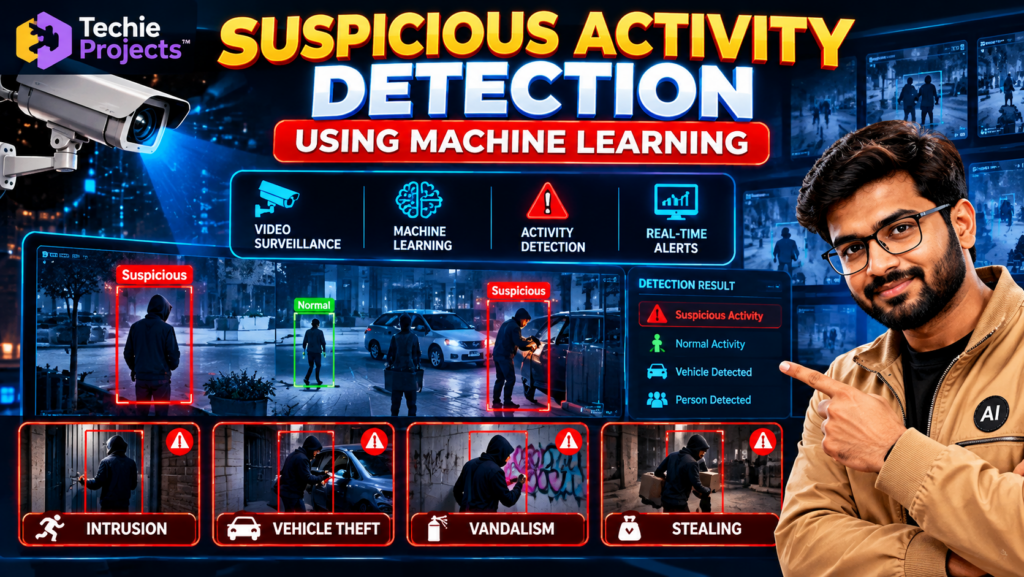
Suspicious activity detection using machine learning is an educational computer vision project that explores how video footage can be analyzed to identify activities that may require further attention. Using Python and video-processing techniques, the project demonstrates concepts related to surveillance monitoring, activity recognition, and automated alerts.
This project is suitable for B.Tech, B.E., Computer Science, Information Technology, Artificial Intelligence, and Machine Learning students interested in developing a practical final-year project. It offers an opportunity to understand how video input, image processing, and machine learning can work together in an activity-monitoring application.
🎬 Project Demo
Watch the project demonstration to understand its interface, workflow, and implemented detection features.
The demonstration can help you explore how the application processes supported visual input and displays its output. The activities it can identify depend on the model, dataset, and functionality included in the actual project version.
🎯 Objectives of the Project
The main objective of suspicious activity detection using machine learning is to demonstrate how computer vision and machine learning concepts can support the analysis of surveillance footage.
The key objectives include:
- Processing supported video or image input.
- Exploring methods for identifying activities of interest.
- Applying computer vision techniques to visual data.
- Displaying detection results through an application interface.
- Understanding how alerts can be connected to detection outputs.
- Studying the limitations of automated surveillance analysis.
⚙️ Features of Suspicious Activity Detection Using Machine Learning
The available features depend on the supplied implementation. Common components of this type of project may include the following.
1. Video Input Processing
The application can process supported video footage or other configured visual input. Video frames provide the information required for subsequent analysis.
2. Activity Analysis
The system uses its implemented detection logic or trained model to analyze visual information and identify patterns associated with selected activities.
3. Suspicious Activity Classification
A model may classify selected actions or events into predefined categories. The output depends on the classes supported by the model and the quality of the training data.
4. Alert Display
If included in the project, the interface may display a warning when a detection condition is met. An alert indicates that the system has flagged an event for review; it does not prove that wrongdoing has occurred.
5. Graphical User Interface
A graphical interface can make it easier to provide video input, view processing results, and understand the application’s output.
6. Machine Learning Integration
Machine learning can help the application identify patterns in visual data when a suitable trained model is included.
Confirm the actual detection classes, input modes, and alert functionality before purchasing the project.
🔄 How the Project Works
The general workflow of suspicious activity detection using machine learning can be explained through these steps:
- Video input: The application receives a supported video file or camera stream, depending on its implementation.
- Frame extraction: Video is processed into individual frames for analysis.
- Preprocessing: The frames are prepared according to the requirements of the implemented model.
- Activity detection: The model or detection logic examines the visual input for supported patterns.
- Result generation: The application generates a prediction or classification.
- Output display: Detected events and relevant warnings are displayed if those features are implemented.
This workflow helps students understand the connection between video processing, model inference, and application development.
🧰 Technologies Used
The technology stack depends on the actual source code. A typical project may use:
- Python: Main programming language.
- OpenCV: Video processing and image manipulation.
- Machine learning or deep learning libraries: For model training or inference, as applicable.
- Trained model and dataset: For the activity categories supported by the application.
- GUI framework: Such as Tkinter, if a desktop interface is included.
Refer to the project’s installation instructions to confirm the required library versions.
💻 Software and Hardware Requirements
Software Requirements
- A compatible operating system.
- Python version supported by the project.
- Required Python libraries and model dependencies.
- Visual Studio Code, PyCharm, or another compatible editor.
- Supported video input or camera access, if required.
Hardware Requirements
- A desktop or laptop computer.
- Adequate RAM and storage.
- A compatible processor for the selected model.
- A webcam, if live video analysis is supported.
Actual requirements vary according to the model and implementation.
🎓 Applications
Suspicious activity detection using machine learning can demonstrate concepts relevant to:
- Video surveillance research.
- Computer vision education.
- Automated video analysis.
- Activity recognition experiments.
- Smart monitoring prototypes.
- Machine learning and deep learning projects.
Any practical surveillance deployment requires careful testing, privacy safeguards, and appropriate human oversight.
✅ Advantages
- Demonstrates practical Python and computer vision concepts.
- Connects machine learning with video analysis.
- Provides a structured workflow for an academic project.
- Offers opportunities to investigate detection performance.
- Can serve as a foundation for further research and experimentation.
⚠️ Limitations and Responsible Use
Automated activity detection can produce false positives and missed detections. Performance may be affected by lighting, camera angle, video quality, occlusion, crowded scenes, and differences between the training data and real-world footage.
A flagged activity should not automatically be treated as evidence of a crime or misconduct. Human review is important, and surveillance data should be handled responsibly with appropriate privacy protections.
🚀 Future Scope
Students can explore possible improvements such as:
- Testing additional activity categories.
- Evaluating different detection models.
- Measuring precision, recall, and false-positive rates.
- Improving performance on varied video conditions.
- Exploring real-time processing, if supported by the hardware.
- Adding event logs or configurable notifications.
- Evaluating the model on representative datasets.
These are possible extensions, not claims that every feature is already implemented.
🎓 Why Choose This Project for Your Final Year?
Suspicious activity detection using machine learning combines video processing, Python programming, and machine learning concepts in a project that can be explained through a clear technical workflow.
It may be suitable for students seeking a computer vision or AI-related project for academic demonstration. Students can study the implementation, understand the model’s limitations, and investigate improvements based on their course requirements.
📲 Get the Project Source Code and Pricing
Looking for a suspicious activity detection using machine learning project for your final-year submission or academic demonstration?
Contact Techie Projects to confirm availability and the exact deliverables before purchasing. Ask about:
- Python source code and model files, if included.
- Installation instructions and dependencies.
- Project documentation and explanation materials, if available.
- Supported activity classes and input modes.
- Demonstration features and pricing.
- Customization options, where available.
📲 Call/WhatsApp: +91-9460060699
🌎 Website: www.techieprojects.com
📺 Instagram: @pythonprojects_
🔗 Explore Related Projects
Add internal links to the relevant published pages on your website:
- Abnormal Activity Detection Using Deep Learning
- Crowd Monitoring Using Computer Vision
- People Detection and Tracking Using YOLO
- Real-Time Object Detection with Voice Output
- Intrusion Detection System Using Machine Learning
❓ Frequently Asked Questions
What is suspicious activity detection using machine learning?
It is a computer vision project that explores how video input and machine learning techniques can identify predefined activity patterns for further review.
Which programming language is used?
Python is commonly used for video processing and model integration in this type of project. The exact dependencies depend on the supplied implementation.
Does the project support real-time detection?
Real-time detection is available only if the supplied version supports live video input and processing. Confirm this feature before purchasing.
Can this project be used for a final-year engineering demonstration?
It may be suitable for a final-year academic project, depending on your institution’s requirements and the features actually included.
Does a suspicious activity alert prove that a person has committed a crime?
No. An automated detection result is only a prediction or flag for review. It should not be treated as proof of wrongdoing.
How can I purchase the project?
Contact Techie Projects through WhatsApp to confirm availability, source code, documentation, supported features, and pricing.
📝 Conclusion
Suspicious activity detection using machine learning is an educational project for exploring Python, video processing, and automated activity analysis. It provides students with an opportunity to understand how computer vision systems analyze visual data while learning about model evaluation and responsible use.
For project availability, source code details, and pricing, contact Techie Projects through WhatsApp.