
Introduction
Human activity recognition using TensorFlow is a machine learning project that explores how computer vision and deep learning can identify human activities from images or video, depending on the model implementation. This project is suitable for computer science and engineering students who want to learn about activity classification, human pose analysis, and practical AI development.
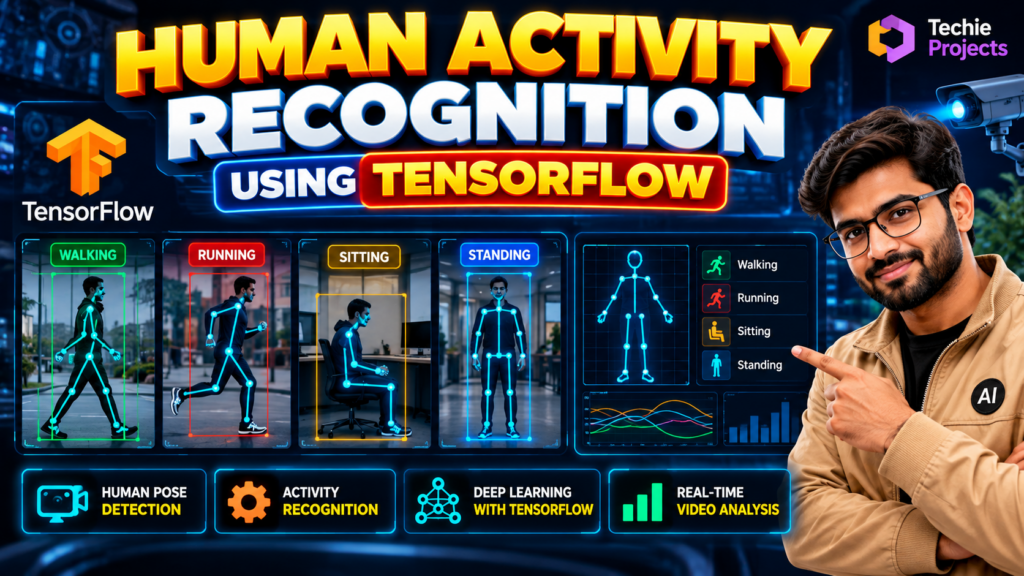
The project demonstrates how an AI-based system can analyze supported input data and classify activities such as walking, running, sitting, or standing, provided these classes are included in the trained model.
🎬 Project Demo
Watch the project demonstration to understand the interface, workflow, and activity recognition process. The demo can help you evaluate whether this project matches your academic requirements.
🎯 Objectives of the Project
The main objective of human activity recognition using TensorFlow is to demonstrate how deep learning techniques can be applied to recognize patterns in human movement.
Key objectives include:
- Understanding human activity recognition using AI.
- Exploring TensorFlow-based deep learning workflows.
- Processing supported images or video input.
- Classifying activities supported by the trained model.
- Developing a practical project for learning, demonstration, and academic presentation.
⭐ Key Features
Depending on the implementation and trained model, the project may include:
- Human activity classification: Identify supported activity categories from input data.
- Video or image analysis: Process supported visual input.
- Deep learning integration: Demonstrate how TensorFlow can be used in an AI workflow.
- Graphical user interface: Use the available interface to interact with the project.
- Activity results: Display the predicted activity or classification result.
- Educational workflow: Explore data processing, model inference, and output presentation.
Confirm the exact features and supported input formats before purchasing.
⚙️ How Does the Project Work?
The general workflow of human activity recognition using TensorFlow consists of the following stages:
- Input collection: Provide a supported image, video, or other input format used by the implementation.
- Preprocessing: Prepare the input according to the model’s requirements.
- Feature extraction: The trained model processes relevant patterns in the input.
- Activity classification: The model predicts one of the activity classes it was trained to recognize.
- Result display: The application presents the prediction through its available interface.
The exact workflow depends on the model architecture, dataset, and code used in the project.
🧠 Technologies Used
The technologies may include:
- Python programming language
- TensorFlow deep learning framework
- Computer vision libraries, where required
- Image or video processing tools, where supported
- A graphical user interface, if included in the implementation
Please confirm the actual libraries and versions with Techie Projects before setting up the project.
💻 Software and Hardware Requirements
Software Requirements
- Compatible Windows, Linux, or other supported operating system
- Python version compatible with the project’s dependencies
- TensorFlow and the required Python packages
- Code editor or Python IDE
Hardware Requirements
- Computer or laptop
- Compatible processor
- Sufficient RAM for the model and input data
- Additional GPU support only if required by the implementation
The exact requirements depend on the model size and project configuration.
📚 Applications of Human Activity Recognition
Human activity recognition can be explored in several areas:
- Smart surveillance: Research into automated analysis of video footage.
- Healthcare research: Studying movement patterns in controlled research settings.
- Smart environments: Recognizing supported activities in sensor or camera-based systems.
- Sports analytics: Analyzing movement patterns for selected activities.
- Human-computer interaction: Exploring systems that respond to recognized movements.
- Academic research: Learning about deep learning, computer vision, and classification.
These are potential application areas; a student prototype should not be assumed to be suitable for real-world deployment without additional testing.
✅ Advantages of This Project
- Provides practical exposure to TensorFlow and deep learning.
- Helps students understand an AI-based classification workflow.
- Connects programming concepts with computer vision applications.
- Can support a final-year project demonstration and technical discussion.
- Offers opportunities to explore model evaluation and future improvements.
⚠️ Limitations
- Predictions depend on the quality and diversity of the training data.
- Performance may vary with lighting, camera angles, occlusion, and movement.
- The model can recognize only the classes and patterns it has learned.
- Real-world use requires proper testing, validation, and consideration of privacy.
- The project should not be treated as a guaranteed-accuracy surveillance solution.
🚀 Future Scope
Possible future improvements include adding more activity categories, testing different model architectures, improving performance on varied video inputs, and creating a more user-friendly interface. Researchers could also explore pose estimation, temporal analysis, and model evaluation on diverse datasets.
Any proposed improvement would need to be implemented and tested before being advertised as an existing feature.
Benefits of Human Activity Recognition Using TensorFlow
Human activity recognition using TensorFlow helps students understand how deep learning models can analyze movement patterns and classify supported activities. This project combines Python programming, model inference, and activity classification in a practical AI application. It is a useful learning opportunity for students exploring computer vision and machine learning.
Project Workflow and Implementation
The human activity recognition using TensorFlow project follows a structured workflow that includes input preparation, preprocessing, model execution, and result presentation. Students can explore how a trained model identifies activity patterns and produces predictions for supported classes. The implementation can also be extended through model evaluation, improved datasets, and additional activity categories.
🎓 Why Choose This Project for Your Final Year?
Human activity recognition using TensorFlow is a useful topic for students interested in artificial intelligence, machine learning, and computer vision. It provides a way to study how data moves through a deep learning workflow and how model predictions can be presented in an application.
Before selecting the project, review its demonstration, supported features, system requirements, and compatibility with your university’s guidelines.
📲 Get the Human Activity Recognition Using TensorFlow Project Details and Pricing
Looking for a human activity recognition project for your final-year submission or academic learning?
Want to use this project for your final-year engineering work? Contact Techie Projects to confirm the available source code, documentation, setup requirements, project features, and pricing.
📲 Call/WhatsApp: +91-9460060699
🌎 Website: www.techieprojects.com
📺 Instagram: @pythonprojects_
🔗 Explore Related Projects
Explore these related topics on Techie Projects and link each title to its corresponding published article:
- Human Pose Estimation Using Deep Learning
- Real-Time Object Detection Using Python
- People Detection and Tracking Using YOLO
- Suspicious Activity Detection Using Machine Learning
- Speech Emotion Recognition Using Deep Learning
❓ Frequently Asked Questions
1. What is human activity recognition using TensorFlow?
It is an AI project that demonstrates how a trained deep learning model can classify supported human activities from suitable input data.
2. Which programming language is used?
Python is commonly used for TensorFlow-based machine learning projects. The exact implementation and dependencies should be confirmed before setup.
3. Can this project be used for a final-year engineering submission?
It may be suitable for an academic project, depending on your course requirements, the implemented features, and your institution’s rules. Review the demonstration and confirm the deliverables before purchasing.
4. Does the project include source code and documentation?
Please contact Techie Projects to confirm which deliverables are included in the current project package.
5. Can the project be customized?
Customization may be possible depending on the requested changes and the existing implementation. Contact Techie Projects to discuss your requirements and receive a quote.
6. Does the model recognize every human activity?
No. A model generally predicts only the classes it has been trained and configured to recognize. Its performance depends on the data, implementation, and testing.
🏁 Conclusion
Human activity recognition using TensorFlow is an educational project topic that combines Python, deep learning, and activity classification. It can help students explore AI workflows and understand how models interpret supported visual data.
If you are interested in purchasing this project, contact Techie Projects to confirm the current features, source code availability, documentation, requirements, and pricing before placing your order.