
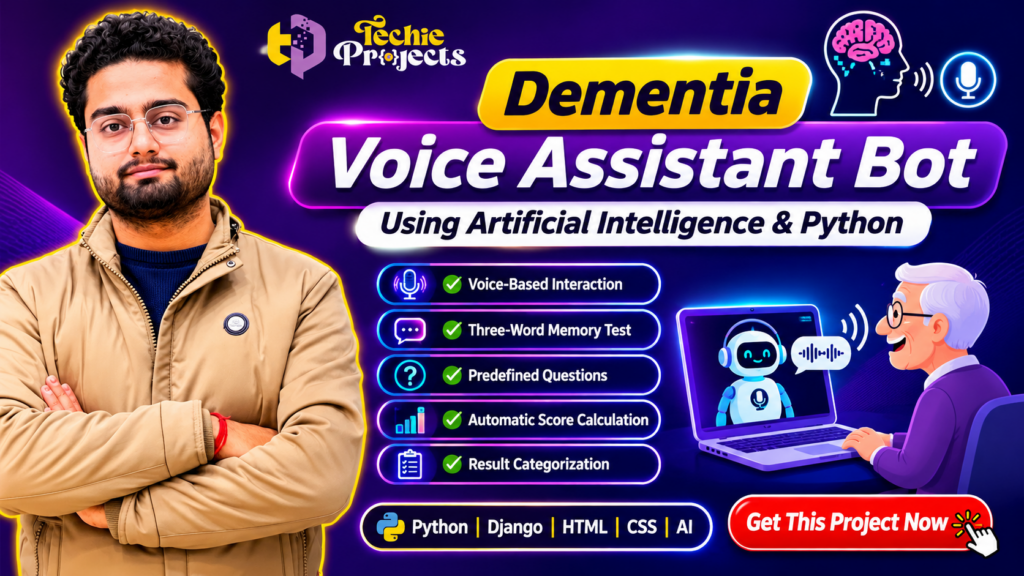
Are you looking for an innovative Dementia Voice Assistant Bot project for your B.Tech, M.Tech, MCA, BCA, or final-year engineering submission? Get this AI-powered project from Techie Projects and explore how Artificial Intelligence, Python, voice cloning, and intelligent conversation systems can be combined to develop an interactive healthcare assistance application.
The Dementia Voice Assistant Bot is an innovative software project designed to demonstrate voice-based interaction and cognitive assessment activities through an intelligent conversational interface. The system greets the patient, presents three words for immediate registration, asks the patient to repeat those words, conducts a predefined set of questions, and finally checks whether the patient can recall the same three words.
This project is an excellent choice for students interested in Artificial Intelligence, Python development, Generative AI, Natural Language Processing, and healthcare technology. Instead of spending weeks developing everything from scratch, you can get a ready-to-study project from Techie Projects with implementation support and project-related resources.
Whether you need a final-year project, a practical demonstration, or an academic software prototype, this project provides an opportunity to understand how voice-enabled AI applications work.
📞 Contact Techie Projects for Project Enquiries
Want to purchase this project or get more information about its implementation, source code, and documentation?
Contact Techie Projects to enquire about project availability, pricing, technical requirements, and customization options.
- 📱 WhatsApp: +91 9460060699
- 🌐 Website: www.techieprojects.com
- 📸 Instagram: @pythonprojects_
- 🎓 YouTube: Techie Projects
Get your Dementia Voice Assistant Bot project today and make your final-year project preparation easier!
🎬 Watch the Dementia Voice Assistant Bot Project Demo
Want to see how the application works before purchasing? Watch the complete project demonstration to understand its graphical user interface, voice interaction, and conversational workflow.
▶ Watch Dementia Voice Assistant Bot Using Artificial Intelligence on YouTube
In this demonstration, you can explore the application interface and understand how the AI-powered voice assistant interacts with the user.
The demonstration covers the software interface, patient interaction process, voice-based functionality, and project implementation.
🤖 What Is a Dementia Voice Assistant Bot?
A Dementia Voice Assistant Bot is an AI-based software application designed to demonstrate conversational interaction and memory-recall activities through voice communication.
The system provides a structured interaction process in which the user communicates with the application using speech. It presents specific words, asks predefined questions, and evaluates the user’s responses according to the programmed scoring logic.
The main objective of this project is to demonstrate how Artificial Intelligence and voice-based technologies can be integrated into a healthcare-oriented software prototype.
The application combines conversational interaction, voice processing, and automated response evaluation to create an interactive experience.
Unlike traditional applications that depend entirely on buttons and text inputs, a voice-enabled application allows users to interact through spoken communication.
This makes the project particularly interesting for students exploring AI-powered healthcare applications.
Important: This project is an educational software prototype. Its scores and categories are based on programmed logic and should not be interpreted as a medical diagnosis or a clinically validated dementia assessment.
🎯 Objectives of the Dementia Voice Assistant Bot Project
The primary objectives of this project include:
- To develop an AI-based voice assistant for interactive communication.
- To implement voice-based patient interaction.
- To present three words for immediate registration.
- To allow users to repeat the presented words.
- To conduct predefined questions through the application.
- To evaluate responses using programmed scoring logic.
- To check whether users can recall the previously presented words.
- To generate scores and assign categories according to the implemented rules.
- To demonstrate the practical application of Python and Artificial Intelligence.
- To develop a user-friendly graphical interface for the application.
These objectives make the project suitable for students who want to explore the integration of AI and healthcare-oriented software development.
⚙️ How Does the Dementia Voice Assistant Bot Work?
The working process of the Dementia Voice Assistant Bot is based on a sequence of voice interactions and programmed evaluation activities.
Let’s understand its complete workflow.
1. Patient Greeting
When the application starts, the voice assistant greets the patient and initiates the conversation.
The greeting creates a simple starting point for interaction and helps the user understand the application.
2. Three-Word Presentation
The application presents three specific words to the patient.
The patient is instructed to remember these words because they will be asked to recall them later during the interaction.
This activity demonstrates immediate word registration.
3. Word Repetition
After presenting the words, the application asks the patient to repeat them.
The system processes the patient’s responses according to the implemented interaction and evaluation logic.
4. Predefined Question Session
The voice assistant conducts a predefined set of questions provided within the application.
The patient responds to these questions through the interaction interface.
This stage forms an important part of the application’s conversational workflow.
5. Memory Recall Activity
After completing the predefined questions, the assistant asks the patient to recall the same three words presented earlier.
The application evaluates the responses according to its programmed rules.
6. Score Calculation
Based on the patient’s responses, the system calculates scores using the implemented scoring mechanism.
The evaluation logic is designed to process the interaction results.
7. Category Assignment
Finally, the system assigns categories based on the calculated scores and programmed conditions.
The results are intended for demonstration and educational purposes rather than clinical decision-making.
🌟 Key Features of the Dementia Voice Assistant Bot
The project demonstrates several useful functionalities that make it an interesting Artificial Intelligence application.
🗣️ Voice-Based Interaction
The application supports a voice-oriented interaction workflow, allowing users to communicate with the assistant through spoken responses.
🤖 AI-Powered Assistant
The project demonstrates how Artificial Intelligence can be integrated into a conversational application to support automated interaction.
🧠 Memory Recall Activity
The application presents three words and later asks the user to remember them.
This functionality demonstrates a structured memory-recall activity.
❓ Predefined Question Management
The assistant conducts a predefined set of questions as part of the interaction process.
📊 Automated Score Calculation
The application calculates scores according to the responses and programmed evaluation rules.
📋 Result Categorization
The system assigns categories based on the calculated scores and predefined conditions.
💻 Graphical User Interface
The application provides a graphical interface developed using web technologies, making it easier to interact with the system.
🔊 Voice Cloning and Generative Speech Concepts
The project is presented as a voice-cloning and generative-speech-oriented application, providing an opportunity to explore voice technologies and conversational systems.
🛠️ Technologies Used in the Project
The Dementia Voice Assistant Bot combines different software technologies to demonstrate the development of an intelligent voice-based application.
1. Python
Python is the primary programming language used for implementing the application logic and integrating the required functionalities.
It is widely used in Artificial Intelligence, Machine Learning, Natural Language Processing, and automation projects.
2. Django
Django is a Python-based web framework used in the project implementation.
It provides a structured approach to developing web applications and managing backend functionality.
3. HTML
HTML is used to structure the application’s web interface.
It helps organize different elements displayed to the user.
4. CSS
CSS is used for designing the graphical interface and improving the presentation of the application.
5. Artificial Intelligence
Artificial Intelligence concepts are used to demonstrate intelligent interaction and automated response processing.
6. Voice Technologies
Voice-related technologies are an important part of the project’s conversational workflow.
They help demonstrate speech-oriented interaction and voice-based assistance.
💻 Software Requirements
Before running the Dementia Voice Assistant Bot, students should understand the basic software requirements.
| Requirement | Details |
|---|---|
| Programming Language | Python |
| Implementation | Web Framework |
| Framework | Django |
| Frontend | HTML, CSS |
| Operating System | Windows 10 / Windows 11 |
| Application Type | Web-Based Software |
| Project Domain | Artificial Intelligence |
The actual Python package dependencies and versions should be checked against the supplied project files before installation.
🎓 Why Choose This Project for Your Final Year?
Selecting the right final-year project is an important decision for engineering and computer application students.
A good academic project should demonstrate practical implementation, technical understanding, and the ability to solve a clearly defined problem.
The Dementia Voice Assistant Bot offers students an opportunity to explore several modern technologies in one application.
1. Practical AI Implementation
Students can understand how AI concepts can be integrated into an interactive software application.
2. Python Programming Experience
The project provides practical exposure to Python-based application development.
3. Healthcare Technology Domain
Healthcare technology is an interesting application area for Artificial Intelligence. This project demonstrates a software-based approach to voice interaction and memory-recall activities.
4. Understanding Web Development
Students can explore how Django, HTML, and CSS work together to develop a web application.
5. Academic Project Demonstration
The graphical interface and interaction workflow provide material for explaining the implementation during project demonstrations and academic presentations.
6. Learning Multiple Technologies
Students can explore Python, AI concepts, voice interaction, web development, and automated evaluation within a single project.
🚀 Applications of the Dementia Voice Assistant Bot
The project can be used as an educational demonstration of AI-based conversational software in healthcare-related scenarios.
Some potential application areas include:
- Academic Demonstrations: Demonstrating voice-based AI applications in colleges and universities.
- AI Research Learning: Understanding conversational interfaces and automated response evaluation.
- Healthcare Technology Education: Exploring software concepts related to patient interaction.
- Python Development Practice: Learning how to develop web applications using Python and Django.
- Voice Interface Prototypes: Studying voice-based interaction workflows.
- Generative AI Learning: Exploring voice and conversational AI concepts.
The application should not replace professional medical evaluation, caregiver supervision, or clinical assessment.
📚 Modules of the Dementia Voice Assistant Bot
The project can be understood through the following functional modules.
1. User Interaction Module
This module handles the interaction between the user and the voice assistant.
2. Greeting Module
The greeting module initiates the conversation and welcomes the patient.
3. Word Registration Module
This module presents three words and handles the initial repetition activity.
4. Question Management Module
The application conducts predefined questions during the interaction session.
5. Memory Recall Module
This module asks the user to recall the previously presented words.
6. Response Evaluation Module
The system evaluates responses according to the implemented conditions and scoring logic.
7. Result Generation Module
This module calculates the final score and assigns categories based on the programmed rules.
Together, these modules create the complete interaction workflow of the application.
📈 Advantages of the Dementia Voice Assistant Bot
The project offers several educational and technical advantages.
- Demonstrates AI-based conversational interaction.
- Provides exposure to Python application development.
- Introduces voice-based software interaction.
- Demonstrates automated response evaluation.
- Includes structured word-recall activities.
- Provides practical experience with Django.
- Combines frontend and backend development.
- Can be used for academic project demonstrations.
- Helps students understand healthcare-oriented AI software concepts.
⚠️ Limitations and Future Scope
Like other academic software prototypes, the Dementia Voice Assistant Bot has certain limitations.
The accuracy of the application’s results depends on its implemented logic, speech-processing components, and input handling.
The scoring categories should not be considered medically validated. Further research, professional clinical input, privacy safeguards, and formal validation would be necessary before considering any real-world healthcare deployment.
Future Enhancements
Students can explore the following enhancements as future development opportunities:
- Multilingual Voice Interaction: Add support for multiple languages to improve accessibility.
- Improved Speech Recognition: Explore advanced speech-recognition technologies.
- Enhanced Conversational AI: Integrate more advanced conversational models.
- Caregiver Dashboard: Develop an interface for authorized caregivers to review interaction history.
- Secure Data Management: Introduce appropriate authentication and data-protection mechanisms.
- Improved Voice Generation: Explore more natural-sounding speech generation techniques.
- Accessible User Interface: Improve the interface for users who may have difficulty interacting with traditional software.
These enhancements can help students explore additional research and development possibilities.
💰 Why Purchase the Dementia Voice Assistant Bot from Techie Projects?
Developing an Artificial Intelligence project from scratch can require considerable time, technical knowledge, and implementation effort.
If you are a student working on a final-year submission, purchasing an existing project can help you study a practical implementation and focus on understanding its functionality.
Techie Projects provides project solutions for students interested in Python, Artificial Intelligence, Machine Learning, Deep Learning, Web Development, and other emerging technologies.
When you enquire about this project, you can discuss the following:
- Project source code availability.
- Software installation and execution requirements.
- Project documentation availability.
- Project demonstration and working functionality.
- Technical implementation details.
- Customization requirements.
- Project pricing and delivery details.
Why wait? Get in touch with Techie Projects to check the availability and price of this Dementia Voice Assistant Bot project.
Our team can help you understand the available project resources and select a suitable solution for your academic requirements.
🛒 How to Purchase the Dementia Voice Assistant Bot Project?
Purchasing your project from Techie Projects is simple.
Follow these steps:
Step 1: Explore the Project
Read the project information and watch the YouTube demonstration to understand its working process.
Step 2: Contact Our Team
Send your project enquiry through WhatsApp.
Step 3: Discuss Your Requirements
Share your academic requirements, preferred technologies, and any customization needs.
Step 4: Confirm Project Availability and Pricing
Our team will provide the applicable project details and pricing.
Step 5: Get Your Project
Proceed with the purchase after confirming the deliverables, availability, and support arrangements.
📲 Click Here to Enquire About This Project on WhatsApp
💡 Recommended Artificial Intelligence and Python Projects
Looking for more innovative projects for your final-year submission? Explore these related project ideas from Techie Projects.
- Brain Tumor Detection and Classification: An image-processing and deep-learning project focused on brain MRI image classification.
- Breast Cancer Detection: A Machine Learning project demonstrating classification using medical datasets.
- Blood Cancer Detection: An AI-oriented project exploring blood-related image classification.
- Brain Stroke Classification and Detection: A software project demonstrating machine-learning-based classification.
- AI Exam Proctoring System: An intelligent examination monitoring application.
- Fake News Detection Using Machine Learning: A Natural Language Processing project for classifying news content.
- DeepFake Detection: An AI-based project focused on identifying manipulated media.
- Face Recognition Attendance System: An automated attendance application using facial recognition.
- Medical Chatbot Using Artificial Intelligence: A conversational application demonstrating healthcare-related information retrieval.
- Object Detection Using YOLO: A computer vision project for real-time object identification.
Explore more projects on www.techieprojects.com and find a suitable project for your academic requirements.
❓ Frequently Asked Questions (FAQs)
1. What is a Dementia Voice Assistant Bot?
A Dementia Voice Assistant Bot is an AI-oriented software prototype that demonstrates voice-based interaction, predefined questions, word registration, memory recall, and automated response evaluation.
2. Which programming language is used in this project?
Python is the primary programming language used for implementing the project.
3. Which framework is used for development?
The project implementation uses Django as its web framework, with HTML and CSS for the graphical user interface.
4. Is this project suitable for B.Tech final-year students?
Yes. It can be considered by B.Tech Computer Science and related engineering students interested in Artificial Intelligence, Python, and healthcare technology.
5. Can MCA and M.Tech students choose this project?
Yes. Students from MCA, M.Tech, BCA, and related academic programs can explore this project according to their university requirements and project scope.
6. Does the project include a graphical user interface?
Yes. The project uses a graphical web interface developed with HTML, CSS, and Django.
7. Does the system calculate scores?
Yes. The application calculates scores and assigns categories based on its implemented evaluation logic.
8. Can I watch the project demonstration before purchasing?
Yes. You can watch the project demonstration on the Techie Projects YouTube channel using the demo link provided in this article.
9. Is the project a medical diagnosis system?
No. It is an educational software prototype demonstrating voice interaction and programmed memory-recall activities. It is not a clinically validated diagnostic tool.
10. How can I purchase this project?
You can contact Techie Projects through WhatsApp at +91 9460060699 to enquire about pricing, availability, source code, documentation, and other project deliverables.
🎯 Conclusion
The Dementia Voice Assistant Bot is an interesting Artificial Intelligence and Python-based software project that demonstrates how voice interaction, conversational workflows, and automated response evaluation can be combined in one application.
From patient greeting and three-word registration to predefined questions, memory recall, score calculation, and category assignment, the project provides students with an opportunity to understand the development of an interactive AI-powered application.
For B.Tech, M.Tech, MCA, and BCA students looking for an innovative final-year project, this application can be a useful learning and demonstration opportunity.
If you are interested in purchasing the Dementia Voice Assistant Bot, contact Techie Projects today to discuss project availability, pricing, source code, documentation, and implementation requirements.
🚀 Get your Artificial Intelligence project from Techie Projects and take the next step toward completing your final-year project!
🌐 Visit: www.techieprojects.com
📱 WhatsApp: +91 9460060699
📸 Instagram: Techie Projects

