
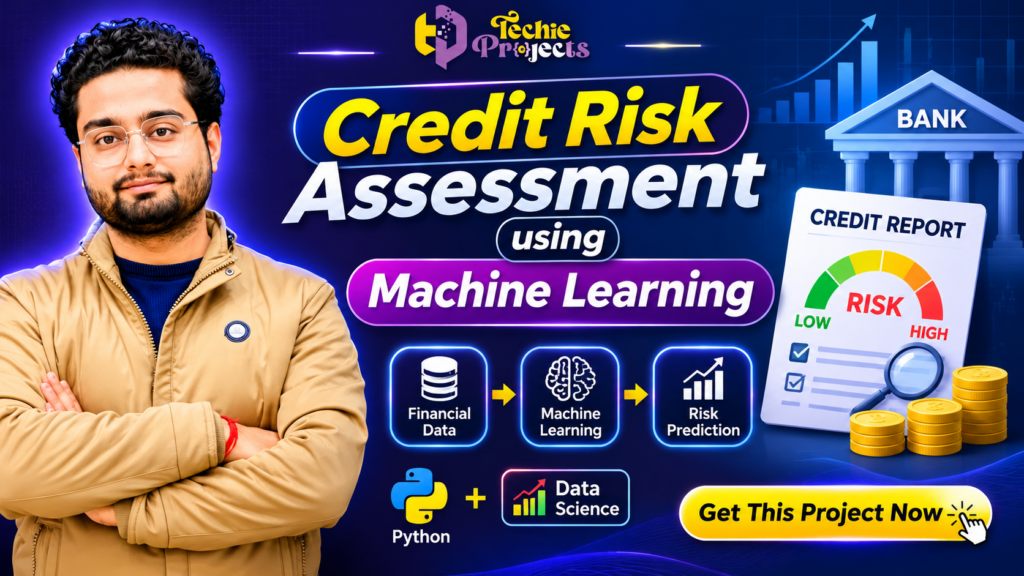
🚀 Want to build an impressive Data Science project for your final-year engineering submission? Get the Credit Risk Assessment using Machine Learning Project from Techie Projects and explore how Artificial Intelligence and Python can help analyze financial risk and predict potential loan defaults!
Are you searching for a practical Machine Learning project that combines Python programming, financial data analysis, predictive modelling, and real-world applications? The Credit Risk Assessment using Machine Learning project is an excellent choice for students interested in Artificial Intelligence, Data Science, Financial Technology (FinTech), and Machine Learning.
Instead of spending weeks searching for datasets, selecting algorithms, and developing an entire application from scratch, you can contact Techie Projects to purchase this project and get assistance with its implementation.
This project demonstrates how machine learning techniques can analyze borrower information and identify potential credit risks based on historical financial data. It provides an opportunity to understand how predictive analytics can support financial institutions in evaluating loan applications.
Whether you are a B.Tech, BCA, MCA, M.Tech, or Computer Science student, this project can help you explore an important application of Artificial Intelligence in the financial sector.
📞 Contact Techie Projects for Project Enquiries
Interested in purchasing the Credit Risk Assessment using Machine Learning Project? Contact us to enquire about package availability, pricing, source code, documentation, installation guidance, and technical support options.
💬 WhatsApp Enquiry: Chat with Techie Projects
📱 Contact Number: +91 94600 60699
🌐 Official Website: www.techieprojects.com
📸 Instagram: Follow Techie Projects
🎓 Project Areas: Robotics, Machine Learning, Arduino, Deep Learning, Artificial Intelligence, and Android App.
✅ Request Project Details: Share your engineering branch, preferred features, and technical requirements to enquire about the most suitable available package.
🚀 Ready to get started? Click here to enquire on WhatsApp and mention Credit Risk Assessment using Machine Learning Project.
Package contents, prices, hardware availability, and support options should be confirmed before purchase.
🎬 Watch the Credit Risk Assessment using Machine Learning Project Demo
Explore the project demonstration to understand the concept, interface, and working approach of the credit risk prediction system.
The demonstration introduces the application of Python and Machine Learning in financial risk analysis.
Project: Credit Risk Assessment using Machine Learning
💡 What Is Credit Risk Assessment using Machine Learning?
Credit risk assessment is the process of evaluating the possibility that a borrower may fail to repay a loan or meet financial obligations.
Banks, financial institutions, and lending organizations evaluate several factors before approving loans. These factors may include income, employment status, credit history, outstanding debt, loan amount, repayment history, and other financial information.
Traditional credit assessment methods often depend on predefined rules and conventional statistical approaches. However, machine learning provides additional techniques for identifying patterns in historical financial datasets.
The Credit Risk Assessment using Machine Learning project demonstrates how predictive algorithms can analyze borrower information and classify potential credit risk.
The system uses historical data to identify relationships between financial attributes and repayment outcomes. After training, the selected model can generate predictions for new input records.
For students, this project provides practical exposure to:
- Python programming.
- Data preprocessing and cleaning.
- Exploratory Data Analysis (EDA).
- Machine Learning algorithms.
- Classification techniques.
- Model evaluation.
- Financial data visualization.
- Predictive analytics.
It is an interesting combination of financial concepts and modern computing technologies.
Credit Risk Assessment using Machine Learning for Final Year Projects
The Credit Risk Assessment using Machine Learning project is an excellent opportunity for students to understand how Artificial Intelligence is applied in financial institutions. This project combines Python programming, financial data analysis, and predictive modelling to demonstrate how machine learning algorithms can identify potential credit risks.
🎯 Objectives of the Credit Risk Prediction Project
The primary objective is to demonstrate how machine learning techniques can assist in analyzing financial information and predicting credit-related outcomes.
The important objectives include:
1. Analyze Financial Information
Understand borrower-related attributes and identify the information that may influence loan repayment.
2. Predict Credit Risk
Apply classification algorithms to estimate whether a borrower belongs to a particular risk category based on the training data.
3. Improve Data Analysis Skills
Understand how data preprocessing, feature selection, and exploratory analysis contribute to predictive modelling.
4. Compare Machine Learning Algorithms
Evaluate different classification approaches and understand their strengths and limitations.
5. Develop Practical Python Skills
Work with Python libraries used in data science and machine learning applications.
6. Why Develop Credit Risk Assessment using Machine Learning?
Developing Credit Risk Assessment using Machine Learning helps students understand practical classification problems. It provides hands-on experience with financial datasets, feature engineering, model training, and prediction techniques used in modern Data Science applications.
⚙️ How Does the Credit Risk Assessment System Work?
The system follows a machine learning workflow that transforms financial data into useful predictive information.
1. Data Collection
The first step involves collecting a historical financial dataset containing borrower-related information.
The dataset may include attributes such as:
- Applicant income.
- Loan amount.
- Loan duration.
- Employment information.
- Credit history.
- Existing financial obligations.
- Repayment status.
The quality and relevance of the dataset directly influence model performance.
2. Data Preprocessing
Raw financial datasets may contain missing values, inconsistent records, categorical attributes, and unnecessary columns.
Data preprocessing prepares the dataset for machine learning.
Common preprocessing operations include:
- Handling missing values.
- Removing duplicate records.
- Encoding categorical variables.
- Feature scaling where required.
- Selecting relevant features.
- Splitting the dataset into training and testing sets.
3. Exploratory Data Analysis
Exploratory Data Analysis helps understand the structure and distribution of financial information.
Students can use graphs, charts, and statistical summaries to identify patterns in the dataset.
For example, the analysis may explore relationships between applicant income, loan amount, credit history, and repayment outcomes.
4. Model Training
After preprocessing, the dataset is used to train suitable machine learning algorithms.
The algorithms learn patterns from historical records and attempt to identify relationships between input attributes and the target variable.
5. Credit Risk Prediction
Once the model is trained, it can process new borrower information and generate a prediction.
The output depends on the target categories and model design used in the implementation.
6. Model Evaluation
The trained model should be evaluated using appropriate performance metrics.
This helps determine how accurately the algorithm classifies the test records.
🤖 Machine Learning Algorithms Used
Different classification algorithms can be applied to credit risk prediction. The final selection depends on the dataset, implementation, and evaluation results.
Logistic Regression
Logistic Regression is a commonly used classification algorithm that estimates the probability of a particular outcome.
It is useful as a baseline model for understanding relationships between financial attributes and credit-related outcomes.
Decision Tree Classifier
Decision Tree uses a tree-like structure to make predictions based on feature conditions.
It is relatively easy to understand and can help students interpret how different attributes contribute to classification decisions.
Random Forest Classifier
Random Forest combines multiple decision trees to generate predictions.
It can help capture more complex relationships in structured financial datasets and reduce the limitations of relying on a single decision tree.
Support Vector Machine
Support Vector Machine is a supervised learning algorithm that identifies decision boundaries between different classes.
It can be useful for classification problems involving multiple financial attributes.
K-Nearest Neighbors
KNN predicts a class based on the nearest observations in the feature space.
It provides another approach for understanding similarity-based classification.
The algorithms should be compared using the same evaluation dataset to obtain a meaningful performance assessment.
📊 Important Features of the Project
The Credit Risk Assessment using Machine Learning project provides an opportunity to explore several important data science concepts.
1. Financial Data Analysis
Analyze borrower-related information and understand the factors associated with credit risk.
2. Predictive Modelling
Apply supervised machine learning techniques to historical financial records.
3. Data Visualization
Represent financial information using graphs and charts to understand patterns.
4. Classification Techniques
Explore how machine learning algorithms classify records into different categories.
5. Model Performance Evaluation
Understand accuracy, precision, recall, F1-score, and confusion matrices.
6. Python Implementation
Use Python programming and relevant data science libraries to develop the system.
7. Practical Learning
Understand the complete machine learning workflow, from dataset preparation to prediction.
🛠️ Technologies and Software Requirements
Python Implementation for Credit Risk Assessment using Machine Learning
Python makes Credit Risk Assessment using Machine Learning easier to implement because it provides powerful libraries such as Pandas, NumPy, and Scikit-learn. These libraries help developers prepare financial datasets, train classification models, evaluate predictions, and visualize results.
The project is based on Python programming and machine learning concepts.
The following technologies are relevant to this implementation:
| Technology | Purpose |
|---|---|
| Python | Main programming language |
| Pandas | Data manipulation |
| NumPy | Numerical operations |
| Scikit-learn | Machine Learning algorithms |
| Matplotlib | Data visualization |
| Seaborn | Statistical visualization |
| Jupyter Notebook | Development environment |
Hardware Requirements:
- Processor: Intel Core i3 or above recommended.
- RAM: 4 GB minimum; 8 GB recommended.
- Storage: Sufficient space for datasets and project files.
- Operating System: Windows or Linux.
The exact requirements depend on the dataset size and implementation.
📈 Model Evaluation Metrics
Evaluating a machine learning model is an important part of the project.
A model should not be considered successful based only on its accuracy score. Credit risk classification may involve imbalanced datasets, where one category has significantly more observations than another.
Important evaluation metrics include:
Accuracy: Measures the proportion of correctly classified observations.
Precision: Measures how many predicted positive observations are actually positive.
Recall: Measures how many actual positive observations are correctly identified.
F1-Score: Combines precision and recall into a single metric.
Confusion Matrix: Displays correct and incorrect predictions for each class.
These metrics help students understand the effectiveness and limitations of the trained model.
🏦 Real-World Applications of Credit Risk Assessment
Credit risk prediction is an important area of financial technology.
The techniques demonstrated in this project are relevant to several applications.
1. Banking Sector
Banks evaluate borrower information before approving loans. Predictive analytics can support the assessment process.
2. Loan Approval Systems
Financial organizations can use predictive models as one component of their loan evaluation workflows.
3. Financial Technology Companies
FinTech platforms use data analytics and machine learning techniques to develop financial services.
4. Credit Card Risk Analysis
Machine learning can help analyze financial patterns associated with credit card repayment and potential default.
5. Risk Management
Predictive modelling can help financial analysts identify patterns that may indicate increased financial risk.
6. Financial Data Science
Data scientists can use similar classification approaches to investigate financial datasets and build predictive applications.
Business Applications of Credit Risk Assessment using Machine Learning
Financial institutions can explore Credit Risk Assessment using Machine Learning to support borrower analysis and risk management. Predictive models can help identify patterns in financial records and provide additional information for credit evaluation.
Important: An academic machine learning model is not automatically suitable for real banking decisions. Production financial systems require proper validation, explainability, fairness testing, security, and regulatory compliance.
Learn Data Science with Credit Risk Assessment using Machine Learning
Students working on Credit Risk Assessment using Machine Learning can gain practical knowledge of supervised learning, classification algorithms, financial analytics, and predictive modelling. These concepts are valuable for students preparing for careers in Data Science and Artificial Intelligence.
🎓 Why Choose This Project for Your Final-Year Submission?
Choosing the right final-year project is an important decision for engineering and computer application students.
A good project should demonstrate technical understanding and provide opportunities for practical learning.
The Credit Risk Assessment using Machine Learning project is relevant to students interested in:
- Computer Science Engineering.
- Information Technology.
- Artificial Intelligence.
- Machine Learning.
- Data Science.
- MCA and BCA.
- M.Tech research and academic projects.
The project combines programming, statistics, financial concepts, and predictive modelling.
It can also provide useful discussion points during project presentations and viva examinations.
Students can explore how datasets are prepared, how classification algorithms work, and how prediction results are evaluated.
Get Credit Risk Assessment using Machine Learning Project Source Code
Are you looking for Credit Risk Assessment using Machine Learning project implementation for your academic submission? Techie Projects can help you explore the available Python project package, source code, demonstration, and implementation guidance. Contact our team to discuss pricing and availability.
💰 Purchase Credit Risk Assessment using Machine Learning from Techie Projects
Choose Techie Projects for your Credit Risk Assessment using Machine Learning project requirements. Contact us to discuss project availability, implementation details, pricing, and academic requirements.
Are you ready to work on a practical Data Science project?
Purchase the Credit Risk Assessment using Machine Learning project from Techie Projects and get assistance with your academic project requirements.
Instead of struggling with project development without proper direction, connect with our team to discuss the available project package and implementation support.
What Can You Enquire About?
- Python project implementation.
- Machine learning model development.
- Dataset and preprocessing details.
- Project demonstration.
- Source code availability.
- Project documentation availability.
- Installation and execution guidance.
- Customization requirements.
The exact package contents and available support can be confirmed before purchasing.
Why Purchase from Techie Projects?
Techie Projects focuses on developing technology-based academic projects across multiple domains.
Our project areas include:
- Artificial Intelligence and Machine Learning.
- Python Development.
- Data Science and Data Analytics.
- Computer Vision and Image Processing.
- Natural Language Processing.
- Deep Learning.
- Internet of Things.
- Web Development.
- Embedded Systems.
We aim to help students understand practical technologies through project-based learning.
Whether you need a Machine Learning project, Python application, or final-year engineering project, contact our team to discuss your requirements.
🚀 How to Purchase This Project?
Getting started is simple.
Step 1: Contact Our Team
Send a WhatsApp enquiry to Techie Projects.
Step 2: Discuss Your Requirements
Tell us your course, branch, academic requirements, and project expectations.
Step 3: Confirm Project Availability
Discuss the project implementation, available package contents, pricing, and delivery details.
Step 4: Confirm Your Purchase
Proceed after reviewing and confirming the project details.
Step 5: Start Learning and Implementation
Explore the project, understand the machine learning workflow, and prepare for your academic presentation.
📞 WhatsApp Now: https://wa.me/919460060699
💡 Recommended Projects
Looking for more interesting projects in Artificial Intelligence and Data Science? Explore these related project ideas from Techie Projects.
- Fake News Detection using Machine Learning – Identify potentially misleading information using NLP and classification techniques.
- Credit Card Fraud Detection using Machine Learning – Analyze transaction records and identify potentially fraudulent activities.
- Intrusion Detection System (IDS) Project – Predict attacker retention patterns using historical data.
- Loan Approval Prediction using Machine Learning – Analyze applicant information and predict loan approval outcomes.
- Stock Price Prediction using Machine Learning – Explore financial time-series data and predictive modelling.
- Heart Disease Prediction using Machine Learning – Apply classification techniques to healthcare datasets.
- Suspicious Detection using Deep Learning – Explore deep learning approaches for identifying suspicious patterns.
These projects are suitable for exploring different applications of Python, Artificial Intelligence, and Data Science.
🔗 Explore Related Python Projects
Discover more practical project ideas and implementation concepts on Techie Projects.
Explore our website for:
- Python Projects.
- Machine Learning Projects.
- Artificial Intelligence Projects.
- Data Science Projects.
- Computer Vision Projects.
- Deep Learning Projects.
- Final Year Engineering Projects.
🌐 Visit: www.techieprojects.com
You can also follow our Instagram page for project updates, demonstrations, and technology-related content.
📸 Follow Techie Projects on Instagram
❓ Frequently Asked Questions (FAQs)
1. What is Credit Risk Assessment using Machine Learning?
It is a machine learning application that analyzes borrower-related financial information and predicts credit-related risk categories based on patterns learned from historical data.
2. Which programming language is used in this project?
Python is the primary programming language used for developing the project.
3. Which algorithms can be used for credit risk prediction?
Logistic Regression, Decision Tree, Random Forest, Support Vector Machine, and K-Nearest Neighbors are examples of algorithms suitable for classification tasks.
4. Is this project suitable for final-year engineering students?
Yes. It is relevant to Computer Science, Information Technology, Artificial Intelligence, and Data Science students.
5. Can beginners understand this project?
Yes. Students with basic Python and machine learning knowledge can use it as a learning project. Understanding data preprocessing and classification concepts will be helpful.
6. Can I purchase the project from Techie Projects?
Yes. Contact Techie Projects to discuss pricing, availability, package contents, and project requirements.
7. Is the project useful for learning Data Science?
Yes. It covers important concepts such as data cleaning, exploratory analysis, classification, predictive modelling, and evaluation.
8. How can I contact Techie Projects?
You can contact us through WhatsApp at +91 94600 60699 or visit www.techieprojects.com.
9. Is Credit Risk Assessment using Machine Learning suitable for MCA and B.Tech students?
Yes. Credit Risk Assessment using Machine Learning is relevant to B.Tech, BCA, MCA, M.Tech, and Computer Science students interested in Python programming, Artificial Intelligence, and Data Science.
🎯 Conclusion
The Credit Risk Assessment using Machine Learning project is an interesting combination of Python programming, financial data analysis, and predictive modelling.
It introduces students to the practical application of machine learning in the financial sector and helps them understand how classification algorithms can analyze borrower information.
From data preprocessing and exploratory analysis to model training and evaluation, this project covers several important stages of a typical data science workflow.
For students preparing final-year engineering submissions, MCA projects, BCA projects, or Data Science demonstrations, it offers an opportunity to explore an industry-relevant technical topic.
If you are looking for a practical project with implementation assistance, connect with Techie Projects today.
🚀 Don’t waste time searching endlessly for your next project. Get the Credit Risk Assessment using Machine Learning Project from Techie Projects!
📞 Contact / WhatsApp: +91 94600 60699
🌐 Website: www.techieprojects.com
📸 Instagram: @pythonprojects_
🎓 Techie Projects – Turning Ideas into Practical Technology Projects!

