
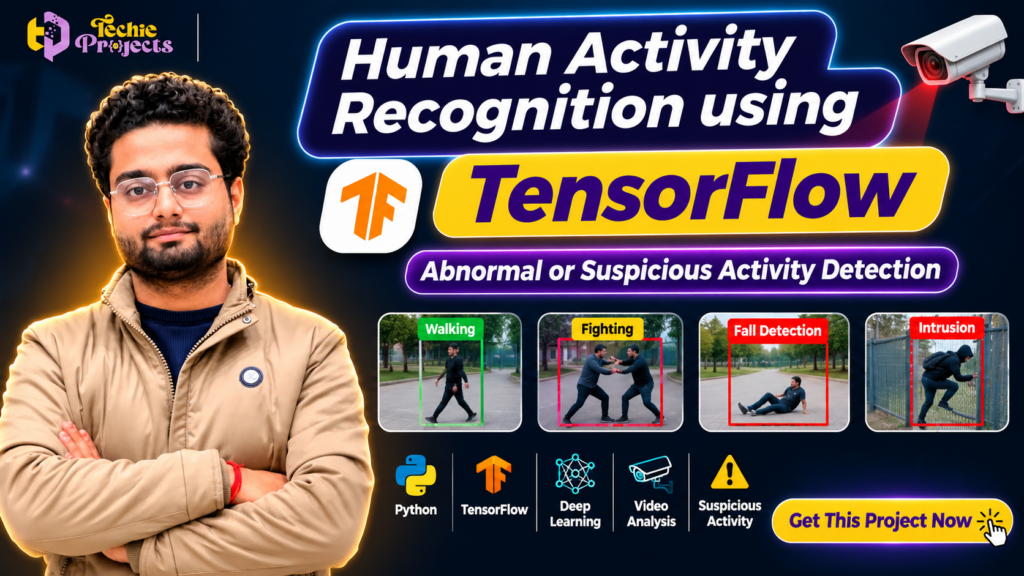
Human Activity Recognition using TensorFlow provides a practical approach to understanding how Artificial Intelligence can identify different human activities. By combining Python programming, deep learning, and computer vision, students can explore automated activity classification and suspicious behavior analysis.
Are you looking for an advanced AI and Deep Learning project for your final-year engineering submission? 🚀 Get the Human Activity Recognition using TensorFlow project from Techie Projects and explore how Artificial Intelligence can identify human activities and help detect potentially abnormal or suspicious behavior through video analysis.
This project is designed for Computer Science Engineering (CSE), Artificial Intelligence, Data Science, and IT students who want to work with real-world applications of Deep Learning, Python, TensorFlow, and Computer Vision.
💡 Instead of spending weeks struggling with project development, model implementation, and technical configurations, you can enquire about our ready-to-explore project solution. Contact Techie Projects to learn about source code availability, project demonstrations, implementation support, and customization options.
📞 Contact Techie Projects for Project Enquiries
Looking to purchase this project for your final-year submission? Connect with our team to discuss project availability, pricing, source code, documentation, and customization.
- 📞 Contact / WhatsApp: +91 94600 60699
- 🌐 Website: www.techieprojects.com
- 📸 Instagram: @pythonprojects_
🎬 Watch the Human Activity Recognition Using TensorFlow Project Demo
Watch the project demonstration to understand the interface, activity analysis workflow, and suspicious activity detection concept.
Human Activity Recognition using TensorFlow – AI-Based Suspicious Activity Detection
The demonstration helps students understand the project’s working process and its potential applications in intelligent surveillance and automated video analysis.
🤖 What Is Human Activity Recognition?
Human Activity Recognition (HAR) is an Artificial Intelligence technology that identifies and classifies human activities using video frames, images, or sensor data.
The technology uses machine learning and deep learning algorithms to analyze patterns in human movement and recognize different activities.
For example, an activity recognition system may identify:
- Walking and running
- Fighting or aggressive movements
- Falling or unusual body movements
- Suspicious movements
- Unauthorized entry or intrusion-related activities
The primary objective is to reduce the need for continuous manual observation and provide automated assistance in analyzing human activities.
Human Activity Recognition using TensorFlow combines Python programming, deep learning, and video analysis techniques to demonstrate how intelligent systems can recognize different human activities.
🎯 Project Overview
The Human Activity Recognition project is developed using Python and TensorFlow to demonstrate automated activity analysis through deep learning techniques.
The system focuses on analyzing visual information and identifying activity patterns. It provides an academic implementation of AI-based suspicious activity detection.
The project is particularly useful for students interested in understanding how deep learning models can be applied to surveillance-related applications.
The implementation demonstrates the relationship between video processing, image analysis, neural networks, and activity classification.
Main Objectives
- Develop an AI-based human activity recognition application.
- Understand deep learning techniques for activity classification.
- Analyze visual information from video inputs.
- Explore abnormal and suspicious activity detection.
- Understand TensorFlow-based model implementation.
- Demonstrate the potential of automated surveillance analysis.
⚙️ How Does Human Activity Recognition Using TensorFlow Work?
The system follows a video analysis and activity recognition workflow. It processes visual information and uses trained deep learning models to identify activity patterns.
The general workflow can be divided into the following stages.
1. Video Input
The system receives video input containing human activities. Depending on the implementation, the input can come from a recorded video or a supported camera source.
2. Frame Extraction
The video is divided into individual frames for further analysis. Frame extraction helps the application process visual information in smaller units.
3. Image Preprocessing
The extracted frames are prepared for model processing. Preprocessing may include resizing, normalization, and other operations required by the selected deep learning architecture.
4. Feature Extraction
Deep learning models learn useful patterns from visual information. These patterns may help distinguish different movements and activities.
5. Activity Classification
The trained model analyzes the processed information and predicts the corresponding activity category.
6. Result Visualization
The application presents the analysis results through its interface. The output helps users understand the recognized activity and the system’s prediction.
This complete workflow makes Human Activity Recognition using TensorFlow an interesting practical example of Artificial Intelligence and Computer Vision.
🧠 Technologies Used in the Project
One of the major advantages of Human Activity Recognition using TensorFlow is its integration of modern AI technologies. Students can understand how TensorFlow models process visual information, extract meaningful patterns, and generate activity classification results.
The project combines several technologies commonly used in modern AI development.
Python
Python is the primary programming language. It provides libraries and development tools for image processing, machine learning, and application development.
TensorFlow
TensorFlow is a deep learning framework used for building and executing machine learning models. It supports neural network development and model training.
Deep Learning
Deep learning techniques help systems learn complex patterns from data. Depending on the implemented architecture, neural networks can be used to recognize visual activity patterns.
Computer Vision
Computer Vision enables computers to process and understand visual information. It is an important component of video-based activity recognition applications.
Tkinter
Tkinter can be used to develop a graphical user interface for Python applications, allowing users to interact with the system.
⭐ Key Features of the Project
The Human Activity Recognition using TensorFlow project demonstrates several important functionalities.
1. Human Activity Recognition
The application demonstrates how deep learning can be used to recognize human activities from visual information.
2. Suspicious Activity Detection
The system focuses on identifying activity patterns associated with potentially abnormal or suspicious behavior.
3. Video-Based Analysis
The project demonstrates the use of video data for activity recognition and visual analysis.
4. AI-Based Classification
Machine learning and deep learning concepts are applied to classify activities based on learned patterns.
5. Python-Based Implementation
The application uses Python, making it suitable for students interested in practical AI development.
6. Graphical User Interface
The project provides an interface for interacting with the application and understanding its functionality.
7. Academic Learning
Students can explore model implementation, preprocessing, classification, and the overall deep learning workflow.
Note: Actual detection categories and supported input sources depend on the supplied project implementation and trained model.
🚨 Abnormal and Suspicious Activity Detection
One of the interesting applications of Human Activity Recognition is identifying unusual activities in surveillance footage.
Traditional surveillance systems often require human operators to continuously monitor video recordings. AI-based activity analysis can assist by automatically examining video content and identifying patterns that may require further attention.
Examples of potentially relevant activities include:
- Fighting or aggressive physical movements.
- Falling incidents.
- Unusual movements in restricted areas.
- Suspicious entry or intrusion-related behavior.
- Other activities represented in the model’s training categories.
The system should be considered an assistance tool rather than a definitive security decision-maker. Model predictions require validation, and real-world deployment needs suitable testing.
🏢 Real-World Applications of Human Activity Recognition
The Human Activity Recognition using TensorFlow project also introduces students to intelligent video analytics. This technology can be explored for surveillance research, abnormal activity identification, and automated monitoring applications.
Human activity recognition has applications across different industries.
1. Smart Surveillance Systems
AI-based video analysis can help security teams review surveillance footage and identify events that may require attention.
2. Healthcare Monitoring
Activity recognition techniques can support research into patient movement analysis, fall detection, and assisted monitoring.
3. Smart Homes
Intelligent home applications can use activity recognition to understand certain movement patterns and support automation.
4. Industrial Safety
Computer vision systems can help researchers explore workplace safety monitoring and the recognition of specific activities.
5. Public Safety Research
Activity recognition can be studied for applications involving public-space monitoring and event analysis.
6. Intelligent Transportation
Similar deep learning techniques can be extended to research involving pedestrian movement and traffic-related visual analysis.
📊 Advantages of Human Activity Recognition Using TensorFlow
There are several reasons why this project is useful for engineering students.
- Practical AI Learning: Understand how deep learning is applied to real-world problems.
- Python Programming: Improve practical Python development skills.
- TensorFlow Experience: Explore a widely used deep learning framework.
- Computer Vision Knowledge: Learn how computers process video and image information.
- Model Understanding: Study the relationship between training data and classification results.
- Project Demonstration: Present an AI-based application during academic project evaluation.
- Future Scope: Build a foundation for exploring advanced video analytics applications.
💻 Software Requirements
The following are the software requirements indicated for this project.
| Component | Requirement |
|---|---|
| Programming Language | Python |
| Deep Learning Framework | TensorFlow |
| Operating System | Windows 10/11 |
| GUI Framework | Tkinter |
| Application Domain | Artificial Intelligence |
| Project Type | Human Activity Recognition |
Hardware Requirements
- Processor: Intel Pentium 3 or equivalent as a basic listed requirement.
- RAM: 4 GB minimum listed requirement.
- Storage: 500 GB hard disk listed requirement.
- Input Devices: Keyboard and mouse.
Actual performance requirements may vary depending on the TensorFlow version, model architecture, video resolution, and processing configuration. A more capable processor and additional RAM are recommended for smoother experimentation.
🎓 Why Is This Project Suitable for Final-Year Engineering Students?
Final-year engineering projects should demonstrate practical technical knowledge and problem-solving ability.
Human Activity Recognition using TensorFlow provides an opportunity to combine multiple computer science concepts in one application.
Students can explore:
- Artificial Intelligence fundamentals.
- Deep learning architecture.
- Python programming.
- Video processing.
- Computer vision techniques.
- Activity classification.
- Model evaluation.
- Graphical user interface development.
It can be considered for B.Tech, M.Tech, BCA, MCA, and other computer science-related academic projects, depending on institutional requirements.
🔬 Future Scope of the Project
The project can be extended in several directions through additional research and development.
Real-Time Activity Recognition
A future version can explore live video processing and real-time activity classification using supported camera sources.
Advanced Deep Learning Models
Students can experiment with CNN-LSTM, 3D CNN, and other suitable architectures for learning spatial and temporal activity patterns.
Improved Detection Accuracy
Additional training data, model optimization, and evaluation techniques can be investigated to improve classification performance.
Cloud-Based Monitoring
The application could be extended with cloud-based video storage and remote monitoring capabilities.
Mobile Application Integration
A mobile application could be developed to display activity analysis results and notifications.
Multiple Camera Integration
Future development could investigate combining multiple video sources for broader monitoring coverage.
These enhancements can make the project more advanced and provide opportunities for further academic research.
🛒 Purchase Human Activity Recognition Using TensorFlow Project from Techie Projects
If you are searching for an advanced final-year AI project, Human Activity Recognition using TensorFlow is worth exploring. Contact Techie Projects to enquire about project availability, source code, demonstration, documentation, and customization options.
Are you ready to work on an AI-based final-year engineering project?
Get the Human Activity Recognition using TensorFlow project from Techie Projects!
We provide project development solutions across multiple technology domains, helping engineering students explore practical software and AI applications.
When enquiring about this project, you can discuss the following:
- Project source code availability.
- Working project demonstration.
- Software and installation requirements.
- Project implementation details.
- Documentation availability.
- Customization requirements.
- Technical assistance options.
Our team can explain the available project package and help you select a solution according to your academic requirements.
💰 Why Choose Techie Projects?
Techie Projects focuses on developing technology-based projects for students across different engineering domains.
Our project domains include:
- Artificial Intelligence and Machine Learning.
- Deep Learning.
- Python Development.
- Data Science and Data Analytics.
- Computer Vision and Image Processing.
- Natural Language Processing.
- Internet of Things (IoT).
- Web Development.
- Android Application Development.
Whether you are searching for a Python-based AI project or an advanced deep learning application, you can explore our available project solutions.
💡 Recommended Projects
Explore these related engineering project ideas from Techie Projects:
- Human Emotion Detection Using Deep Learning
- Face Recognition Attendance System
- Real-Time Object Detection Using YOLO
- Violence Detection Using Deep Learning
- Accident Detection Using Computer Vision
- Intrusion Detection System Using Machine Learning
- Fire and Smoke Detection Using Deep Learning
- Helmet Detection Using YOLO
- Crowd Detection and Analysis System
- Suspicious Object Detection Using Computer Vision
❓ Frequently Asked Questions (FAQs)
1. What is Human Activity Recognition using TensorFlow?
It is an AI-based application that demonstrates how TensorFlow and deep learning techniques can be used to recognize and classify human activities from visual information.
2. Which programming language is used?
Python is the primary programming language used in this project.
3. Which deep learning framework is used?
TensorFlow is the deep learning framework specified for the project.
4. Can this project detect suspicious activities?
The project focuses on abnormal and suspicious activity detection. Actual supported categories depend on the trained model and implementation.
5. Is this project suitable for final-year students?
Yes. It is a suitable topic to explore for students interested in Artificial Intelligence, Deep Learning, Python, and Computer Vision, subject to their academic requirements.
6. Can the project be customized?
Customization can be discussed with Techie Projects according to the available implementation and student requirements.
7. How can I purchase this project?
Contact Techie Projects through WhatsApp at +91 94600 60699 to enquire about pricing, source code, demonstration, and available project packages.
🎯 Conclusion
Human Activity Recognition using TensorFlow is an interesting Artificial Intelligence project that combines Python programming, deep learning, computer vision, and video analysis.
It demonstrates how intelligent systems can analyze visual information and identify different human activity patterns. The project also provides a useful foundation for students interested in suspicious activity detection, automated surveillance research, and advanced AI applications.
For students planning their final-year engineering submission, this project offers an opportunity to explore practical deep learning concepts and understand how AI technologies can be applied to real-world challenges.
🚀 Want to purchase this project? Contact Techie Projects today and take the next step toward your AI engineering project!
📞 Contact / WhatsApp: +91 94600 60699
🌐 Website: www.techieprojects.com
📸 Instagram: @pythonprojects_