
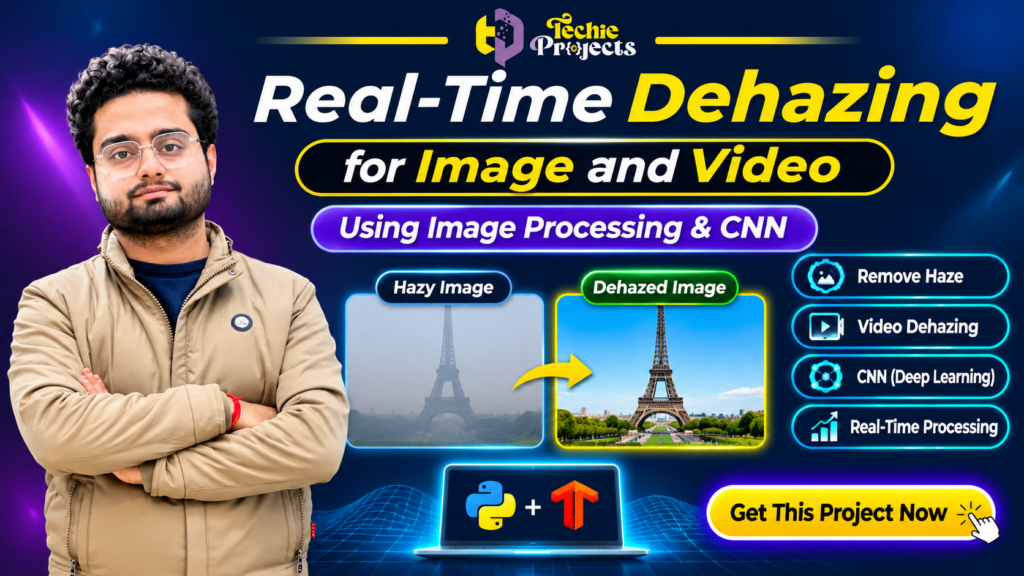
Are you looking for an innovative final-year engineering project in Artificial Intelligence, Deep Learning, or Computer Vision? 🚀 Get the Real-Time Image Dehazing Project from Techie Projects and explore how deep learning can transform unclear, hazy images into clearer and more informative visuals.
The Real-Time Image Dehazing project is designed for students who want to understand advanced image processing techniques using Python and Convolutional Neural Networks (CNN). It demonstrates how computer vision systems can identify and reduce the visual effects of atmospheric haze in images and video frames.
Instead of spending weeks searching for project ideas, struggling with implementation, or building everything from scratch, you can get a project solution from Techie Projects and explore its implementation, functionality, and working demonstration.
🎓 This project is suitable for B.Tech, M.Tech, MCA, BCA, Computer Science, Artificial Intelligence, and Data Science students looking for an interesting academic project.
📞 Contact Techie Projects for Project Enquiries
Interested in purchasing the Real-Time Image Dehazing Project? Contact us to enquire about package availability, pricing, source code, documentation, installation guidance, and technical support options.
💬 WhatsApp Enquiry: Chat with Techie Projects
📱 Contact Number: +91 94600 60699
🌐 Official Website: www.techieprojects.com
📸 Instagram: Follow Techie Projects
🎓 Project Areas: Robotics, Machine Learning, Arduino, Deep Learning, Artificial Intelligence, and Android App.
✅ Request Project Details: Share your engineering branch, preferred features, and technical requirements to enquire about the most suitable available package.
🚀 Ready to get started? Click here to enquire on WhatsApp and mention Real-Time Image Dehazing Project .
Package contents, prices, hardware availability, and support options should be confirmed before purchase.
🎬 Watch the Real-Time Image Dehazing Project Demo
Explore the working demonstration of the Real-Time Image Dehazing project and understand how image restoration techniques can improve the visibility of hazy scenes.
The demonstration introduces the concept of haze removal, image enhancement, and deep learning-based processing.
Watch the project video to understand its functionality and practical applications before making your purchase decision.
🌫️ What Is Real-Time Image Dehazing?
Image dehazing is an image restoration technique that reduces the visual degradation caused by atmospheric particles such as dust, smoke, fog, and pollution.
When light travels through the atmosphere, suspended particles scatter and absorb light. As a result, images captured by cameras may appear unclear, faded, or low in contrast.
The Real-Time Image Dehazing system focuses on improving image visibility by applying image processing and deep learning techniques.
Traditional image enhancement methods can improve contrast and brightness, but they may not always recover useful visual information from heavily degraded images.
Deep learning approaches offer another way to address this problem. A CNN can learn visual patterns from training data and use those patterns to estimate cleaner image representations.
This project introduces students to the relationship between image restoration, CNN architectures, Python programming, and computer vision.
🎯 Main Objectives of the Project
The primary objective is to demonstrate how deep learning can be applied to image and video dehazing.
The important objectives include:
- Develop a Python-based image dehazing application.
- Understand the effects of haze on digital images.
- Explore CNN-based image restoration techniques.
- Improve the visibility of hazy images.
- Demonstrate image enhancement through before-and-after comparisons.
- Explore processing of video frames.
- Understand practical applications of computer vision.
- Develop knowledge of deep learning and image processing.
These objectives make the project useful for students interested in building practical AI and computer vision applications.
⚙️ How Does the Image Dehazing System Work?
The system follows a general image restoration workflow.
1. Input Image or Video
The process starts when the user provides a hazy image or video.
The input may contain fog, haze, reduced contrast, or atmospheric distortion.
2. Image Preprocessing
The input is prepared for further processing.
Preprocessing may include:
- Image resizing
- Pixel normalization
- Frame extraction
- Image format conversion
- Data preparation
These operations help prepare the input for the deep learning model.
3. CNN-Based Image Processing
A Convolutional Neural Network is a deep learning architecture commonly used for computer vision applications.
CNN models learn visual features from images through convolution operations and multiple processing layers.
For image dehazing, a trained model can learn relationships between hazy images and their corresponding clearer versions.
The model uses learned information to estimate a dehazed output.
4. Image Restoration
The system processes the input and generates an enhanced image.
The objective is to reduce haze effects and improve visual clarity while retaining important image details.
5. Output Visualization
Finally, the original hazy image and processed output can be displayed for comparison.
This makes it easier to understand the effectiveness of the image restoration process.
🧠 Technologies Used in This Project
The project introduces several important technologies used in modern artificial intelligence applications.
Python
Python is the primary programming language used for developing the application. It provides an extensive ecosystem of libraries for machine learning, image processing, and computer vision.
Convolutional Neural Network (CNN)
CNN is a deep learning architecture that learns visual patterns and features from image data. It is useful for image classification, restoration, enhancement, and other computer vision applications.
Image Processing
Image processing techniques help manipulate, analyze, and enhance digital images.
OpenCV
OpenCV is a popular computer vision library used for image reading, image manipulation, video processing, and frame extraction.
Deep Learning
Deep learning allows computer systems to learn complex representations from data. In image restoration, it can be used to estimate clearer images from degraded inputs.
✨ Key Features of the Real-Time Image Dehazing Project
The project introduces several useful features for understanding image restoration.
🌁 Haze Removal
The system demonstrates the reduction of haze effects in images and aims to improve visual visibility.
🎥 Video Dehazing
Video processing can be explored by extracting individual frames, applying the dehazing process, and combining the processed frames into an output video.
🧠 CNN-Based Processing
The project introduces CNN-based approaches for learning image features and performing image restoration.
🖼️ Before-and-After Comparison
Users can compare the original hazy image with the processed result to understand the visual improvements.
🐍 Python Implementation
Python provides the development environment and supporting libraries required for implementing the image processing workflow.
📊 Computer Vision Learning
Students can understand how deep learning and image processing techniques are combined to solve practical visual problems.
💡 Applications of Image Dehazing Technology
Image dehazing has applications in several industries where image clarity is important.
1. Autonomous Vehicles
Self-driving vehicles use cameras and other sensors to understand their surroundings. Reduced visibility caused by fog or haze can affect visual perception.
Image enhancement research can help improve the quality of camera inputs.
2. Surveillance Systems
Outdoor surveillance cameras may capture unclear footage during foggy or polluted weather.
Image restoration techniques can help improve the visibility of recorded scenes.
3. Traffic Monitoring
Traffic monitoring systems use cameras to observe vehicles, roads, and traffic conditions.
Image dehazing can be explored as a preprocessing technique for improving visual information.
4. Remote Sensing
Satellite and aerial images may be affected by atmospheric conditions.
Image dehazing techniques can help improve the visual quality of remote sensing data.
5. Outdoor Photography
Photographers can use image enhancement techniques to improve pictures captured in foggy or hazy environments.
6. Robotics
Robotic systems often depend on camera inputs for environmental understanding and navigation.
Image restoration can be investigated as part of a larger computer vision pipeline.
🎓 Why Should Engineering Students Choose This Project?
Choosing the right final-year project is important for demonstrating technical knowledge and practical implementation skills.
The Real-Time Image Dehazing project offers an opportunity to explore multiple technical concepts within one application.
Benefits for students include:
- Understand practical applications of CNN.
- Learn Python-based image processing.
- Explore deep learning concepts.
- Develop knowledge of computer vision.
- Understand image restoration workflows.
- Prepare an academic project demonstration.
- Improve technical presentation skills.
- Build a foundation for advanced AI projects.
This project can also serve as a starting point for further research into image enhancement, object detection, and intelligent video processing.
💻 Software Requirements
The following are typical software requirements for developing a Python-based image dehazing application. Exact dependencies may vary depending on the implementation.
| Component | Requirement |
|---|---|
| Programming Language | Python |
| Deep Learning | CNN |
| Image Processing | OpenCV |
| Numerical Processing | NumPy |
| Image Visualization | Matplotlib |
| Operating System | Windows 10/11 |
| Development Environment | Python IDE |
Hardware Requirements
- Processor: Intel Core i3 or above recommended.
- RAM: 4 GB minimum, 8 GB or more recommended.
- Storage: Sufficient space for datasets and model files.
- GPU: Optional, but useful for accelerating deep learning inference and training.
Actual performance depends on the model architecture, image resolution, hardware, and implementation.
📚 Important Concepts You Can Learn
Working with this project can help students understand the following concepts:
1. Digital Image Processing: Learn how digital images are represented, manipulated, and enhanced.
2. Convolution Operations: Understand how CNNs extract visual features from image data.
3. Deep Learning Models: Explore how neural networks learn patterns from training datasets.
4. Image Restoration: Understand methods used to recover useful visual information from degraded images.
5. Video Frame Processing: Learn how video can be processed as a sequence of individual frames.
6. Model Evaluation: Explore image quality measurements and visual comparisons to evaluate restoration results.
🚀 Future Scope of the Project
The project can be extended with additional features to explore more advanced computer vision applications.
Some possible future improvements include:
1. Real-Time Camera Integration
Integrate a live camera feed to investigate image dehazing on continuously captured frames.
2. Advanced CNN Architectures
Explore more advanced neural network architectures to improve image restoration quality.
3. Mobile Application Integration
Develop a mobile interface that allows users to upload images and view enhanced results.
4. Video Enhancement
Extend the implementation to process longer video sequences while investigating temporal consistency between frames.
5. AI-Based Image Enhancement
Combine dehazing with other image enhancement methods to improve contrast, brightness, and visual quality.
6. Cloud-Based Processing
Deploy the application on a cloud platform to explore remote image processing.
🌟 Why Real-Time Image Dehazing Is Important in Computer Vision
The Real-Time Image Dehazing technique plays an important role in modern computer vision applications. Images captured in foggy, dusty, and polluted environments often lose their original clarity, making it difficult for computer systems to identify important visual information.
With the help of deep learning, Real-Time Image Dehazing can be explored to improve the visibility of degraded images. CNN-based image restoration approaches learn visual features from training data and use them to estimate clearer image outputs.
One major advantage of Real-Time Image Dehazing is its potential application in video surveillance, autonomous vehicles, traffic monitoring, and outdoor camera systems. These applications require reliable visual information for further analysis.
For engineering students, implementing Real-Time Image Dehazing using Python provides practical exposure to CNN architectures, OpenCV, image enhancement, and deep learning workflows.
The Real-Time Image Dehazing project also helps students understand how image restoration techniques can be integrated into larger artificial intelligence applications.
If you are interested in learning advanced computer vision concepts, this Real-Time Image Dehazing project is a valuable project topic to explore.
🛒 Get the Real-Time Image Dehazing Project from Techie Projects
Looking for a ready-to-explore Python image processing project? Contact Techie Projects to enquire about the Real-Time Image Dehazing implementation, available source code, demonstration, and project support.
Techie Projects provides project development solutions across Artificial Intelligence, Machine Learning, Deep Learning, Python, Data Science, Computer Vision, Web Development, and other technical domains.
When you enquire about the Real-Time Image Dehazing project, our team can discuss the available implementation and the deliverables included in the selected package.
Reasons to contact Techie Projects:
- Project solutions across multiple technology domains.
- Practical project demonstrations.
- Assistance with project requirements.
- Discussion of implementation and technical concepts.
- Project options for engineering students.
- Support for understanding the selected project.
Whether you are preparing a final-year engineering project, exploring a mini project, or learning advanced image processing, our team can help you identify a suitable solution.
💰 Get This Real-Time Image Dehazing Project Now!
Want to purchase the project for your final-year submission or academic learning?
Don’t waste your valuable time searching through multiple incomplete implementations. Contact Techie Projects to enquire about the Real-Time Image Dehazing project and discuss the available source code, demonstration, documentation, and implementation support.
Our team can help you understand the available package and requirements before confirming your order.
📲 Contact Us Today!
Techie Projects
- 📞 Contact / WhatsApp: +91 94600 60699
- 🌐 Website: www.techieprojects.com
- 📸 Instagram: @pythonprojects_
👉 Get This Project Now – Send Us a WhatsApp Enquiry!
💡 Recommended Projects
If you are interested in image processing, artificial intelligence, and deep learning, explore these related project ideas:
- Real-Time Object Detection Using YOLO
- Face Recognition Attendance System
- Plant Leaf Disease Detection Using Deep Learning
- Garbage Detection Using Image Processing
- Helmet Detection Using YOLO
- Number Plate Recognition System
- Remote Controlled River Cleaning Boat Project
- DeepFake Detection Using Deep Learning
- Satellite Image Classification Using Machine Learning
- Object Tracking Using Computer Vision
🔗 Explore Related Python Projects
Explore more project ideas and development solutions from Techie Projects:
- Artificial Intelligence Projects
- Machine Learning Projects
- Deep Learning Projects
- Computer Vision Projects
- Image Processing Projects
Visit our website to explore more engineering projects and find a solution that matches your academic requirements.
❓ Frequently Asked Questions (FAQs)
1. What is a Real-Time Image Dehazing project?
It is an image processing project that demonstrates how haze can be reduced from images and video frames using image restoration and deep learning techniques.
2. Which programming language is used?
Python is used as the primary programming language for implementing the image processing and deep learning workflow.
3. What is the role of CNN in image dehazing?
CNN learns visual features from training images and can be used to estimate clearer image representations from hazy inputs.
4. Is this project suitable for final-year engineering students?
Yes. It is a relevant project topic for B.Tech, M.Tech, MCA, and computer science students interested in AI, deep learning, and computer vision.
5. Can this project process videos?
Video dehazing can be implemented by processing individual video frames and reconstructing the output video. The supported functionality depends on the selected implementation.
6. Can beginners understand this project?
Students with basic Python and programming knowledge can use this project to learn image processing and deep learning concepts.
7. How can I purchase this project?
Contact Techie Projects through WhatsApp at +91 94600 60699 or visit www.techieprojects.com to enquire about pricing, availability, and project deliverables.
🏁 Conclusion
The Real-Time Image Dehazing project is an interesting application of Python, CNN, deep learning, and image processing. It introduces students to the challenges of haze removal and demonstrates how computer vision techniques can be used to improve image visibility.
From image preprocessing and CNN-based restoration to video frame processing and future AI enhancements, this project offers several opportunities to explore practical deep learning concepts.
If you are searching for a meaningful final-year engineering project in image processing or artificial intelligence, contact Techie Projects today.
🚀 Get Your Project Now!
📞 Contact / WhatsApp: +91 94600 60699
🌐 Visit: www.techieprojects.com

