
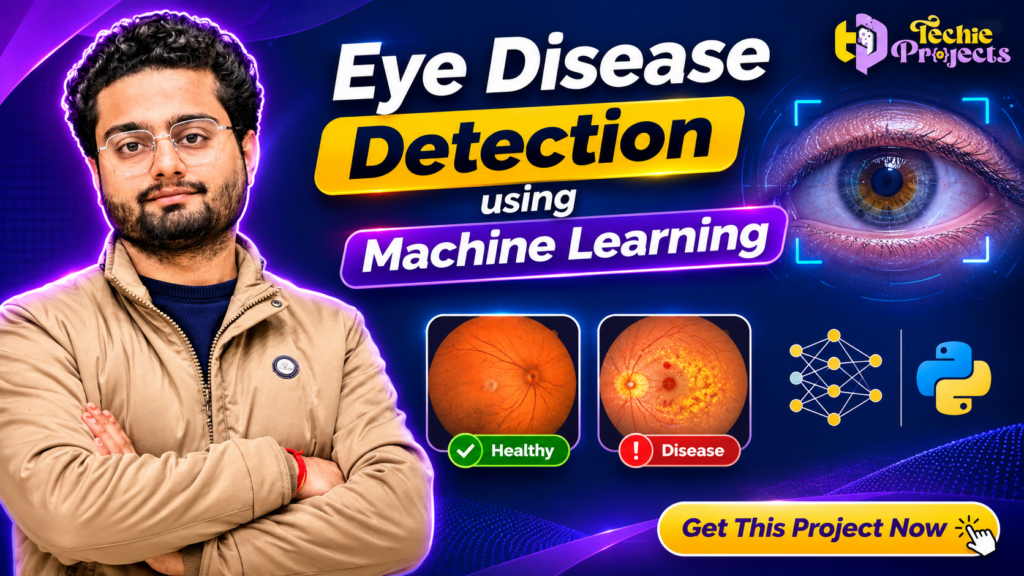
The Eye Disease Detection Using Machine Learning project is designed for students who want to explore practical Artificial Intelligence applications. It combines Python programming, Deep Learning, and medical image classification to demonstrate how automated systems can analyse retinal images and generate predictions.
🚀 Looking for a ready-to-explore Eye Disease Detection Using Machine Learning project for your final-year engineering submission? Get your project from Techie Projects today!
If you are a B.Tech, BCA, MCA, M.Tech, or Computer Science Engineering student searching for an innovative Artificial Intelligence project, this is an excellent opportunity to explore the practical applications of Python, Deep Learning, and Medical Image Processing.
Instead of spending weeks searching for project ideas, struggling with implementation, and resolving multiple Python library errors, choose a practical project solution from Techie Projects.
The Eye Disease Detection Using Machine Learning project demonstrates how Artificial Intelligence and Deep Learning techniques can be applied to retinal image analysis and image classification. It provides an opportunity to understand how computer systems learn visual patterns from image datasets and generate predictions using trained models.
🎓 Purchase this project from Techie Projects and explore its implementation, source code availability, project documentation, and technical details. Contact our team today to discuss pricing and project requirements.
📞 Contact Techie Projects for Project Enquiries
Interested in purchasing the Eye Disease Detection Using Machine Learning Project? Contact us to enquire about package availability, pricing, source code, documentation, installation guidance, and technical support options.
💬 WhatsApp Enquiry: Chat with Techie Projects
📱 Contact Number: +91 94600 60699
🌐 Official Website: www.techieprojects.com
📸 Instagram: Follow Techie Projects
🎓 Project Areas: Robotics, Machine Learning, Arduino, Deep Learning, Artificial Intelligence, and Android App.
✅ Request Project Details: Share your engineering branch, preferred features, and technical requirements to enquire about the most suitable available package.
🚀 Ready to get started? Click here to enquire on WhatsApp and mention Eye Disease Detection Using Machine Learning Project.
Package contents, prices, hardware availability, and support options should be confirmed before purchase.
🎬 Watch the Eye Disease Detection Project Demo
Explore the project demonstration to understand its interface, image-processing workflow, and classification functionality.
The demonstration introduces the Eye Disease Detection Using Machine Learning application and explains how retinal images can be processed through a Python-based Deep Learning workflow.
Watch the project demo available on this page to explore its functionality before making your purchase enquiry.
💡 What Is Eye Disease Detection Using Machine Learning?
Eye disease detection is an important application area of Artificial Intelligence and healthcare technology. It involves analysing eye-related images to identify visual patterns associated with different eye conditions.
Retinal images contain visual information about the internal structures of the eye. Analysing these images using computer-based techniques is an active area of medical image processing research.
The Eye Disease Detection Using Machine Learning project demonstrates how Python programming, image preprocessing, and Deep Learning can be combined to build an image classification application.
The system processes input images and generates predictions based on the categories supported by its trained model.
For students, this project provides practical exposure to several important technical concepts, including:
- Artificial Intelligence.
- Machine Learning.
- Deep Learning.
- Computer Vision.
- Image Processing.
- Python Programming.
- Medical Image Classification.
It is an educational implementation that helps students understand the relationship between image datasets, model training, and automated classification.
🎯 Objectives of the Project
One important advantage of the Eye Disease Detection Using Machine Learning application is that it introduces students to the complete image classification workflow, from dataset preparation and image preprocessing to model training and prediction generation.
The main objective of the Eye Disease Detection Using Machine Learning project is to develop a Python-based application that demonstrates retinal image classification using Deep Learning techniques.
The major objectives include:
- Develop an image classification application using Python.
- Understand retinal image processing techniques.
- Apply Deep Learning concepts to image analysis.
- Explore how machine learning models learn from image datasets.
- Process input images for classification.
- Generate predictions using a trained model.
- Develop an understandable graphical user interface.
- Explore Artificial Intelligence applications in healthcare technology.
- Improve practical knowledge of Python and Computer Vision.
These objectives make the project suitable for students interested in developing practical Artificial Intelligence applications.
⚙️ How Does the Eye Disease Detection System Work?
The Eye Disease Detection Using Machine Learning system uses a trained Deep Learning model to analyse input images. The application processes the selected image and generates a classification result based on the categories supported by the model.
The Eye Disease Detection Using Machine Learning application follows a sequence of image-processing and classification operations.
1. 📂 Image Dataset Collection
The first stage involves collecting retinal images required for model development.
An image dataset contains examples belonging to different predefined categories. These images are used to train and evaluate the classification model.
The quality, diversity, and correct labelling of the dataset play an important role in model performance.
2. 🖼️ Image Preprocessing
Before images are supplied to a Deep Learning model, they may require preprocessing.
Common preprocessing operations include:
- Image resizing.
- Pixel normalization.
- Image format conversion.
- Noise reduction, where required.
- Dataset organization.
- Preparation of training and testing samples.
These operations help maintain consistent image dimensions and input formats.
3. 🧠 Deep Learning Model Development
Deep Learning is an important component of this project.
Convolutional Neural Networks (CNNs) are commonly used for image classification because they can learn spatial patterns and visual features from image data.
During model training, the network learns from labelled examples and adjusts its parameters to reduce prediction errors.
The trained model can subsequently be used to generate predictions for new images.
4. 🔍 Retinal Image Classification
Once the model is trained, the application can process an input retinal image.
The model analyses the visual features and generates a prediction according to its supported categories.
This stage demonstrates how automated image classification can be implemented using Python and Deep Learning.
5. 📊 Result Visualization
The final stage displays the classification output through the application interface.
A graphical interface makes it easier for users to upload images, initiate processing, and view the generated results.
The complete workflow demonstrates how different components of an Artificial Intelligence application work together.
⭐ Key Features of the Project
The Eye Disease Detection Using Machine Learning project introduces several important features related to image processing and automated classification.
With the Eye Disease Detection Using Machine Learning project, students can understand how image preprocessing, CNN-based feature extraction, and automated classification contribute to an AI-powered application.
🔹 1. Image Upload Functionality
Users can provide retinal images through the application interface for processing.
🔹 2. Image Preprocessing
The application demonstrates image preparation operations required before model classification.
🔹 3. Deep Learning Integration
Deep Learning techniques are used to learn visual patterns from the training dataset.
🔹 4. Automated Image Classification
The trained model generates predictions for input images according to its supported categories.
🔹 5. Graphical User Interface
The application provides an interface for interacting with the image-processing and classification workflow.
🔹 6. Python-Based Implementation
Python provides the programming environment for integrating the different application components.
🔹 7. Healthcare Technology Application
The project demonstrates an educational application of Artificial Intelligence in medical image analysis.
🛠️ Technologies Used
The project introduces students to several technologies and concepts used in modern Artificial Intelligence development.
| Technology | Purpose |
|---|---|
| Python | Main programming language |
| Machine Learning | Model development concepts |
| Deep Learning | Image classification |
| CNN | Visual feature learning |
| TensorFlow / Keras | Deep Learning framework, where used |
| OpenCV | Image processing, where used |
| NumPy | Numerical operations, where used |
| Tkinter | Graphical interface, where used |
The exact libraries and versions depend on the supplied implementation.
💻 Software Requirements
The following are typical software requirements for a Python-based Deep Learning project. Confirm the exact requirements with the project package before installation.
- Programming Language: Python
- Operating System: Windows 10 / Windows 11
- IDE: Visual Studio Code / PyCharm
- Deep Learning Framework: TensorFlow or Keras, where applicable
- Image Processing: OpenCV, where applicable
- Numerical Processing: NumPy
- User Interface: Tkinter, where applicable
🖥️ Hardware Requirements
A suitable development computer should have:
- Processor: Intel Core i3 or higher.
- RAM: 8 GB recommended.
- Storage: Sufficient free disk space for datasets and dependencies.
- Graphics: Integrated graphics may be sufficient for lightweight inference; GPU support depends on the model and framework.
Training requirements vary according to the dataset size, model architecture, and hardware configuration.
🎓 Why Is This Project Suitable for Final-Year Students?
Students choosing the Eye Disease Detection Using Machine Learning project can gain practical exposure to Python development, neural networks, image processing, and Computer Vision. These concepts are valuable for students interested in pursuing careers in Artificial Intelligence and Data Science.
Selecting an appropriate final-year project is an important part of an engineering degree.
Students generally look for projects that demonstrate practical implementation, modern technologies, and real-world applications.
The Eye Disease Detection Using Machine Learning project offers exposure to several important technical areas.
1. Practical Python Knowledge
Students can understand how Python is used to build an application involving image processing and model integration.
2. Artificial Intelligence Concepts
The project introduces important concepts related to machine learning, neural networks, and automated classification.
3. Computer Vision Experience
Students can explore how computer systems process images and learn visual features.
4. Academic Demonstration
The application can be used as a learning reference when preparing project presentations and technical demonstrations.
5. Resume and Portfolio Development
Students interested in AI and Machine Learning can use their understanding of the project to discuss image classification workflows during technical interviews.
💰 Why Purchase Your Project from Techie Projects?
Choosing the right project provider can make your academic project journey more organized.
Techie Projects focuses on developing and providing technology-based project solutions across different domains.
Here are some reasons to contact us:
- 🎓 Projects for engineering and computer application students.
- 💻 Python, Artificial Intelligence, and Machine Learning project solutions.
- 🧠 Deep Learning and Computer Vision applications.
- 📚 Project-related learning and implementation guidance, as agreed.
- 📞 Direct communication for project enquiries.
- 💡 Multiple project domains and technology options.
When you enquire about the Eye Disease Detection Using Machine Learning project, our team can discuss the available package, deliverables, pricing, and technical requirements.
🚀 Who Can Purchase This Project?
This project may be suitable for students pursuing:
- B.Tech Computer Science Engineering.
- B.Tech Information Technology.
- BCA.
- MCA.
- M.Tech.
- Artificial Intelligence and Data Science.
- Computer Science and Engineering.
- Diploma in Computer Engineering.
Students interested in Python, Deep Learning, Computer Vision, and healthcare technology can explore this application as an academic learning project.
📈 Future Scope of the Project
There are several possibilities for extending this educational application.
1. Multiple Eye Disease Categories
The model can be extended to support additional retinal image categories when suitable labelled datasets are available.
2. Improved Deep Learning Architectures
Students can experiment with different CNN architectures and transfer learning models to compare classification performance.
3. Web-Based Application
The existing application can potentially be extended into a web-based interface using Flask, Django, or Streamlit.
4. Cloud-Based Deployment
A future version could be deployed on a cloud platform to make the educational application accessible through a web browser.
5. Model Performance Evaluation
Students can explore accuracy, precision, recall, F1-score, confusion matrices, and other evaluation techniques.
These improvements provide opportunities for further learning and experimentation.
💡 Recommended Projects
Looking for more Artificial Intelligence and Machine Learning projects? Explore these related project ideas from Techie Projects.
- Diabetic Retinopathy Detection Using Deep Learning – Explore retinal image classification.
- Skin Cancer Detection Using Machine Learning – Develop an image-based classification application.
- Brain Tumor Detection Using Deep Learning – Explore medical image analysis.
- Plant Leaf Disease Detection – Apply Computer Vision to agricultural images.
- Pneumonia Detection Using CNN – Explore medical image classification.
- Face Recognition Attendance System – Develop an automated attendance application.
- DeepFake Detection Using Machine Learning – Explore AI-based media classification.
🔗 Explore Related Python Projects
Discover more project solutions and ideas on Techie Projects:
- Artificial Intelligence Projects.
- Machine Learning Projects.
- Deep Learning Projects.
- Python Projects.
- Computer Vision Projects.
- Image Processing Projects.
- Data Science Projects.
- Final Year Engineering Projects.
Visit www.techieprojects.com to explore additional project categories.
❓ Frequently Asked Questions (FAQs)
1. What is Eye Disease Detection Using Machine Learning?
It is an educational Artificial Intelligence application that demonstrates how retinal images can be processed and classified using machine learning and deep learning techniques.
2. Which programming language is used?
Python is the primary programming language used for the application.
3. Is this project suitable for B.Tech students?
Yes. It is relevant to students interested in Computer Science, Artificial Intelligence, Machine Learning, and Computer Vision.
4. Can BCA and MCA students purchase this project?
Yes. Students from BCA and MCA backgrounds can enquire about the project and its suitability for their academic requirements.
5. Does the project use Deep Learning?
Yes. The project focuses on deep learning-based image classification concepts.
6. Can I get the project source code?
Contact Techie Projects to confirm source code availability, package details, and pricing.
7. Is project documentation available?
Enquire with our team about the documentation and other deliverables included in the available package.
8. Can I get technical assistance?
Technical assistance and implementation guidance can be discussed with the Techie Projects team before purchase.
9. Is this a real medical diagnostic system?
No. This is an educational project demonstrating image classification. It is not a clinically validated medical diagnostic tool and must not be used to diagnose or treat patients.
10. How can I purchase this project?
You can contact Techie Projects through WhatsApp at +91 94600 60699 or visit our website to enquire about availability and pricing.
🛒 Get This Project Now – Contact Techie Projects!
Are you ready to explore an exciting Artificial Intelligence project for your final-year submission?
The Eye Disease Detection Using Machine Learning project is an excellent opportunity to understand Python programming, Deep Learning, image processing, and healthcare-related AI applications.
Don’t waste your valuable project preparation time searching for multiple disconnected resources. Contact Techie Projects to discuss the available project package and take the next step towards your academic goals.
🎓 Purchase Enquiry – Get Your Project Details Today!
📞 Contact / WhatsApp: +91 94600 60699
🌐 Website: www.techieprojects.com
📸 Instagram: Techie Projects
Techie Projects – Innovative Projects, Practical Learning, and Technology Solutions.

