
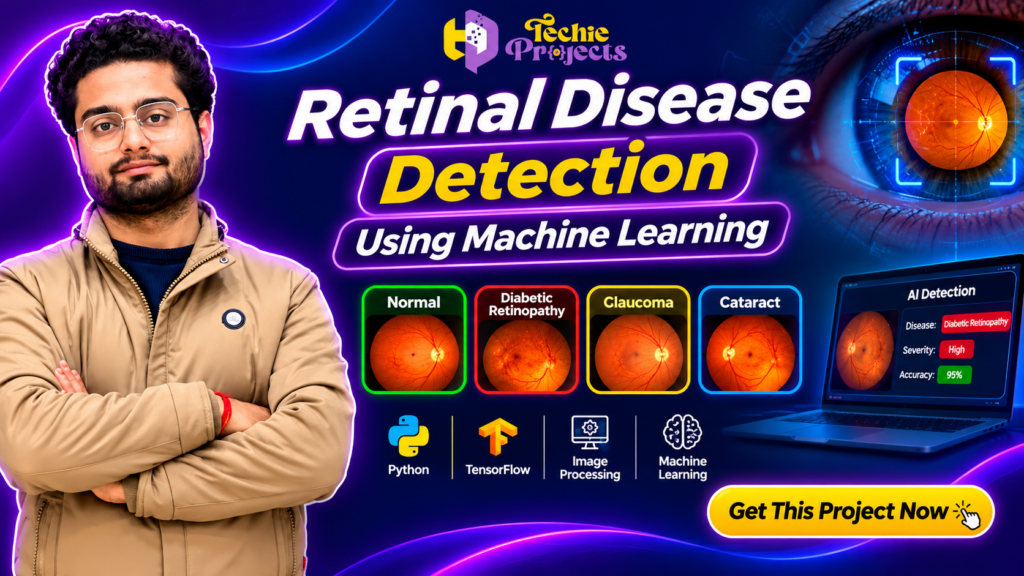
🚀 Looking for a ready-to-understand Retinal Disease Detection Using Machine Learning project for your final-year engineering submission? Purchase this AI-based project from Techie Projects and explore the practical implementation of Deep Learning, Python, and Medical Image Processing!
Stop wasting valuable time searching for project ideas, struggling with Python implementation, and fixing complicated machine learning errors. Techie Projects offers practical engineering project solutions designed to help students explore advanced technologies and understand real-world-inspired applications.
Our Retinal Disease Detection Using Machine Learning project demonstrates how Artificial Intelligence and Deep Learning techniques can analyze retinal fundus images and classify selected eye-related conditions, including Diabetic Retinopathy, Glaucoma, and Cataract.
Whether you are a B.Tech, M.Tech, BCA, MCA, Diploma, or Computer Science Engineering student, this project is an interesting choice for exploring Artificial Intelligence, Medical Image Processing, and Computer Vision.
🎯 Want to purchase this project?
Contact Techie Projects today to discuss source code availability, project demonstration, documentation, pricing, and technical assistance.
📞 Contact Techie Projects for Project Enquiries
Interested in purchasing the Retinal Disease Detection Using Machine Learning Project? Contact us to enquire about package availability, pricing, source code, documentation, installation guidance, and technical support options.
💬 WhatsApp Enquiry: Chat with Techie Projects
📱 Contact Number: +91 94600 60699
🌐 Official Website: www.techieprojects.com
📸 Instagram: Follow Techie Projects
🎓 Project Areas: Robotics, Machine Learning, Arduino, Deep Learning, Artificial Intelligence, and Android App.
✅ Request Project Details: Share your engineering branch, preferred features, and technical requirements to enquire about the most suitable available package.
🚀 Ready to get started? Click here to enquire on WhatsApp and mention Retinal Disease Detection Using Machine Learning Project.
Package contents, prices, hardware availability, and support options should be confirmed before purchase.
🎬 Watch the Retinal Disease Detection Project Demo
Explore the project demonstration to understand how retinal images are processed and classified using machine learning and deep learning techniques.
The demonstration showcases the project interface, retinal image classification concept, and AI-based detection results.
Watching the demonstration can help you understand the project’s working concept before purchasing.
🩺 What Is Retinal Disease Detection Using Machine Learning?
The human retina is a light-sensitive layer located at the back of the eye. It plays an important role in vision by receiving light and transmitting visual information to the brain.
Different eye-related conditions can affect retinal structures and may require professional medical examination.
Retinal Disease Detection Using Machine Learning is an Artificial Intelligence-based academic project that demonstrates how computer algorithms can analyze retinal fundus images and classify selected categories.
The project uses image processing and deep learning concepts to identify patterns within retinal images.
The major classification categories demonstrated in this project include:
- Normal: Retinal images belonging to the normal reference category.
- Diabetic Retinopathy: Retinal images associated with diabetic retinopathy.
- Glaucoma: Images belonging to the glaucoma classification category.
- Cataract: Images associated with cataract-related classification.
The system processes an input image and displays its predicted category through the application interface.
This project provides an opportunity to understand how Artificial Intelligence can be applied to medical image analysis.
Important: This is an educational machine learning demonstration, not a clinically validated diagnostic system. Its predictions must not replace examination or advice from qualified eye-care professionals.
🎯 Objectives of the Project
The main objective is to develop an intelligent image classification application using Python and Deep Learning.
The important objectives include:
- Develop an AI-based retinal image classification application.
- Understand medical image processing techniques.
- Apply machine learning and deep learning concepts.
- Classify selected retinal image categories.
- Explore image preprocessing and feature extraction.
- Understand model training and prediction.
- Display classification results through an application interface.
- Explore the practical applications of Artificial Intelligence in healthcare research.
These objectives make the project relevant to students interested in developing AI-based academic applications.
⚙️ Key Features of the Project
The Retinal Disease Detection Using Machine Learning project combines different technologies to demonstrate automated image classification.
1. 👁️ Retinal Image Classification
Image classification is the primary functionality of this project.
The system accepts a retinal fundus image and processes it using the selected trained model.
Based on the learned image patterns, the application displays a predicted classification category.
This functionality helps students understand how deep learning models can identify patterns in medical images.
2. 🩺 Diabetic Retinopathy Classification
Diabetic retinopathy is an eye condition associated with diabetes that affects retinal blood vessels.
The project demonstrates how image classification models can analyze retinal images belonging to the diabetic retinopathy category.
Students can explore how deep learning algorithms learn visual patterns from labeled datasets.
3. 🔍 Glaucoma Classification
Glaucoma is a group of eye conditions that can damage the optic nerve.
The project includes a glaucoma classification category to demonstrate how AI models can process retinal images and generate predictions.
4. 👁️ Cataract Classification
Cataract is a condition involving clouding of the eye’s natural lens.
The project demonstrates image classification for the selected cataract category.
Students can understand how different image categories are represented in a machine learning dataset.
5. ✅ Normal Image Classification
The system also includes a normal retinal image category.
This allows students to understand how classification models distinguish between different labeled image groups.
6. 🧠 Deep Learning Integration
Deep Learning is an important component of the project.
Students can explore how neural networks learn patterns from image datasets and generate classification predictions.
Depending on the implementation, the project can use convolutional neural network concepts for image classification.
7. 📊 Prediction Results
After processing the input image, the application displays the predicted disease category.
The interface can also display confidence or accuracy-related values according to the implemented model.
Students should understand that model confidence is not equivalent to clinical diagnostic accuracy.
🛠️ Technologies Used in the Project
The project uses popular Python technologies for developing machine learning and image processing applications.
| Technology | Application |
|---|---|
| Python | Main programming language |
| TensorFlow | Deep learning implementation |
| Keras | Neural network development |
| OpenCV | Image processing |
| NumPy | Numerical operations |
| Machine Learning | Image classification concepts |
| Deep Learning | Feature learning and prediction |
These technologies are widely used in academic Artificial Intelligence and Computer Vision projects.
💻 Hardware Requirements
The following are suggested development specifications:
- Processor: Intel Core i3 or higher.
- RAM: Minimum 4 GB; 8 GB recommended.
- Storage: 5 GB or more free space.
- Operating System: Windows 10/11.
- Graphics: Integrated graphics or compatible GPU, depending on the model.
💡 Software Requirements
- Python 3.x.
- TensorFlow and Keras.
- OpenCV.
- NumPy.
- Visual Studio Code or PyCharm.
- Required datasets.
- Supporting Python libraries.
The exact requirements depend on the implementation and model architecture.
🔬 How Does Retinal Disease Detection Using Machine Learning Work?
The project follows a structured workflow to process retinal fundus images and generate classification results.
Step 1: Input Retinal Image
The user provides a retinal fundus image through the application.
The image acts as input for the classification system.
Step 2: Image Preprocessing
The input image is prepared for model processing.
Preprocessing may include:
- Image resizing.
- Image normalization.
- Noise reduction.
- Color channel processing.
- Data preparation.
These operations help maintain consistency between input images and model requirements.
Step 3: Feature Extraction
The deep learning model learns visual patterns from retinal images.
A Convolutional Neural Network (CNN) can learn image features such as shapes, textures, and other visual patterns.
Step 4: Model Prediction
The trained model processes the prepared image and generates classification scores for supported categories.
The highest-scoring category may be displayed as the predicted output.
Step 5: Display Classification Result
The application displays the predicted category.
For example, the output may indicate:
- Normal.
- Diabetic Retinopathy.
- Glaucoma.
- Cataract.
The result represents the model’s prediction for the supplied image, not a medical diagnosis.
🎓 Why Choose This Project for Your Final Year?
Choosing a suitable final-year engineering project can be challenging.
Students often look for projects that combine practical implementation, modern technology, and interesting demonstration outputs.
The Retinal Disease Detection Using Machine Learning project brings together multiple important technical concepts.
1. Practical Artificial Intelligence Experience
Students can explore how AI algorithms are applied to medical image classification problems.
2. Python Programming Skills
The project provides practical exposure to Python libraries such as TensorFlow, Keras, NumPy, and OpenCV.
3. Deep Learning Knowledge
Students can understand neural networks, image datasets, training, validation, and prediction.
4. Interesting Project Demonstration
The application provides visual outputs that can be explained during academic presentations.
5. Resume and Portfolio Development
Working with Artificial Intelligence and medical image processing can help students demonstrate technical learning in their portfolios.
6. Future Research Opportunities
Students can extend the project by exploring additional retinal image classification techniques and advanced deep learning architectures.
🚀 Future Scope of the Project
The project can be enhanced with additional features to explore more advanced medical image analysis concepts.
Some possible extensions include:
- Advanced CNN Architecture: Experiment with different convolutional neural network architectures.
- Transfer Learning: Explore pretrained models such as ResNet, VGG, and EfficientNet.
- Explainable AI: Use Grad-CAM to visualize image regions influencing model predictions.
- Web Application: Develop a user-friendly web interface for image classification.
- Cloud Integration: Explore cloud-based model deployment.
- Dataset Expansion: Train and evaluate models using larger and more diverse datasets.
- Performance Evaluation: Compare precision, recall, F1-score, and confusion matrices.
- Multi-Class Classification: Explore additional retinal disease categories where suitable labeled datasets are available.
These enhancements can provide students with additional learning opportunities in Deep Learning and Artificial Intelligence.
🩺 Benefits of Retinal Disease Detection Using Machine Learning
Retinal Disease Detection Using Machine Learning offers an interesting approach to understanding how Artificial Intelligence can support medical image analysis research. This project helps students explore retinal image classification, deep learning models, and Python-based image processing techniques through practical implementation.
🧠 Understanding Deep Learning in Retinal Image Analysis
One of the important aspects of Retinal Disease Detection Using Machine Learning is the application of deep learning algorithms to retinal fundus images. CNN-based models can learn visual features from labeled datasets and generate predictions for different image categories. Students can experiment with preprocessing, model training, validation, and classification.
💻 Python Implementation and Project Development
The Retinal Disease Detection Using Machine Learning project provides practical exposure to Python programming and popular libraries such as TensorFlow, Keras, OpenCV, and NumPy. Students can understand how these technologies work together to build an image classification application.
🎓 Final Year Engineering Project Opportunity
If you are searching for an interesting Artificial Intelligence project, Retinal Disease Detection Using Machine Learning can be considered for your final-year engineering project. It combines computer vision, medical image processing, and deep learning concepts in one academic implementation.
🚀 Applications of Retinal Disease Detection Using Machine Learning
Retinal Disease Detection Using Machine Learning demonstrates how image classification techniques can be explored for educational medical image analysis. The project can help students understand AI-based classification workflows and investigate future improvements using advanced neural networks and larger datasets.
🛒 Purchase Your Project from Techie Projects
Want to develop your academic project using Python and Deep Learning? Purchase the Retinal Disease Detection Using Machine Learning project from Techie Projects. Contact our team to enquire about source code availability, documentation, project demonstrations, pricing, and technical assistance.
🛒 Why Purchase Your Project from Techie Projects?
Are you worried about completing your final-year project within your college submission deadline?
Do you need a practical project that demonstrates Artificial Intelligence and Deep Learning?
Techie Projects provides engineering project solutions across multiple technical domains, helping students explore project development and modern technologies.
📞 Contact / WhatsApp: +91 94600 60699
When you contact us about this project, you can discuss:
- Source code availability.
- Project implementation details.
- Dataset availability.
- Installation requirements.
- Project demonstration.
- Documentation availability.
- Customization requirements.
- Technical support options.
The exact deliverables depend on the selected package. Please confirm the inclusions, pricing, and delivery timeline before purchasing.
⭐ Why Students Explore Techie Projects
- AI and Machine Learning project solutions.
- Python-based academic projects.
- Deep Learning and Computer Vision applications.
- Image Processing projects.
- Data Science and Data Analytics projects.
- Web Development and IoT solutions.
- Project-related technical assistance options.
Our aim is to help students explore practical technology concepts and develop a better understanding of their academic projects.
💰 How to Purchase Retinal Disease Detection Using Machine Learning Project?
Getting started with Techie Projects is simple.
Follow these steps to enquire about the project.
Step 1: Contact Our Team
Send us a WhatsApp message mentioning the project name.
Step 2: Share Your Requirements
Tell us your engineering branch, academic level, and project submission requirements.
Step 3: Discuss Project Deliverables
Ask about source code, datasets, documentation, installation, demonstration, and technical assistance.
Step 4: Confirm Project Pricing
Our team will share the applicable pricing and available package details.
Step 5: Place Your Order
Review the deliverables and confirm your purchase.
<mark>🚀 GET YOUR PROJECT NOW!</mark>
Looking for a Retinal Disease Detection Using Machine Learning project with Python and Deep Learning?
Contact Techie Projects today!
📞 Contact / WhatsApp: +91 94600 60699
💡 Recommended Projects
If you are interested in AI-based healthcare and image processing applications, explore these additional engineering project ideas.
- 🩺 Skin Cancer Detection Using Machine Learning.
- 🧠 Brain Tumor Detection Using Deep Learning.
- 👁️ Eye Disease Classification Using CNN.
- 🫁 Pneumonia Detection Using Deep Learning.
- 🩻 COPD Disease Detection from Chest X-Rays
- 🧬 Breast Cancer Prediction Using Machine Learning.
- 🏥 Diabetes Prediction Using Python.
- 🧠 Alzheimer’s Disease Detection Using Machine Learning.
- 🔬 Retinal Disease Detection using Machine Learning
- 🩺 Diabetic Retinopathy Detection Using CNN.
🔗 Explore Related Python Projects
Explore more academic project solutions and technology ideas at Techie Projects.
- Artificial Intelligence Projects.
- Machine Learning Projects.
- Deep Learning Projects.
- Python Projects.
- Computer Vision Projects.
- Image Processing Projects.
- Data Science Projects.
- Data Analytics Projects.
- IoT Projects.
- Web Development Projects.
Visit www.techieprojects.com to discover more engineering projects.
❓ Frequently Asked Questions (FAQs)
1. What is Retinal Disease Detection Using Machine Learning?
It is an educational Artificial Intelligence project that demonstrates how machine learning algorithms can analyze retinal fundus images and classify selected eye-related conditions.
2. Which diseases are included in this project?
The demonstrated classification categories include Normal, Diabetic Retinopathy, Glaucoma, and Cataract.
3. Which programming language is used?
Python is the primary programming language used in this project.
4. Which algorithms are used?
Deep learning techniques, particularly CNN-based image classification approaches, can be used depending on the implementation.
5. Is this project suitable for B.Tech students?
Yes. It is a suitable academic project topic for Computer Science, Artificial Intelligence, Information Technology, and related engineering branches.
6. Can beginners understand this project?
Students with basic Python knowledge can learn the project step by step with an understanding of image processing and deep learning fundamentals.
7. Can I purchase the project source code?
Contact Techie Projects to confirm source code availability, documentation, and other package deliverables.
8. How can I purchase this project?
Contact our team through WhatsApp at +91 94600 60699 or visit www.techieprojects.com to discuss pricing and availability.
9. Can this system provide a medical diagnosis?
No. This is an academic image classification demonstration. It is not clinically validated and cannot replace professional examination or diagnosis by an ophthalmologist.
🎯 Conclusion
The Retinal Disease Detection Using Machine Learning project is an interesting combination of Artificial Intelligence, Python programming, Deep Learning, and Medical Image Processing.
With its classification categories for Normal, Diabetic Retinopathy, Glaucoma, and Cataract, the project provides students with an opportunity to explore how AI models process retinal images and generate predictions.
For final-year engineering students, it offers a practical way to understand image classification, neural networks, model training, and prediction.
If you are planning to purchase an AI-based academic project, contact Techie Projects to discuss the available implementation and package details.
Don’t wait until your project submission deadline approaches!
🚀 Get your Retinal Disease Detection Using Machine Learning project from Techie Projects and start exploring Artificial Intelligence today!
📞 Contact / WhatsApp: +91 94600 60699
🌐 Website: www.techieprojects.com
📸 Instagram: @pythonprojects_
Techie Projects – Your Partner for Innovative Engineering Projects!

