
Introduction
Breast cancer prediction using deep learning is an educational machine learning project that demonstrates how Python and deep learning techniques can be applied to analyze medical datasets and explore patterns associated with breast cancer. This project is suitable for computer science students, final-year engineering students, and learners interested in artificial intelligence, machine learning, and healthcare-related applications.
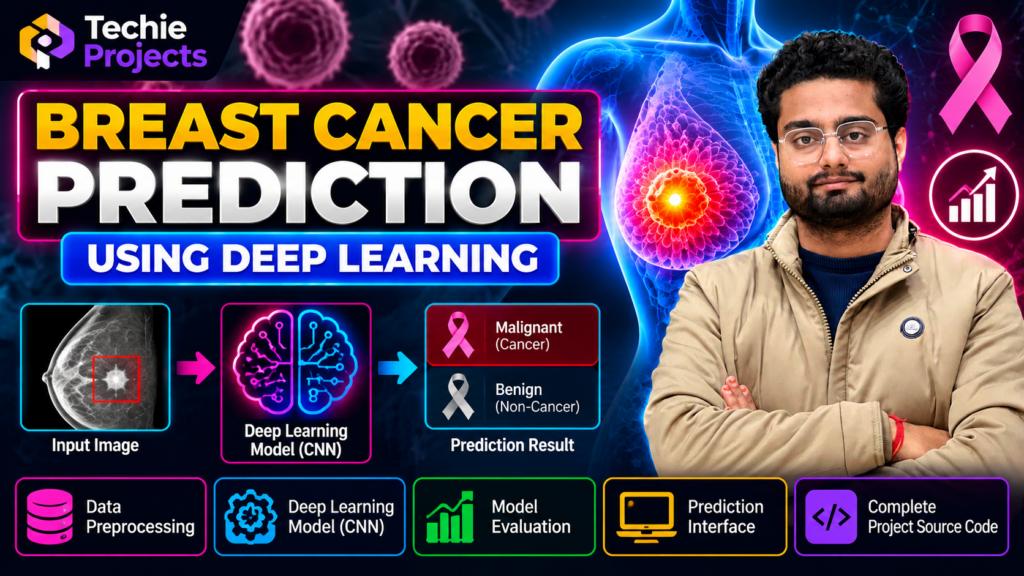
The project demonstrates a typical deep learning workflow, including data preparation, preprocessing, model development, prediction, and result visualization. Depending on the dataset and implementation, students can explore how a trained model produces predictions from input data.
If you are looking for a Breast Cancer Prediction Using Deep Learning project with source code, Techie Projects can help you explore project availability, implementation details, and customization options for your academic requirements.
🎬 Breast Cancer Prediction Using Deep Learning – Project Demo Video
Watch the project demonstration to understand its interface, workflow, and prediction process. The demo can help you explore how the application works before deciding whether it suits your final-year project requirements.
What Is Breast Cancer Prediction Using Deep Learning?
Breast cancer prediction using deep learning is a machine learning application that uses a trained model to analyze input data and generate a prediction. Depending on the implementation, the project may use structured medical datasets, extracted features, or medical images.
Deep learning models can learn patterns from training data. In an academic project, students can investigate data preprocessing, model architecture, training performance, evaluation metrics, and prediction outputs.
Important: This project is intended for educational and research purposes. It is not a clinically validated diagnostic system and must not be used to diagnose cancer or replace advice from qualified healthcare professionals.
Deep Learning Workflow
The breast cancer prediction using deep learning workflow includes dataset preparation, preprocessing, model training, and evaluation. Students can use this process to understand how deep learning models analyze data and generate predictions.
Project Implementation
This breast cancer prediction using deep learning project demonstrates how Python libraries can support model development, prediction, and result visualization in an educational environment.
Final-Year Project Benefits
Choosing a breast cancer prediction using deep learning project gives students an opportunity to explore neural networks, data analysis, and responsible AI practices for academic research.
🎯 Project Objectives
The main objectives of this project include:
- Understand the fundamentals of deep learning and machine learning.
- Explore a dataset relevant to breast cancer research.
- Prepare and preprocess input data for model training.
- Develop or use a suitable trained deep learning model.
- Generate prediction results from supported inputs.
- Evaluate model performance using appropriate metrics.
- Build an interface to demonstrate the project’s workflow.
- Learn how AI concepts can be explored in healthcare research.
Key Features of the Project
The features available depend on the supplied implementation and dataset.
1. Dataset Processing
Prepare the dataset for training and testing. This may include handling missing values, encoding categorical features, normalizing numerical data, or resizing images when image-based data is used.
2. Deep Learning Model
Develop or integrate an appropriate model for the selected dataset. A neural network or convolutional neural network (CNN) may be suitable depending on whether the project uses structured data or images.
3. Prediction Interface
Provide a user interface where users can enter supported inputs or upload permitted sample data and view the model’s output.
4. Result Visualization
Display prediction outputs and, where implemented, evaluation metrics or charts that help users understand the model’s behavior.
5. Model Evaluation
Evaluate the model with suitable metrics such as accuracy, precision, recall, F1-score, and a confusion matrix. These metrics should be calculated from appropriate test data rather than assumed in advance.
6. Academic Demonstration
Use the project to demonstrate dataset preparation, model training, testing, prediction, and the basic concepts behind a deep learning application.
Technologies Used
The exact technology stack depends on the version of the project. A typical implementation may use:
- Programming language: Python
- Deep learning: TensorFlow/Keras or PyTorch
- Data processing: Pandas and NumPy
- Machine learning utilities: Scikit-learn
- Image processing: OpenCV or Pillow, if image inputs are used
- Visualization: Matplotlib or Seaborn
- User interface: Streamlit, Flask, Tkinter, or another supported framework
Confirm the actual libraries used in the supplied project before including them in your project report.
How the Project Works
A typical breast cancer prediction using deep learning workflow follows these steps:
- Data collection: Obtain an appropriate dataset for the selected project approach.
- Data preprocessing: Clean and prepare the dataset or images.
- Data splitting: Separate data into training, validation, and testing sets where appropriate.
- Model development: Build or configure a suitable deep learning model.
- Model training: Train the model using the training data.
- Model evaluation: Evaluate predictions on separate test data using relevant metrics.
- Prediction: Pass supported input data to the trained model.
- Result display: Present the output through the application’s interface.
This workflow provides students with a practical introduction to the development and evaluation of deep learning applications.
Software and Hardware Requirements
Software Requirements
- Python environment
- Required Python libraries for the supplied implementation
- Code editor such as Visual Studio Code or PyCharm
- Jupyter Notebook, if used for experimentation
- Dataset compatible with the selected model
Hardware Requirements
- Computer or laptop
- Recommended 8 GB RAM or more for comfortable development
- Sufficient storage for datasets, dependencies, and model files
- GPU acceleration if required by the chosen model and dataset
The exact requirements depend on dataset size, model complexity, and implementation.
Advantages of the Project
- Provides practical exposure to deep learning concepts.
- Helps students understand data preparation and model evaluation.
- Combines Python programming with an applied research topic.
- Can support academic demonstrations and project presentations.
- Offers opportunities to explore visualization and interface development.
- Can be extended with additional experiments under appropriate supervision.
Applications and Learning Opportunities
An educational breast cancer prediction project can help students study:
- Machine learning workflows for healthcare-related datasets.
- Data preprocessing and feature analysis.
- Neural network development and evaluation.
- Prediction interfaces and result visualization.
- Model limitations, dataset bias, and responsible AI practices.
A successful academic demonstration does not establish clinical reliability. Real-world medical use requires rigorous validation, clinical oversight, and compliance with applicable regulations.
Limitations and Future Scope
Model results depend on the dataset’s quality, representativeness, preprocessing, and evaluation methodology. A model trained on one dataset may not generalize to other populations or data sources. High accuracy on a test dataset alone does not prove that a system is suitable for medical use.
Possible academic extensions include:
- Comparing different machine learning and deep learning models.
- Improving data preprocessing and validation.
- Adding performance charts and a confusion matrix.
- Developing a clearer user interface.
- Documenting limitations, bias, and responsible AI considerations.
- Testing model robustness on suitable, properly authorized datasets.
Why Choose Techie Projects?
If you need a breast cancer prediction using deep learning project for your final year, Techie Projects can help you enquire about project availability and implementation options.
Depending on the selected package, ask about:
- Project source code and setup instructions.
- Software and library requirements.
- Dataset details and model implementation.
- Project demonstration and explanation.
- Report or documentation availability.
- Customization options for your academic requirements.
Before purchasing, confirm exactly what is included in the package and whether it matches your college’s requirements.
Get the Breast Cancer Prediction Project
Looking for a Python deep learning project for your final-year engineering submission? Contact Techie Projects to request the current project details, pricing, and available customization options.
📲 Call/WhatsApp: +91-9460060699
🌎 Website: www.techieprojects.com
📺 Instagram: @pythonprojects_
🎓 Explore Related Projects
Explore these related project topics on Techie Projects:
- Intrusion Detection System Using Machine Learning
- Dental Caries Detection Using Deep Learning
- Sign Language Recognition Using Machine Learning
- Crowd Monitoring Using Computer Vision
- Abnormal Activity Detection Using Deep Learning
- Explore More Deep Learning Projects
Frequently Asked Questions
1. What is breast cancer prediction using deep learning?
It is an educational project that explores how a trained deep learning model can analyze supported data and produce predictions related to a breast cancer dataset.
2. Which programming language is used?
Python is commonly used because it supports data processing, model development, evaluation, and application building.
3. Can this project be used for a final-year engineering submission?
It may be suitable for an academic project, depending on your college’s requirements, the implementation, and the documentation available. Confirm the deliverables before purchasing.
4. Does the project guarantee accurate medical predictions?
No. Performance depends on the data, model, evaluation process, and intended use. An academic prototype should not be treated as a medical diagnostic tool.
5. How can I get the project source code?
Contact Techie Projects through WhatsApp to ask about source code availability, pricing, documentation, and customization.
Conclusion
Breast cancer prediction using deep learning is a useful academic topic for students who want to explore Python, neural networks, data preprocessing, and model evaluation in a healthcare-related context. By studying the complete workflow, students can gain practical experience with machine learning development and responsible AI practices.
If you are interested in purchasing or customizing this project for your academic requirements, contact Techie Projects to discuss the available implementation, deliverables, and pricing. Always use the project for educational purposes unless it has undergone the appropriate validation and authorization for any additional use.