
Introduction
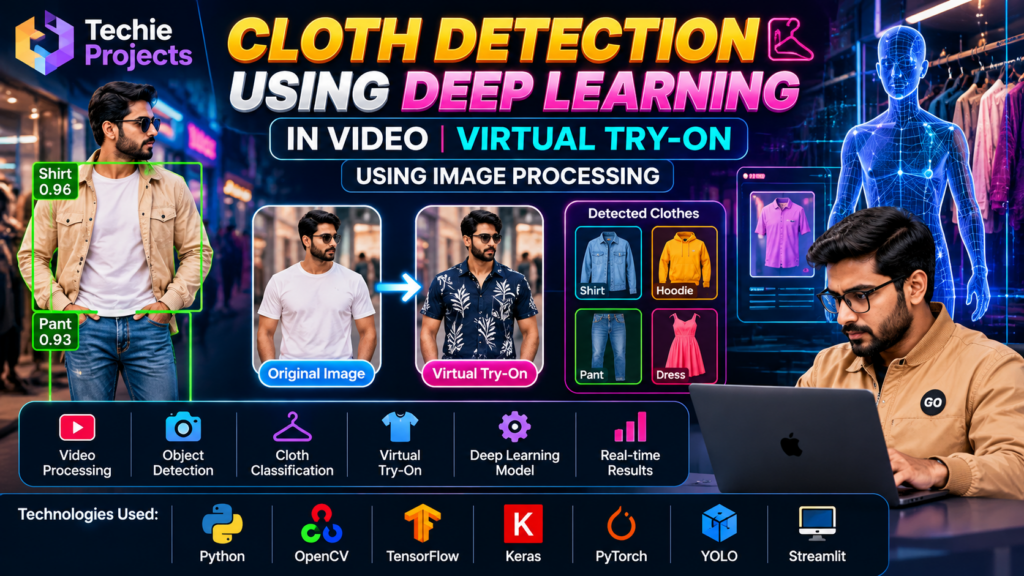
Cloth detection using deep learning is an AI-based project that explores how computer vision and image processing can identify clothing items in images or video and support virtual try-on applications. Developed as a Python project concept, it is suitable for students interested in artificial intelligence, deep learning, image processing, and fashion technology.
The cloth detection using deep learning project demonstrates how visual data can be analyzed to identify clothing categories and how virtual try-on workflows can present alternative clothing appearances. It can be an interesting final-year engineering project for students looking to understand practical computer vision applications.
If you are searching for a ready-made academic project, Python source code, or customization options, Techie Projects can help you discuss the available implementation and project requirements.
🎬 Cloth Detection Using Deep Learning – Project Demo Video
Explore the project demonstration to understand the clothing detection workflow, visual results, and virtual try-on concept. The demo provides an overview of how computer vision techniques can be used in a fashion technology application.
Watch the demonstration and contact Techie Projects to discuss source code availability, installation requirements, and customization options for your academic project.
👕 What Is Cloth Detection Using Deep Learning?
Cloth detection using deep learning is a computer vision application that uses trained AI models to recognize clothing items or locate them within an image or video frame. Depending on the implementation, the system may identify categories such as shirts, trousers, jackets, dresses, or other garments.
A virtual try-on feature can extend this concept by showing how a selected garment might appear on a person in an image. The quality of the result depends on the model, image alignment, segmentation, dataset, and implementation approach.
This project combines several useful concepts:
- 🧠 Deep learning and computer vision
- 🖼️ Image processing and object detection
- 🎥 Video frame analysis
- 👚 Clothing classification
- 💻 Virtual try-on interface concepts
🚀 Key Features of the Project
1. 👔 Clothing Detection
The application can be designed to recognize supported clothing categories in input images or video frames using a trained computer vision model.
2. 🎥 Video-Based Analysis
Video frames can be processed to demonstrate clothing detection over time. Real-time performance depends on the model, hardware, and implementation.
3. 🖼️ Image Processing
Image preprocessing techniques help prepare visual inputs for detection, classification, or segmentation.
4. 👗 Virtual Try-On Concept
A virtual try-on component can demonstrate how clothing images or garment overlays may be presented alongside a person’s image. More advanced implementations may require person segmentation, pose estimation, and garment warping.
5. 📊 Visual Results
The interface can display detected clothing labels, bounding boxes, confidence scores, or processed images when these features are supported by the selected implementation.
6. 🐍 Python-Based Development
Python provides a practical environment for experimenting with computer vision libraries and deep learning frameworks.
7. 🛠️ Customization Possibilities
Depending on the available source code, students can discuss changes to clothing categories, the user interface, supported input formats, or project documentation.
⚙️ How Does the Project Work?
The cloth detection using deep learning workflow can be organized into the following stages.
Step 1: Input Image or Video
The system receives an image or video containing a person or clothing item.
Step 2: Preprocessing
The input is resized, normalized, or otherwise prepared for the selected model.
Step 3: Clothing Detection
A trained object detection or classification model analyzes the visual input and identifies supported clothing categories.
Step 4: Result Visualization
The application displays the model’s output, which may include labels, bounding boxes, confidence scores, or processed images.
Step 5: Virtual Try-On
If the selected implementation includes virtual try-on, it processes the person and garment images to create a visual clothing preview.
Step 6: Output and Evaluation
The results can be reviewed using sample images and videos. Detection performance should be evaluated on suitable test data, and virtual try-on quality should be assessed separately.
🧰 Technologies Used
The exact technology stack depends on the implementation. A typical version may use:
- Programming Language: Python
- Computer Vision: OpenCV
- Deep Learning: TensorFlow/Keras or PyTorch
- Object Detection: YOLO or another suitable detection model
- Data Processing: NumPy
- Interface: Streamlit, Flask, or Tkinter, if included
Confirm the actual frameworks, trained model, and interface included in your selected project package before purchasing.
💻 Software and Hardware Requirements
Software Requirements
- Python and the required project dependencies
- Visual Studio Code, PyCharm, or another compatible IDE
- OpenCV and the selected deep learning framework
- Model weights and configuration files, where applicable
- Input images or video samples
Hardware Requirements
- A computer capable of running Python
- Sufficient RAM and storage for the model and input files
- A compatible GPU may improve performance for larger models, but is not mandatory for every implementation
🎓 Project Objectives
The main objectives of this project are to:
- Understand deep learning applications in computer vision.
- Explore clothing detection in images and video.
- Learn image preprocessing and model inference.
- Understand the concepts behind virtual try-on systems.
- Evaluate model outputs using appropriate test samples.
- Develop practical skills for an AI or computer science project demonstration.
🏆 Applications of Cloth Detection and Virtual Try-On
Clothing detection and virtual try-on concepts can be explored in several areas:
- 🛍️ E-commerce: Support visual product discovery and clothing previews.
- 👗 Fashion Technology: Demonstrate AI-assisted clothing analysis.
- 📱 Smart Shopping Applications: Explore interactive clothing selection interfaces.
- 🎓 Academic Research: Study object detection, segmentation, and image processing.
- 💻 Computer Vision Learning: Experiment with image and video analysis workflows.
These are potential applications; the functionality of a particular project depends on its actual implementation.
💼 Purchase Cloth Detection Using Deep Learning Project
Looking for a cloth detection using deep learning project with Python source code for your final-year engineering project?
Techie Projects can help you enquire about the available project package and discuss your academic requirements before purchasing.
🎯 What Can You Ask About?
- Python source code availability
- Installation and execution instructions
- Included features and supported clothing categories
- Documentation and project report availability
- Virtual try-on functionality, if included
- Customization options and additional requirements
- Pricing, delivery, and technical support terms
Please confirm the exact deliverables and support included in the package before placing your order.
📲 Contact Techie Projects
📲 Call/WhatsApp: +91-9460060699
🌎 Website: www.techieprojects.com
📺 Instagram: @pythonprojects_
Send your course details, project requirements, and preferred features through WhatsApp to discuss the next steps.
🔮 Future Scope
The project can be extended in several directions, depending on the existing codebase and available datasets:
- Add more clothing categories to the detection model.
- Explore instance segmentation for more accurate garment boundaries.
- Improve video processing performance.
- Experiment with pose estimation for virtual try-on.
- Develop a responsive web interface.
- Evaluate detection quality across different lighting conditions and clothing styles.
- Compare multiple computer vision models using consistent test data.
❓ Frequently Asked Questions
1. What is cloth detection using deep learning?
It is a computer vision application that uses a trained AI model to recognize or locate clothing items in images or video.
2. Which programming language is used?
Python is commonly used, with libraries such as OpenCV and a deep learning framework like TensorFlow or PyTorch.
3. Is this project suitable for final-year engineering students?
Yes. It can be a suitable academic project for students studying computer science, AI, machine learning, or computer vision, subject to their institution’s project requirements.
4. Does the project include virtual try-on?
Virtual try-on depends on the selected implementation. Contact Techie Projects to confirm whether garment replacement or clothing preview functionality is included.
5. Can I purchase the source code?
Contact Techie Projects to confirm source code availability, pricing, deliverables, and support terms.
6. Can the project be customized?
Customization may be possible depending on the existing implementation and your requirements. Discuss the requested changes before purchasing.
7. Can this project detect every type of clothing?
No. Detection depends on the model’s supported classes, training data, image quality, and testing conditions.
🎓 Explore Related Projects
Students interested in clothing detection, deep learning, and computer vision may also explore these project ideas:
- Human Activity Recognition using Deep Learning
- Object Detection Using YOLO and Python
- Face Recognition System Using Python
- Real-Time Object Detection Using OpenCV
- Fashion Trend Analysis and Forecasting using AI
Explore more project ideas through the Deep Learning Projects and OpenCV Projects categories.
✅ Conclusion
The cloth detection using deep learning project offers an educational introduction to clothing recognition, image processing, video analysis, and virtual try-on concepts. It can help students explore practical computer vision techniques while building a project for academic demonstration.
If you want to purchase the project or discuss customization, contact Techie Projects to confirm the available features, source code, documentation, pricing, and support.
📲 Ready to discuss your project? Contact Techie Projects on WhatsApp
🌐 Visit TechieProjects.com to explore more engineering projects.