
Introduction
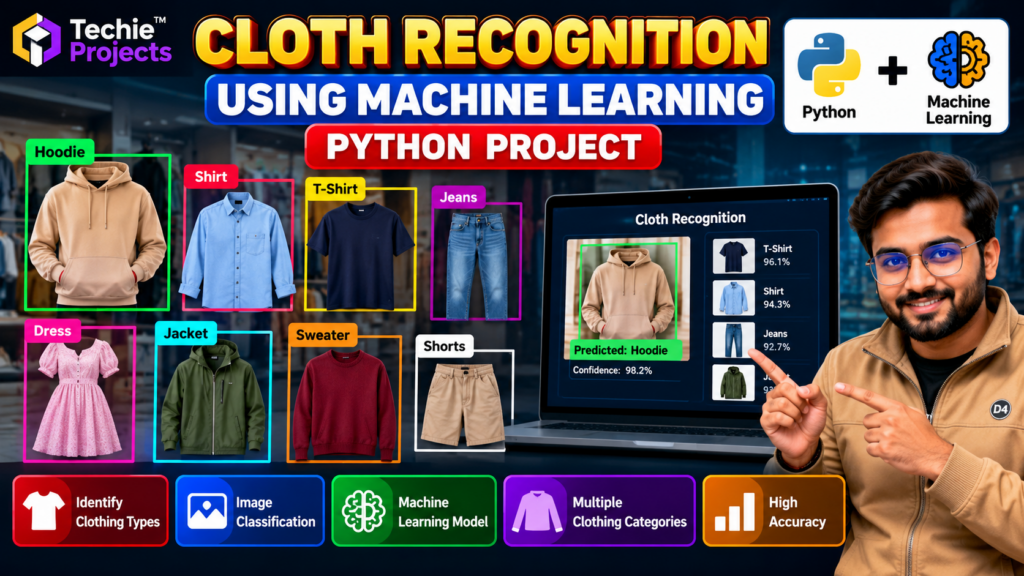
Cloth recognition using machine learning is a computer vision project that explores how clothing items can be identified and classified from images using Python and trained machine learning models. The system can be designed to recognize clothing categories such as shirts, T-shirts, jeans, dresses, jackets, and hoodies, depending on the dataset and model used.
This project is suitable for B.Tech, B.E., BCA, MCA, and computer science students interested in artificial intelligence, deep learning, image classification, and computer vision. It provides an opportunity to understand how machine learning can analyze clothing images and predict their categories.
If you are looking for a practical machine learning project for your mini-project or final-year submission, this topic combines Python programming with real-world image classification concepts.
The cloth recognition using machine learning project demonstrates how a trained model can classify clothing images into predefined categories. By combining image preprocessing with machine learning techniques, students can explore automated garment identification using Python.
🎬 Project Demo
Watch the project demonstration to explore the clothing recognition interface, image classification workflow, and predicted clothing categories.
🎯 Objectives of the Project
The main objectives of this project are:
- Develop a system for recognizing clothing categories from images.
- Understand image preprocessing and classification using Python.
- Explore machine learning and deep learning techniques for computer vision.
- Display predicted clothing labels through a user interface, if supported.
- Evaluate the classification performance of a trained model.
- Explore applications of automated clothing categorization in fashion and retail.
🚀 Key Features of Cloth Recognition Using Machine Learning
1. Clothing Image Classification
The system analyzes an input clothing image and predicts its category based on the classes supported by the trained model.
2. Multiple Clothing Categories
Depending on the dataset and model, the application may classify clothing items such as T-shirts, shirts, trousers, jeans, dresses, jackets, and hoodies.
3. Image Upload and Prediction
An image upload feature can allow users to select a clothing image and view the model’s prediction when this functionality is included in the implementation.
4. Machine Learning Integration
The project demonstrates how a trained classification model can learn patterns from labeled clothing images and use them to predict categories for new inputs.
5. Prediction Results
The application can display the predicted clothing category and, if supported, a model confidence score.
6. Scope for Further Development
The system can be extended with additional clothing categories, improved datasets, a web interface, or a product categorization workflow.
⚙️ How Does the Project Work?
The general workflow of a cloth recognition application involves the following stages.
Step 1: Collect the Dataset
A labeled clothing image dataset is selected. Each image should have an appropriate category label for supervised model training.
Step 2: Preprocess the Images
Images are resized to the required dimensions and converted into a consistent format. Normalization or data augmentation may also be applied.
Step 3: Train the Machine Learning Model
A suitable classification algorithm or convolutional neural network (CNN) is trained on the prepared images. The selected model depends on the dataset and project requirements.
Step 4: Test the Model
The trained model is evaluated using separate test images to measure how accurately it predicts clothing categories.
Step 5: Upload a New Image
If the application supports image uploads, the user selects an image for classification.
Step 6: Display the Prediction
The application processes the image and displays the predicted clothing category. The result depends on the quality of the dataset, the trained model, and the input image.
🛠️ Technologies Used
The following technologies may be used, depending on the implementation:
- Python: Main programming language.
- TensorFlow or PyTorch: Model training and deep learning, if included.
- OpenCV: Image processing, if required.
- NumPy: Numerical operations.
- Pandas: Dataset management, where applicable.
- Matplotlib: Visualization of training results.
- Streamlit, Flask, or Tkinter: User interface, depending on the project version.
Confirm the actual libraries used in your project before installation.
💻 Software Requirements
Typical software requirements include:
- Python 3.x compatible with the selected libraries
- Visual Studio Code, PyCharm, or Jupyter Notebook
- Required machine learning and image processing packages
- A compatible operating system
- A labeled clothing image dataset
- Sufficient storage for the dataset and trained model
🖥️ Hardware Requirements
- Desktop computer or laptop
- At least 4 GB RAM for a basic development environment; 8 GB or more may be preferable for larger datasets
- Adequate disk space for images and model files
- GPU support if required for faster model training
Actual hardware requirements depend on the model architecture and dataset size.
📊 Applications of Cloth Recognition
Fashion and E-Commerce
Clothing classification can help organize product images into categories for online shopping platforms.
Digital Wardrobe Applications
A clothing recognition model could be used as part of a system that categorizes garments in a user’s digital wardrobe.
Retail Product Management
Automated classification may assist with organizing large collections of clothing images.
Fashion Image Analysis
Researchers can use clothing classification to explore visual patterns and categories in fashion datasets.
Academic Research
The project provides a foundation for studying image classification, neural networks, dataset preparation, and model evaluation.
✅ Advantages of the Project
- Demonstrates practical machine learning concepts.
- Provides experience with image preprocessing and classification.
- Can be developed using Python and suitable open-source libraries.
- Offers opportunities to experiment with different classification models.
- Can be extended with a graphical or web-based interface.
- Provides measurable results for academic evaluation and project demonstrations.
⚠️ Limitations
- Similar-looking clothing items may be misclassified.
- Poor lighting, image quality, or unusual camera angles can affect predictions.
- Model performance depends on dataset size, quality, and diversity.
- A model trained on limited categories cannot reliably classify every type of clothing.
- Prediction confidence does not guarantee that a classification is correct.
🔮 Future Scope
The cloth recognition using machine learning system can be extended with additional garment categories, improved training datasets, and transfer learning. These improvements may help evaluate classification performance across different clothing styles and image conditions.
The project can be enhanced in several ways:
- More Clothing Categories: Add more labeled garment types to the dataset.
- Improved Accuracy: Experiment with suitable CNN architectures and transfer learning.
- Real-Time Recognition: Explore camera-based classification where supported.
- Web Application: Create an interface for uploading images and viewing predictions.
- Fashion Recommendation: Combine clothing classification with a separate recommendation system.
- E-Commerce Integration: Explore automated product categorization for fashion catalogs.
- Model Evaluation Dashboard: Display accuracy, precision, recall, and a confusion matrix.
These enhancements may require additional datasets, development, and testing.
🎓 Why Choose This as a Final-Year Project?
Cloth recognition using machine learning is a useful project topic for students who want practical exposure to computer vision and artificial intelligence.
It can help students demonstrate:
- Python programming skills
- Image preprocessing techniques
- Machine learning model training
- Classification and evaluation
- Interface development, if included
- Technical documentation and project presentation
Before selecting the project, confirm that its implementation, complexity, and deliverables match your institution’s requirements.
🛒 Get the Cloth Recognition Project
Are you looking for a cloth recognition using machine learning project in Python for your B.Tech, B.E., BCA, MCA, or final-year submission?
Techie Projects helps students explore engineering project ideas and enquire about available implementations.
Contact us to discuss the cloth recognition project and confirm the features and deliverables available in the selected package.
📲 Call/WhatsApp: +91-9460060699
🌎 Website: www.techieprojects.com
📺 Instagram: @pythonprojects_
You can enquire about:
- Python source code availability
- Project setup and execution instructions
- Required libraries and dependencies
- Documentation and project report availability
- Model training and implementation details
- Demonstration and customization options
📲 Interested in Purchasing This Project?
Enquire About the Cloth Recognition Project on WhatsApp
Share your course, deadline, and project requirements so we can discuss the available options and pricing.
🎓 Recommended Projects
Explore these related project ideas on Techie Projects. Link each title to its corresponding published article.
- Emotion-Based Music Recommendation System Using Python — explore emotion analysis and personalized recommendations.
- AI Virtual Keyboard Using OpenCV — learn about computer vision and gesture-based interaction.
- Real-Time Object Measurement Using Python OpenCV — explore image processing and object analysis.
- Sign Language Recognition Using Machine Learning — investigate visual classification and recognition.
- Garbage Detection Using Python — explore object detection for waste identification.
- Skin Cancer Detection Using Machine Learning — learn about image classification in medical research.
Visit Techie Projects to explore more Python, machine learning, deep learning, and computer vision projects.
❓ Frequently Asked Questions
1. What is cloth recognition using machine learning?
It is an image classification application that uses a trained model to predict clothing categories from images.
2. Which programming language is used?
Python is commonly used because it supports machine learning, deep learning, and image processing libraries.
3. Can this project recognize different clothing types?
Yes, a trained model can classify the categories represented in its training data. The supported categories depend on the dataset and implementation.
4. Is deep learning necessary for this project?
Not always. Traditional machine learning methods may be suitable for some datasets, while CNNs and transfer learning are commonly explored for image classification tasks.
5. Is this project suitable for final-year engineering students?
It can be suitable for students studying computer science, artificial intelligence, data science, and related disciplines, subject to their institution’s requirements.
6. How can I get the project source code?
Contact Techie Projects to confirm source code availability, documentation, dependencies, features, and pricing for the available package.
Conclusion
Cloth recognition using machine learning demonstrates how Python-based computer vision can classify clothing images into predefined categories. From dataset preparation and model training to prediction and evaluation, the project offers practical exposure to important machine learning concepts.
Students interested in developing this project for an academic submission can contact Techie Projects to discuss the available implementation, project deliverables, and customization options.
Ready to discuss your project?
📲 Contact Techie Projects on WhatsApp