
Introduction
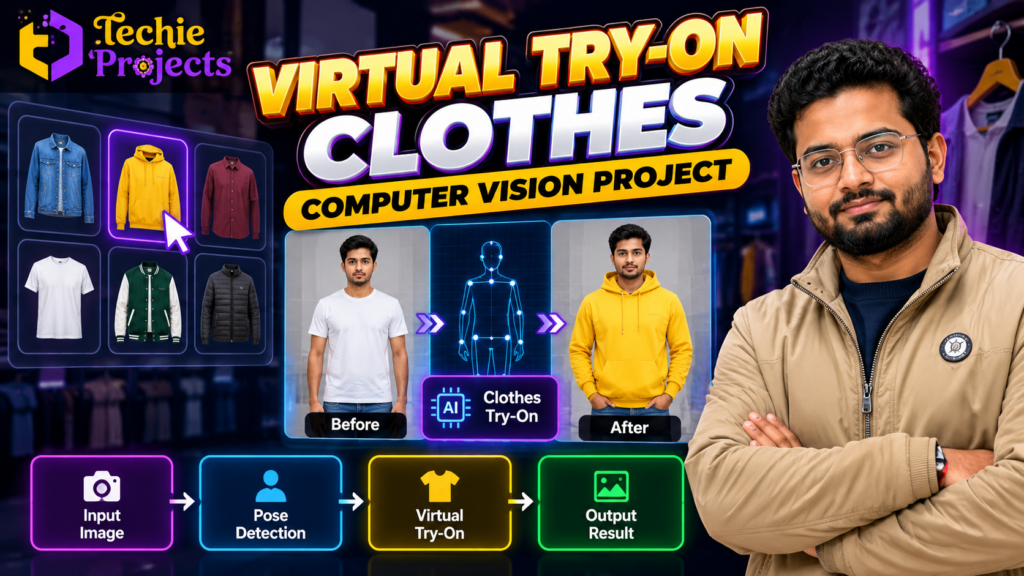
The virtual try-on clothes project using computer vision is an innovative AI-based application that allows users to visualize how clothing may look on them without physically wearing it. This project combines computer vision, image processing, and Python to explore how virtual clothing visualization can improve online shopping experiences. It is an excellent choice for B.Tech, BCA, MCA, and final-year computer science students who want to develop a practical project in artificial intelligence and computer vision.
Online shopping customers often find it difficult to judge how a shirt, jacket, or other garment might look before purchasing it. A virtual try-on system aims to address this challenge by combining a person’s image with digital clothing representations. Students can use this project to understand image processing, human-body analysis, image alignment, and the fundamentals of AI-powered fashion technology.
If you are looking for a virtual try-on clothes project in Python, Techie Projects can help you explore project availability, source code options, implementation details, and customization possibilities for your academic requirements.
🎬 Virtual Try-On Clothes Project – Project Demo Video
Explore the virtual try-on clothes project demo to understand its interface, clothing selection process, and visual output. The demonstration can help students understand how computer vision concepts are applied to fashion visualization and how a Python-based project can be presented during a final-year project review.
Watch the project demonstration on this page to explore its workflow and discuss the available implementation with Techie Projects.
👕 What Is a Virtual Try-On Clothes Project?
A virtual try-on clothes project is a software application that attempts to display selected garments on a person’s image using image-processing techniques and, depending on the implementation, deep learning models. Instead of physically trying on different outfits, users can preview a digital representation of the selected clothing.
A basic implementation may use image resizing, positioning, and blending techniques. A more advanced system may incorporate human segmentation, pose estimation, garment alignment, and generative AI to produce more realistic results.
The main objective of this project is to demonstrate how computer vision can support digital fashion applications. The quality of the output depends on the selected method, input images, model architecture, and available computing resources.
🎯 Objectives of the Virtual Try-On Clothes Project
The major objectives of the virtual try-on clothes project include:
- 👔 To demonstrate virtual clothing visualization using Python.
- 🖼️ To process user images and garment images.
- 🤖 To explore computer vision and AI techniques for fashion applications.
- 📐 To understand image alignment, resizing, and compositing.
- 💻 To develop an interactive application for selecting and previewing clothing.
- 🎓 To provide a practical learning experience for students working on AI and image-processing projects.
- 🚀 To explore possible improvements using pose estimation and deep learning.
⚙️ How Does the Virtual Try-On System Work?
The workflow depends on the implementation, but a typical virtual try-on application follows these steps.
1. Upload or Select a Person’s Image
The user provides an image suitable for clothing visualization. A clear, well-lit image with the relevant body area visible generally makes it easier for the system to process the input.
2. Select a Garment
The user chooses an available garment, such as a shirt, T-shirt, jacket, or other supported clothing item. The garment image should be compatible with the system’s supported input format.
3. Process the Input Images
The application loads the person and clothing images and prepares them for processing. Typical operations may include resizing, background handling, image normalization, and conversion into the format expected by the algorithm.
4. Detect the Person or Body Region
Depending on the implementation, computer vision techniques may identify the person’s body region or estimate body landmarks. Advanced implementations can use pose-estimation or human-segmentation models to improve garment positioning.
5. Align the Clothing Image
The selected clothing is resized, positioned, or transformed to fit the intended body region. Basic systems may use predefined placement rules, while more advanced models can attempt to adapt the garment to the person’s pose.
6. Generate the Virtual Try-On Output
The system combines the processed inputs to produce a preview image. The result can be displayed in the application’s interface so users can compare different garment options.
7. Display the Result
The final output is shown to the user. Depending on the application’s features, the user may be able to select another garment, upload another image, or generate a new preview.
✨ Key Features of the Virtual Try-On Clothes Project
The following features can be included according to the selected project version and its actual implementation.
👚 Clothing Selection
Allow users to choose garments from a predefined collection of supported clothing images.
🖼️ Image Upload
Provide an interface for uploading a person’s photograph and processing it for virtual clothing visualization.
🤖 Computer Vision Integration
Demonstrate image processing and, where supported, body detection, segmentation, or pose-estimation techniques.
🔄 Virtual Clothing Preview
Generate a visual preview by combining the person’s image with the selected garment using the implemented algorithm.
💻 User-Friendly Interface
Use an interface that makes it easy to upload images, select clothing, and view generated results.
📊 Result Comparison
If supported, allow users to compare different generated previews to understand how clothing choices affect the output.
🛠️ Customization Opportunities
The project can potentially be extended with additional garment categories, improved image alignment, new models, or a more polished user interface.
🧰 Technologies Used
The technology stack depends on the version selected for implementation. A typical Python-based virtual try-on project may use the following technologies:
- Python: Main programming language.
- OpenCV: Image loading, resizing, transformation, and processing.
- NumPy: Numerical operations and image-array manipulation.
- Pillow: Image handling and conversion.
- Deep Learning Framework: TensorFlow or PyTorch, if the selected model requires it.
- Computer Vision Models: Pose estimation or segmentation models, if included.
- Streamlit, Flask, or another interface framework: For creating a user-facing application, depending on the implementation.
Not every version requires all these libraries. Confirm the actual requirements before installing packages or purchasing a specific project version.
💻 Software and Hardware Requirements
Software Requirements
- Operating System: Windows or Linux, subject to project compatibility.
- Programming Language: Python.
- IDE: Visual Studio Code, PyCharm, or another compatible Python editor.
- Libraries: The packages specified in the project’s requirements file.
- Additional model files: Required only if the implementation uses pretrained AI models.
Hardware Requirements
- Processor: A modern multi-core processor.
- RAM: 8 GB or more is a practical starting point for many basic implementations.
- Storage: Sufficient free space for the source code, dependencies, input images, and model files.
- GPU: Optional for basic image-processing implementations; a compatible GPU may help with computationally intensive deep learning models.
Actual requirements vary according to the selected model and the size of the input images.
🎓 Why Choose This Project for Your Final Year?
The virtual try-on clothes project offers students an opportunity to explore a real-world application of computer vision and AI. It can be useful for students who want to connect programming concepts with a familiar industry use case.
Academic learning benefits include:
- Understanding practical image-processing workflows.
- Exploring the relationship between AI models and visual applications.
- Learning how to structure a Python project.
- Practising software integration and interface development.
- Preparing a project demonstration and explaining the technical workflow.
- Identifying limitations and proposing future improvements.
Students should understand the implementation and be prepared to explain the algorithms, libraries, results, and limitations during their project evaluation.
🛍️ Get the Virtual Try-On Clothes Project from Techie Projects
Looking for a virtual try-on clothes project in Python for your final-year submission? Techie Projects provides project-related assistance for students who want to explore AI, machine learning, computer vision, and Python-based applications.
You can contact us to discuss the available version and confirm the deliverables before placing an order.
What You Can Ask About
- 📂 Source code availability and supported Python version.
- ⚙️ Installation and execution requirements.
- 📘 Project documentation and explanation materials, where available.
- 🎥 Demo availability and project workflow.
- 🛠️ Customization options for your academic requirements.
- 💬 Technical assistance and setup support, depending on the selected package.
The exact deliverables, price, and support terms should be confirmed with Techie Projects before purchase.
📲 Contact Us to Enquire or Purchase
Interested in getting this project? Contact us to check availability, pricing, and customization options.
- 📲 Call/WhatsApp: +91-9460060699
- 🌎 Website: www.techieprojects.com
- 📺 Instagram: @pythonprojects_
Send a message with your course, project requirements, preferred features, and submission deadline so we can discuss a suitable option.
🌟 Applications of Virtual Try-On Technology
Virtual clothing visualization has potential applications across several areas.
🛒 Online Fashion Shopping
Fashion retailers can explore virtual previews that help shoppers visualize clothing before making a purchase decision.
👗 Fashion and Apparel Design
Designers can use digital visualization to explore garment concepts and communicate design ideas.
🏬 Digital Retail Platforms
Retail platforms may integrate virtual try-on experiences into websites or mobile applications to make product browsing more interactive.
🎓 Academic Research
Students and researchers can investigate image segmentation, pose estimation, garment alignment, and image-generation techniques.
📱 Fashion Applications
Developers can explore ways to incorporate virtual clothing previews into mobile applications and interactive shopping tools.
These are potential applications; a student prototype does not automatically provide the realism, reliability, or commercial capabilities of a production-ready virtual try-on platform.
⚠️ Limitations of the Project
Understanding limitations is an important part of a strong academic project.
- Output quality depends on the input images and selected algorithm.
- Simple image-overlay methods may not reproduce realistic folds, shadows, or body shape.
- Garment alignment may be inaccurate when the person’s pose differs significantly from the expected input.
- Advanced deep learning approaches may require substantial computing resources and suitable model weights.
- Different garment types may require different processing strategies.
- A generated preview may not accurately represent the real garment’s size, fit, texture, or appearance.
Students should explain these limitations honestly in their project reports and demonstrations.
🚀 Future Scope
The virtual try-on clothes project can be extended in several ways:
- Advanced pose estimation: Improve garment placement using body landmarks.
- Human segmentation: Separate the person from the background for improved processing.
- Deep learning-based synthesis: Explore models designed to generate more realistic clothing previews.
- Expanded garment library: Support more clothing categories and styles.
- Interactive web interface: Develop a browser-based experience for uploading images and selecting garments.
- Mobile integration: Explore a mobile interface for easier access.
- Privacy improvements: Process images securely and explain how uploaded photographs are stored or deleted.
These enhancements can help students develop a more advanced version, depending on their skills, project scope, and available resources.
❓ Frequently Asked Questions
1. What is a virtual try-on clothes project?
It is a software application that uses image processing and potentially AI models to generate a visual preview of clothing on a person’s image.
2. Which programming language is used?
Python is commonly used for educational implementations because it supports image-processing libraries and deep learning frameworks.
3. Is this project suitable for B.Tech students?
Yes. It can be suitable for computer science and related engineering students interested in AI, computer vision, and image processing, provided the scope meets their institution’s requirements.
4. Does the project require a GPU?
Not always. Basic image manipulation may run on a CPU, while more computationally intensive deep learning models may benefit from a compatible GPU.
5. Can the project be customized?
Potentially, yes. Possible customizations include additional garments, interface improvements, or alternative computer vision models. Confirm the available customization options before ordering.
6. Can I purchase the source code?
Contact Techie Projects to confirm the current source code availability, price, documentation, and support terms for this project.
7. Does the output guarantee an accurate clothing fit?
No. A virtual preview is an approximation and may not accurately represent real-world garment sizing, fabric behavior, or fit.
🎓 Explore Related Projects
Explore these related project topics on Techie Projects:
- Virtual Dressing Room Using Computer Vision
- Yoga Pose Detection and Correction using Python
- Cloth Recognition Using Machine Learning
- Image Processing Projects Using OpenCV
- Deep Learning Projects Using Python
- AI-Based Fashion Recommendation System
Visit the Techie Projects website to explore available project categories and enquire about related implementations.
✅ Conclusion
The virtual try-on clothes project using computer vision is a practical educational project that introduces students to image processing, Python development, and AI-based fashion visualization. It provides opportunities to learn about image alignment, body-region analysis, visual output generation, and potential real-world applications.
If you are planning a final-year project and want to explore source code, documentation, or customization options, contact Techie Projects to discuss the available package and confirm the deliverables before purchase.
📲 Start your project enquiry today: Chat with Techie Projects on WhatsApp