
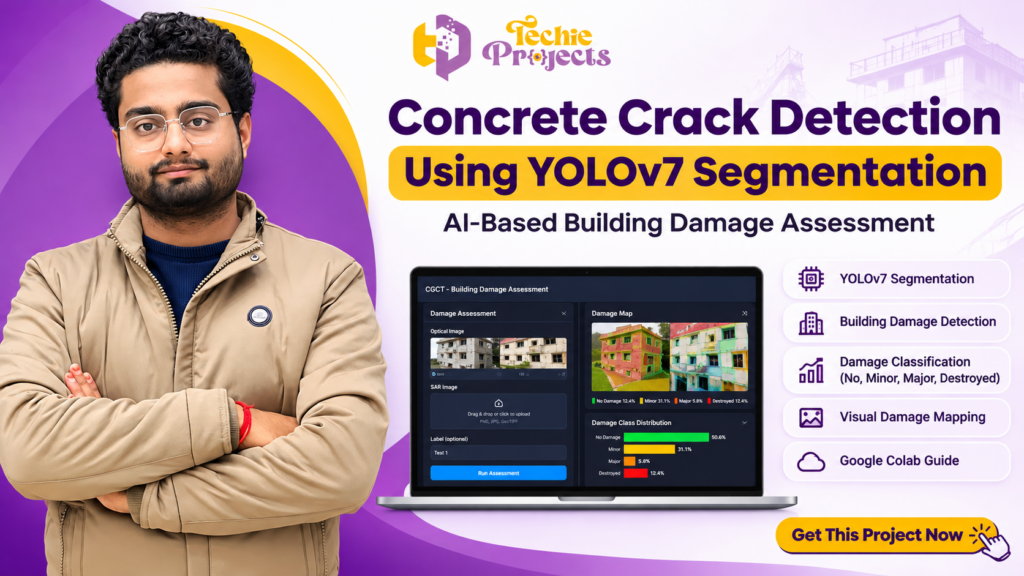
Concrete Crack Detection Using YOLOv7 Segmentation is an advanced AI and Deep Learning project designed to identify and segment damaged regions in concrete structures. It combines YOLOv7 object detection, image segmentation and Computer Vision techniques to analyze structural images and highlight potential cracks. This project is suitable for B.Tech Computer Science students, Artificial Intelligence students and final-year engineering researchers.
🚀 Looking for an advanced AI-based final-year engineering project that combines Deep Learning, Computer Vision, YOLOv7 Segmentation, and real-time building damage assessment? Get your Concrete Crack Detection Using YOLOv7 project from Techie Projects!
Take your final-year project beyond traditional image classification with an intelligent building damage assessment system. This innovative project demonstrates how artificial intelligence and deep learning can help identify visible structural damage, analyze damaged building regions, generate visual damage maps, and present assessment results through an interactive web application.
Whether you are a B.Tech Computer Science student, M.Tech researcher, AI & ML enthusiast, or engineering student searching for an impressive final-year project, this solution offers an excellent opportunity to explore modern computer vision technology.
The project demonstrates an AI-powered approach to building damage assessment using YOLOv7 segmentation, image processing, and an interactive dashboard.
📞 Contact Techie Projects for Project Enquiries
Want to purchase the Concrete Crack Detection Using YOLOv7 project for your college submission, final-year engineering project, research work, or practical demonstration?
Our team at Techie Projects can help you explore the project, understand its functionality, and enquire about the available project package.
- 📱 WhatsApp: +91-9460060699
- 🌐 Website: www.techieprojects.com
- 📸 Instagram: @pythonprojects_
Get your project today and turn your final-year engineering idea into an impressive AI-based solution!
🎬 Watch the Concrete Crack Detection Project Demo
Explore the working demonstration of the AI-based building damage assessment application.
Watch how the application accepts building images, analyzes damage patterns, generates visual damage overlays, and presents damage classification results through an interactive dashboard.
🏗️ What Is Concrete Crack Detection Using YOLOv7 Segmentation?
Concrete structures are essential components of buildings, bridges, roads, flyovers, and other infrastructure. Over time, these structures may develop visible cracks and other forms of damage due to environmental conditions, aging, material deterioration, structural stress, and other factors.
Traditional building inspection methods generally depend on manual observation and physical inspection. Although these approaches remain important, examining large infrastructure areas can require significant time and human effort.
Artificial Intelligence provides new opportunities to support structural inspection through automated image analysis.
Concrete Crack Detection Using YOLOv7 is an AI-based computer vision project that demonstrates how deep learning can analyze building images and identify damaged regions through segmentation-based visual analysis.
The system uses the YOLOv7 segmentation approach to identify relevant regions and generate visual representations of detected damage.
The application also demonstrates building damage assessment through different damage categories:
- 🟢 No Damage
- 🟡 Minor Damage
- 🟠 Major Damage
- 🔴 Destroyed
The results are displayed through an interactive dashboard containing visual damage maps, classification distributions, and assessment information.
This project is particularly suitable for students interested in Artificial Intelligence, Deep Learning, Computer Vision, Image Segmentation, and smart infrastructure monitoring.
🎯 Main Objectives of the Project
The primary objective of this project is to demonstrate an intelligent image-based building damage assessment solution.
The major objectives include:
- Develop an AI-based building damage assessment application.
- Apply YOLOv7 segmentation techniques for visual damage analysis.
- Analyze uploaded building images.
- Identify and visualize damaged building regions.
- Present damage information using different classification categories.
- Generate visual damage assessment maps.
- Display damage distribution through graphical representations.
- Generate downloadable PDF assessment reports.
- Provide an interactive application for testing and analysis.
- Demonstrate the practical application of deep learning in infrastructure assessment.
⚙️ Technologies Used in Concrete Crack Detection Using YOLOv7
This project combines different technologies related to artificial intelligence, deep learning, computer vision, and web application development.
1. Python 🐍
Python is a popular programming language for artificial intelligence and machine learning applications.
It provides libraries and frameworks for image processing, deep learning, data analysis, and application development.
2. YOLOv7
YOLOv7 is a deep learning-based object detection architecture used in computer vision applications.
It provides the foundation for identifying objects and relevant visual regions within images.
In this project, YOLOv7 segmentation is used to demonstrate visual damage-region analysis.
3. Image Segmentation
Image segmentation is an important computer vision technique that identifies specific regions within an image.
Unlike basic image classification, segmentation provides more detailed visual information about the regions of interest.
In building damage assessment, segmentation-based visualization can help highlight potentially damaged areas.
4. Deep Learning
Deep learning uses neural networks to learn patterns from data.
It is widely used in applications such as object detection, image classification, medical image analysis, face recognition, and automated inspection.
5. Computer Vision
Computer Vision enables computers to process and understand visual information.
This project demonstrates computer vision techniques for analyzing building images and visualizing damage-related information.
6. Google Colab
Google Colab provides a cloud-based Python notebook environment.
It is useful for experimenting with machine learning models, executing Python code, and working with deep learning projects.
The project also includes a Google Colab tutorial demonstration.
7. Web-Based Dashboard
The application provides an interactive dashboard for uploading images and examining assessment results.
Users can view image previews, damage overlays, classification distributions, and assessment reports.
💡 Features of the Concrete Crack Detection Project
The following are the major features demonstrated in the Concrete Crack Detection Using YOLOv7 application.
1. Building Image Upload 📷
The application allows users to upload building images for damage assessment.
An uploaded optical image is displayed in the application before running the assessment process.
This functionality provides an easy interface for testing different building images.
2. YOLOv7-Based Segmentation
The project demonstrates segmentation-based visual analysis using YOLOv7.
The model identifies relevant regions and produces visual representations that help users understand the detected areas.
3. AI-Based Damage Assessment
The application analyzes the uploaded image and displays damage assessment results.
The system demonstrates four damage categories:
- No Damage
- Minor Damage
- Major Damage
- Destroyed
These categories provide a structured way to present the assessment output.
4. Visual Damage Map 🗺️
One of the most interesting features is the visual damage map.
The application generates an overlay that highlights different regions using category-based visual indicators.
This makes the assessment output easier to understand compared with displaying only numerical results.
5. Damage Class Distribution 📊
The dashboard displays the distribution of different damage categories using graphical charts.
The demonstration includes percentages for different classes, allowing users to understand how the assessment results are distributed.
6. Optical Image and SAR Image Support
The application interface provides two image input sections:
- Optical Image
- SAR Image
The SAR image input is optional in the demonstrated interface.
The application also indicates that assessment can run in optical-only mode when SAR imagery is not provided.
7. Assessment Confidence Visualization
The application provides a modality confidence visualization as part of the assessment dashboard.
This helps present confidence-related information associated with the assessment output.
8. PDF Report Generation 📄
The application includes a PDF export option.
Users can generate a downloadable assessment report containing visual damage assessment information.
This feature is useful for presenting results during project demonstrations and academic discussions.
9. Assessment History
The interface includes a History section for accessing assessment-related records.
This makes the application more convenient to demonstrate as a complete assessment platform.
10. Interactive User Interface
The application provides a modern dark-themed dashboard with separate sections for uploading images and viewing results.
Its interface makes the project easier to demonstrate to teachers, evaluators, and students.
🔍 How YOLOv7 Segmentation Works for Concrete Crack Detection
The working process of Concrete Crack Detection Using YOLOv7 can be understood through the following steps.
Step 1: Upload Building Image
The user opens the building damage assessment application and uploads an optical image containing a building or concrete structure.
The uploaded image appears in the image preview section.
Step 2: Provide Optional SAR Image
The application also provides an optional SAR image upload section.
Users can provide SAR imagery where supported by the project configuration.
The interface supports optical-only assessment without an additional SAR image.
Step 3: Run Damage Assessment
After selecting the required image, the user clicks the Run Assessment button.
The application starts analyzing the uploaded image using its configured assessment pipeline.
Step 4: Perform AI-Based Analysis
The system processes the image and generates damage-related visual information.
The segmentation-based approach helps identify relevant regions and produce an interpretable visual representation.
Step 5: Generate Damage Overlay
The application displays the damage assessment map.
Different colors represent different damage categories, helping users understand the distribution of the detected regions.
Step 6: Display Damage Classification
The application presents the distribution of the assessment categories.
The demonstration includes No Damage, Minor Damage, Major Damage, and Destroyed classifications.
Step 7: Export PDF Report
Finally, the user can use the PDF option to generate a downloadable assessment report.
The report can be used for academic demonstrations and project documentation.
📊 Sample Project Output and Results
The application demonstration shows an example of a building damage assessment result.
The displayed classification distribution is:
| Damage Category | Example Percentage |
|---|---|
| No Damage | 50.6% |
| Minor Damage | 31.1% |
| Major Damage | 5.8% |
| Destroyed | 12.4% |
These values represent the example output visible in the project demonstration. They are not guaranteed results for every input image.
The dashboard also displays:
- Original optical image
- Visual damage overlay
- Damage class distribution
- Modality confidence visualization
- PDF assessment report
These outputs make the project suitable for demonstrating the practical application of AI in building damage assessment.
Important: The displayed results are model-generated assessment outputs and should not be treated as certified structural safety evaluations. Actual building safety requires inspection by qualified structural engineers.
🌍 Applications of AI in Structural Damage Assessment
AI-based building damage assessment has several potential applications in infrastructure monitoring and research.
1. Building Inspection
Computer vision techniques can help identify visible damage-related regions in building images.
2. Disaster Management
After natural disasters such as earthquakes, floods, or storms, image-based assessment tools can support preliminary damage analysis.
3. Smart City Development
Smart city infrastructure projects can explore AI-powered image analysis for monitoring buildings and other infrastructure.
4. Infrastructure Monitoring
The technology can be investigated for analyzing visible damage patterns in bridges, roads, concrete structures, and buildings.
5. Engineering Research
Researchers can explore image segmentation, deep learning, and computer vision techniques for structural damage analysis.
6. Academic Demonstrations
Students can use this project to demonstrate how AI and deep learning can be applied to practical infrastructure-related problems.
🎓 Why Choose This Project for Your Final-Year Engineering Project?
Choosing the right final-year project is important for engineering students.
A good project should demonstrate technical knowledge, practical implementation, problem-solving ability, and an understanding of modern technologies.
Concrete Crack Detection Using YOLOv7 offers an opportunity to explore multiple technical areas in a single project.
Important Learning Opportunities
- Understand YOLO-based deep learning approaches.
- Explore image segmentation techniques.
- Learn computer vision applications.
- Understand AI-based damage assessment.
- Work with image processing pipelines.
- Explore interactive web dashboards.
- Analyze graphical assessment outputs.
- Understand report generation functionality.
Suitable for Different Engineering Branches
This project can be explored by students from:
- Computer Science Engineering (CSE)
- Artificial Intelligence and Machine Learning (AI & ML)
- Information Technology (IT)
- Data Science
- Electronics and Communication Engineering (ECE)
- Civil Engineering
Students can explore different aspects of the project according to their academic requirements and technical interests.
🛠️ How to Develop a Concrete Crack Detection Project?
Students interested in understanding the development process can explore the following major stages.
Stage 1: Understand the Problem
First, understand the problem of identifying visible cracks and damage-related patterns in concrete structures.
Study how computer vision can help analyze building images.
Stage 2: Prepare the Dataset
A suitable image dataset is important for training and evaluating a deep learning model.
The dataset should contain relevant images and appropriate annotations according to the selected model and task.
Stage 3: Select the Deep Learning Model
Explore YOLOv7 and its segmentation-based implementation.
Understand the model architecture, dataset requirements, training process, and inference pipeline.
Stage 4: Image Processing
Prepare the images according to the model’s input requirements.
Image preprocessing helps maintain consistency during model execution.
Stage 5: Build the Application
Develop an interactive interface for uploading images, running assessments, and displaying the results.
Stage 6: Generate Visualizations
Implement visual damage overlays, class distribution charts, and assessment result displays.
Stage 7: Testing and Evaluation
Test the application using suitable images and examine the generated outputs.
Evaluate the system using appropriate metrics and validation methods.
Stage 8: Documentation
Prepare project documentation explaining the methodology, technologies, implementation, results, and limitations.
📚 Advantages of Concrete Crack Detection Using YOLOv7
Some important advantages of exploring this project include:
- Demonstrates practical AI and deep learning applications.
- Introduces students to image segmentation.
- Combines computer vision with interactive application development.
- Provides visual damage assessment outputs.
- Demonstrates multiple damage classification categories.
- Includes graphical result visualization.
- Supports academic project demonstrations.
- Introduces students to infrastructure-related AI applications.
- Provides an opportunity to understand PDF report generation.
- Helps students develop knowledge of modern AI technologies.
Looking for a practical AI-based engineering project? Techie Projects offers the Concrete Crack Detection Using YOLOv7 Segmentation project for students who want to explore Deep Learning, image processing and intelligent building damage assessment. Get the project and explore its implementation, working demonstration and technical features.
🚀 Why Purchase Your Final-Year Project from Techie Projects?
Are you spending hours searching for a suitable final-year project but still unable to find a project that matches your requirements?
Techie Projects helps engineering students explore practical software projects in Artificial Intelligence, Machine Learning, Python, Deep Learning, Computer Vision, IoT, and Data Science.
Instead of starting with an unclear project idea, you can enquire about an existing project solution and understand its functionality before making a purchase decision.
What Makes Techie Projects a Useful Choice?
- 🎓 Projects for engineering students.
- 🤖 AI, ML, and Deep Learning project ideas.
- 💻 Python and Computer Vision applications.
- 📊 Data Science and analytics projects.
- 🛠️ Practical project demonstrations.
- 📞 Direct project enquiry through WhatsApp.
- 🌐 Multiple project categories available.
If you are interested in the Concrete Crack Detection Using YOLOv7 project, contact our team to confirm the available source code, project files, documentation, installation requirements, and support options.
Don’t wait until your final submission deadline! Explore the project and discuss your requirements with Techie Projects today.
💰 Get Concrete Crack Detection Using YOLOv7 Segmentation Project Now!
Want to develop an advanced AI-based engineering project?
Get the Concrete Crack Detection Using YOLOv7 Segmentation project from Techie Projects and explore how Deep Learning and Computer Vision can help identify structural damage.
🎓 Suitable for:
- B.Tech Computer Science students
- Final-year engineering students
- AI and Machine Learning learners
- Deep Learning project demonstrations
The Concrete Crack Detection Using YOLOv7 project is an interesting option for students who want to explore computer vision, image segmentation, deep learning, and building damage assessment.
Whether you need the project for academic learning, practical implementation, or a final-year demonstration, Techie Projects can help you enquire about the available package.
Purchase Enquiry:
📱 WhatsApp: +91-9460060699
🌐 Visit: www.techieprojects.com
📸 Instagram: @pythonprojects_
Send us your project requirements and ask about the available package and delivery details.
💡 Recommended Projects
Explore more AI, Machine Learning, and Computer Vision projects from Techie Projects:
- Pothole Detection System – Identify road potholes using computer vision.
- Vehicle Detection and Counting – Detect and count vehicles in video streams.
- AI-Based Fire Detection System – Explore automated fire detection using image analysis.
- DeepFake Detection Using Deep Learning – Analyze manipulated images and videos.
- Real-Time Object Detection with Voice Output – Combine object detection with audio feedback.
Visit www.techieprojects.com to explore more engineering projects and discover ideas for your next academic submission.
❓ Frequently Asked Questions (FAQs)
1. What is Concrete Crack Detection Using YOLOv7?
It is an AI-based computer vision project that demonstrates segmentation-based visual analysis of building images and damage assessment using different classification categories.
2. Which technologies are used in this project?
The project focuses on Python, YOLOv7, deep learning, computer vision, image segmentation, and a web-based assessment dashboard.
3. What are the damage categories?
The demonstrated application displays four categories: No Damage, Minor Damage, Major Damage, and Destroyed.
4. Can the project generate a damage assessment report?
Yes. The demonstrated interface includes a PDF export option for generating an assessment report.
5. Is SAR image upload compulsory?
No. The application interface identifies SAR image upload as optional and indicates that optical-only assessment is supported.
6. Is this project suitable for final-year students?
Yes. It is relevant to students interested in Computer Science, Artificial Intelligence, Machine Learning, Data Science, and Computer Vision.
7. Can I learn YOLOv7 through this project?
The project provides an opportunity to explore YOLOv7-based segmentation and its application in visual damage assessment.
8. Where can I purchase this project?
You can contact Techie Projects through WhatsApp at +91-9460060699 or visit www.techieprojects.com for purchase enquiries.
9. Does the project guarantee accurate structural safety assessment?
No. It demonstrates AI-based visual damage analysis. It is not a replacement for professional structural inspection or engineering certification.
🏁 Conclusion
Artificial Intelligence is creating new opportunities in infrastructure monitoring, building inspection, and automated image analysis.
Concrete Crack Detection Using YOLOv7 demonstrates how deep learning and image segmentation can be applied to building damage assessment through visual damage maps, classification distributions, and an interactive web application.
For engineering students, this project offers an excellent opportunity to explore modern technologies such as YOLOv7, Python, Deep Learning, Computer Vision, and Image Segmentation.
If you are searching for an advanced AI-based final-year engineering project, get in touch with Techie Projects.
🚀 Get your Concrete Crack Detection Using YOLOv7 project today!
📱 WhatsApp: +91-9460060699

