
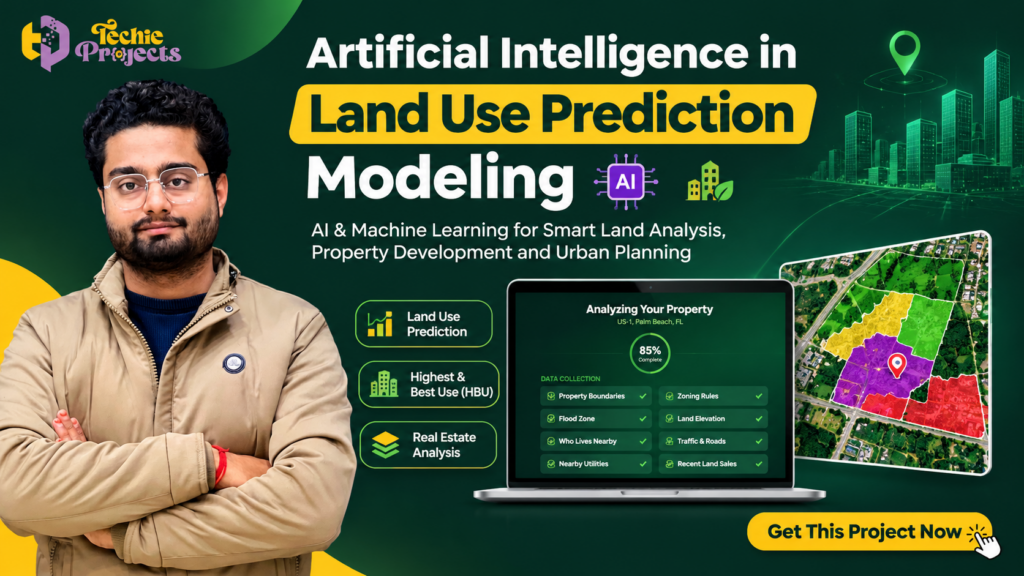
🚀 Looking for an advanced Artificial Intelligence and Machine Learning project for your final-year engineering submission? Get this Artificial Intelligence in Land Use Prediction Modeling project from Techie Projects and explore how AI can transform traditional land analysis into a smarter, data-driven process.
Artificial Intelligence in Land Use Prediction Modeling is transforming how researchers and developers analyze land characteristics, identify development opportunities, and predict future land utilization. By combining machine learning, geospatial data, and intelligent analytics, this technology supports smarter property planning and urban development.
This innovative project demonstrates how Artificial Intelligence, Machine Learning, geospatial data analysis, and AI-powered vision can support land-use prediction, property assessment, development planning, and real estate decision-making.
Whether you are a B.Tech Computer Science student, M.Tech researcher, MCA student, AI enthusiast, or engineering project developer, this project offers an excellent opportunity to understand the practical applications of AI in the real estate and urban planning industries.
🎓 Get the complete project from Techie Projects and turn your final-year project idea into an impressive AI-powered solution!
📞 Contact Techie Projects for Project Enquiries
Want to purchase the Artificial Intelligence in Land Use Prediction Modeling project? Contact our team to discuss project availability, implementation details, demonstration, and project requirements.
- 📱 WhatsApp: +91-9460060699
- 🌐 Website: www.techieprojects.com
- 📸 Instagram: @pythonprojects_
Get your project today and explore the practical implementation of Artificial Intelligence in real-world land analysis.
🎬 Watch the Artificial Intelligence in Land Use Prediction Modeling Project Demo
Explore the working demonstration of an AI-powered real estate and land analysis application.
Watch the project demonstration: AI for Real Estate – Land Use Prediction & Highest Best Use Analysis
The demonstration introduces an interactive application that collects property-related information, analyzes multiple data sources, and generates insights to support land development decisions.
🏡 What Is Artificial Intelligence in Land Use Prediction Modeling?
Artificial Intelligence in Land Use Prediction Modeling refers to the application of AI and machine learning technologies to analyze geographical information, property characteristics, environmental conditions, and surrounding infrastructure to support land-use planning.
Traditional land analysis often requires collecting information from different sources and manually evaluating multiple property-related factors. This process can be time-consuming and challenging, especially when several development possibilities need to be compared.
AI-based land-use prediction systems aim to simplify this process by combining data collection, intelligent analysis, and automated reporting.
The proposed project provides an interactive platform where users can enter a land or property address, select a potential development category, specify an approximate budget, and provide additional supporting documents or site photographs.
The application then gathers available property-related information and processes it to generate a structured property analysis report.
This approach demonstrates how AI can support smarter decisions in real estate, land development, and urban planning.
🎯 Main Objectives of the Artificial Intelligence in Land Use Prediction Modeling Project
The primary objective of this project is to demonstrate how artificial intelligence can be applied to land analysis and property development planning.
The major objectives include:
- Develop an AI-powered land analysis application.
- Analyze property-related geographical information.
- Support land-use prediction and classification.
- Evaluate zoning and environmental factors.
- Analyze surrounding infrastructure and nearby facilities.
- Study potential development opportunities.
- Explore highest and best use (HBU) analysis.
- Generate structured property assessment reports.
- Demonstrate the practical application of AI in real estate analytics.
The project combines multiple data sources and intelligent analysis techniques to provide a practical demonstration of modern AI-based property assessment.
⚙️ How Does the AI Land Use Prediction System Work?
The system follows a structured workflow to analyze the submitted property information.
1. Property Address Input
The process begins when the user enters a property address into the application.
The address acts as the starting point for collecting relevant geographical and property-related information.
The application is designed to demonstrate location-based property analysis.
2. Development Category Selection
Users can select the type of development they are considering.
The available categories displayed in the application include:
- Retail
- Residential
- Industrial
- Self-Storage
- Mixed-Use
- Not Sure
This information helps organize the property assessment according to the user’s development interests.
3. Budget Selection
The application also allows users to select an approximate development budget.
The available budget categories include:
- Under $500K
- $500K–$1M
- $1M–$5M
- $5M+
- Not Sure
Budget information provides additional context for evaluating development scenarios.
4. Upload Site Photographs and Documents
Users can optionally upload property photographs and supporting documents.
The application includes options for uploading:
- Site photographs
- Property-related documents
- PDF files
- DOCX documents
These inputs can support the analysis by providing additional information about the property.
5. Data Collection and AI Analysis
After submitting the information, the application begins its analysis workflow.
It collects available property-related information from multiple sources and processes the collected data to prepare a structured report.
6. Report Generation
The final stage focuses on generating a property analysis report containing relevant findings and development considerations.
This makes the project an interesting example of how AI can assist with complex real estate analysis workflows.
🌍 Key Features of Artificial Intelligence in Land Use Prediction Modeling
This Artificial Intelligence in Land Use Prediction Modeling project demonstrates how AI-powered analysis can evaluate property information, land classification, zoning conditions, and environmental factors. It provides an interactive approach to understanding data-driven land-use decisions.
The application demonstrates several important features related to AI-powered property analysis.
1. Property Boundary Analysis
Property boundaries help identify the geographical extent of a particular land parcel.
Understanding property boundaries is important for land development, site planning, and geographical analysis.
The application includes property boundary information as one of its data collection categories.
2. Zoning Rules Analysis
Zoning regulations determine how land can be used within a particular geographical area.
Different locations may have different restrictions for residential, commercial, industrial, and mixed-use development.
The project includes zoning information as an important consideration during property analysis.
3. Flood Zone Analysis
Environmental conditions play an important role in determining the suitability of land for development.
Flood-zone information can help identify potential flood-related risks associated with a property.
This feature demonstrates how environmental information can contribute to better land-use planning.
4. Land Elevation Analysis
Land elevation provides geographical information about the height and physical characteristics of a particular location.
Elevation information can be useful when studying drainage, terrain, construction planning, and site suitability.
5. Nearby Population Analysis
Understanding the surrounding population can provide useful insights into potential development opportunities.
For example, residential and retail developments may require different types of demographic and demand analysis.
The application includes a category called Who Lives Nearby to demonstrate the importance of surrounding population information.
6. Traffic and Road Connectivity
Road connectivity and traffic conditions are important considerations in property development.
A property with suitable road access may offer different development opportunities compared with a location that has limited connectivity.
The application includes traffic and road information as part of its property analysis workflow.
7. Nearby Utilities Analysis
Utilities such as electricity, water, and other essential infrastructure can influence the feasibility of property development.
The project includes nearby utilities as one of the information categories considered during data collection.
8. Recent Land Sales Analysis
Nearby property sales can provide useful market context when studying land values and development opportunities.
The application includes recent land sales information to demonstrate how market-related data can contribute to property assessment.
9. AI Vision for Site Photographs
The application also demonstrates an AI Vision component for analyzing uploaded site photographs.
Visual information can provide additional context about the physical condition and surroundings of a property.
Combining visual information with geographical and property-related data creates an interesting practical application of AI.
🧠 Technologies Used in the Artificial Intelligence in Land Use Prediction Modeling Project
Artificial Intelligence in Land Use Prediction Modeling demonstrates the integration of modern technologies used in intelligent applications.
Using machine learning algorithms and geospatial analysis, Artificial Intelligence in Land Use Prediction Modeling can help identify land-use patterns and support predictive decision-making.
The project can be understood through the following technology areas:
Artificial Intelligence (AI)
Artificial Intelligence enables applications to process information, identify patterns, and generate intelligent outputs.
In this project, AI is used to demonstrate automated property analysis and report generation.
Machine Learning (ML)
Machine Learning focuses on developing systems that can learn patterns from data and support predictions or classifications.
ML concepts are relevant to land-use classification, property analysis, and development scenario evaluation.
Geospatial Data Analysis
Geospatial analysis involves working with geographical information associated with specific locations.
It is particularly useful for understanding property boundaries, land characteristics, infrastructure, and surrounding geographical conditions.
AI Vision
AI Vision enables systems to interpret visual information from images.
In this project, uploaded site photographs are included as an additional input for property analysis.
Data Analysis and Reporting
Data analysis helps organize information collected from different sources.
The application demonstrates how collected information can be presented in a structured report for easier interpretation.
Note: The exact implementation libraries, APIs, models, and database configuration depend on the delivered project version.
📊 Applications of AI-Based Land Use Prediction
The applications of Artificial Intelligence in Land Use Prediction Modeling include smart city planning, agricultural land classification, real estate development, environmental monitoring, and infrastructure planning.
Artificial Intelligence in Land Use Prediction Modeling has several potential applications across different industries.
1. Smart City Development
Urban planners can use geographical and infrastructure information to study potential development areas and support better city planning.
2. Real Estate Analysis
Real estate professionals can use property-related information to understand locations, surrounding facilities, and development possibilities.
3. Residential Development
Residential developers can evaluate factors such as road connectivity, nearby population, zoning information, and environmental conditions.
4. Commercial Property Planning
Commercial development often requires studying customer accessibility, nearby infrastructure, population, and market conditions.
5. Industrial Land Assessment
Industrial land assessment may involve evaluating connectivity, utilities, zoning requirements, and environmental considerations.
6. Environmental Planning
Geographical and environmental information can help planners understand potential development constraints and land suitability considerations.
7. Academic Research
Students and researchers can explore AI, machine learning, geographical information systems, and data analytics through this project.
🎓 Why Choose This Project for Your Final Year?
Choosing an innovative engineering project is important for demonstrating practical technical knowledge.
This project combines several interesting areas of computer science and emerging technologies.
Here are some reasons to consider it:
- Industry-oriented concept: Explore the practical application of AI in real estate.
- Multiple technology areas: Understand AI, ML, data analysis, and geospatial information.
- Interactive application: Demonstrate a property analysis workflow.
- Research potential: Explore land-use prediction and intelligent decision-support systems.
- Practical learning: Understand how different information sources can be combined.
- Presentation opportunities: Explain a real-world problem through a working application.
The project is suitable for students looking for an innovative topic for B.Tech, M.Tech, MCA, and other computer science-related academic work.
💻 Suggested Modules of the Artificial Intelligence in Land Use Prediction Modeling Project
The application can be explained through the following functional modules:
| Module | Description |
|---|---|
| User Input | Enter property address and development preferences |
| Budget Selection | Select an approximate development budget |
| Property Data Collection | Collect available location-related information |
| Zoning Analysis | Examine relevant zoning information |
| Environmental Analysis | Consider flood zones and elevation |
| Infrastructure Analysis | Study roads and nearby utilities |
| Market Analysis | Consider recent land sales |
| AI Vision | Process uploaded site photographs |
| AI Analysis | Evaluate collected property information |
| Report Generation | Prepare a structured property analysis report |
These modules provide a clear structure for understanding and presenting the application.
🚀 Future Scope of Artificial Intelligence in Land Use Prediction Modeling
AI-powered land analysis has significant opportunities for further research and development.
Some possible future enhancements include:
1. Satellite Image-Based Land Classification
Integrating satellite imagery with deep learning models could support automated classification of land into categories such as residential, agricultural, commercial, and industrial.
2. GIS Integration
Integration with Geographic Information System (GIS) platforms could provide more detailed geographical analysis and interactive mapping capabilities.
3. Advanced Machine Learning Models
Additional machine learning models could be explored for land classification, development suitability analysis, and geographical pattern recognition.
4. Real-Time Data Integration
Connecting additional verified data sources could improve the availability and freshness of property-related information.
5. Interactive Map Visualization
An interactive map could help users understand geographical boundaries, surrounding infrastructure, and different land-use categories.
6. Predictive Urban Planning
Future versions could explore how historical geographical data and development patterns may support urban growth analysis.
7. Automated Feasibility Reports
Further development could introduce more detailed reports covering development scenarios, infrastructure considerations, and property assessment findings.
These enhancements offer excellent opportunities for students interested in AI research and real-world application development.
🛒 Get the Artificial Intelligence in Land Use Prediction Modeling Project from Techie Projects
Are you searching for an innovative final-year engineering project that combines Artificial Intelligence, Machine Learning, and real estate analytics?
Get the Artificial Intelligence in Land Use Prediction Modeling project from Techie Projects!
Instead of spending unnecessary time searching for project ideas and developing everything from scratch, explore our project offering and discuss your requirements with our team.
Our team can help you understand the available project package and its implementation details.
What Can You Discuss Before Purchasing?
- Project functionality and working demonstration.
- Available source code and project files.
- Technology stack and implementation.
- Project setup and execution requirements.
- Documentation and academic requirements.
- Available customization options.
- Project delivery and support details.
Contact us to confirm exactly what is included in the available package before placing your order.
📞 Contact Techie Projects for Project Enquiries
🚀 Want to purchase this project or get a complete project solution? Techie Projects provides project assistance, source code, documentation, implementation guidance, and technical support for engineering students.
📱 WhatsApp / Call: +91-9460060699
🌐 Website: www.techieprojects.com
📸 Instagram: @pythonprojects_
▶️ YouTube: Techie Projects
💡 Recommended Projects
Explore more innovative engineering projects from Techie Projects:
- Vehicle Detection and Counting Using Python
- Helmet and Number Plate Detection Using Deep Learning
- Lane Detection for Self-Driving Cars Using Python
- AI Exam Proctoring System Using Python
- Pothole Detection Using Computer Vision
- Plant Leaf Disease Detection Using Deep Learning
- Smart Surveillance System Using AI
- Intrusion Detection System Using Machine Learning
Discover more ideas through our website: www.techieprojects.com
❓ Frequently Asked Questions (FAQs)
1. What is Artificial Intelligence in Land Use Prediction Modeling?
It is an AI-based approach that uses geographical, environmental, infrastructure, and property-related information to support land-use analysis and development planning.
2. Is this project suitable for final-year engineering students?
Yes. It is a suitable project topic for students pursuing B.Tech, M.Tech, MCA, and related computer science programs, subject to their academic requirements.
3. Which technologies are related to this project?
The project demonstrates concepts related to Artificial Intelligence, Machine Learning, geospatial data analysis, AI Vision, and automated reporting.
4. What are the major features of this application?
Major features include property boundary information, zoning rules, flood-zone analysis, land elevation, nearby population, traffic and roads, utilities, recent land sales, and AI Vision for site photographs.
5. Can this project help in real estate analysis?
Yes. It demonstrates how multiple property-related information sources can be combined to support real estate analysis and development planning.
6. Can the project be customized?
Customization possibilities depend on the available project package and technical requirements. Contact Techie Projects to discuss your needs.
7. How can I purchase this project?
Visit www.techieprojects.com or contact Techie Projects through WhatsApp at +91-9460060699 to enquire about the project package.
🎯 Conclusion
Artificial Intelligence in Land Use Prediction Modeling demonstrates how modern AI technologies can contribute to smarter property assessment, geographical analysis, and land development planning.
By combining property information, zoning rules, environmental data, infrastructure analysis, AI Vision, and automated reporting, this project provides an interesting example of applying Artificial Intelligence to a real-world problem.
For engineering students, it offers an opportunity to explore AI, Machine Learning, geospatial analysis, and intelligent decision-support applications in one project.
🚀 Take the next step toward your final-year engineering project! Explore the Artificial Intelligence in Land Use Prediction Modeling project from Techie Projects and contact our team today.

