
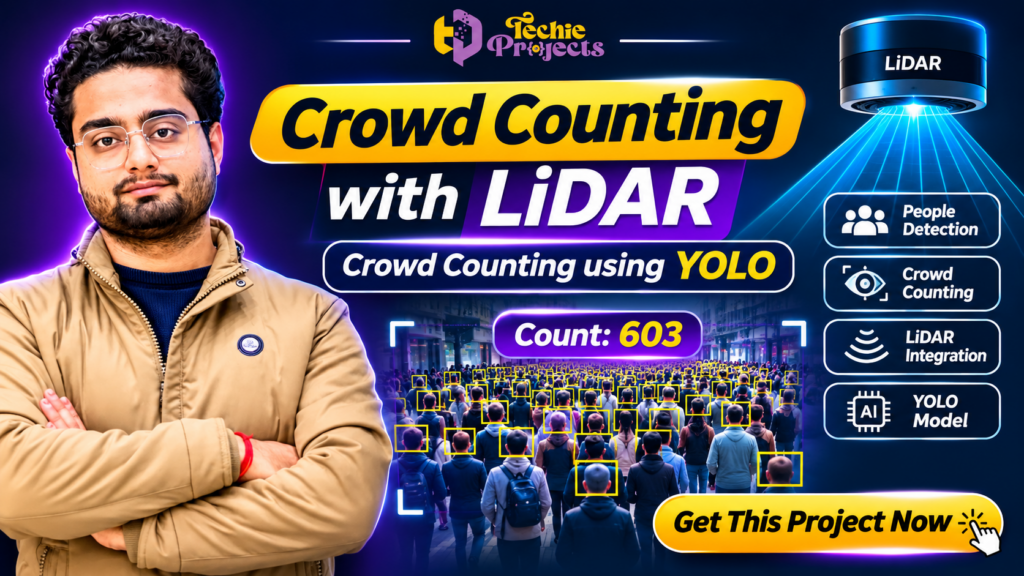
🚀 Looking for an advanced AI and Computer Vision project for your final-year engineering submission? Purchase the Crowd Counting with LiDAR project from Techie Projects and explore intelligent people detection, object tracking, and automated crowd analysis using Python and YOLO.
Instead of spending weeks struggling with model development, dataset preparation, object detection algorithms, and implementation errors, get professional project assistance from Techie Projects. Our Crowd Counting with LiDAR project is designed for students interested in Artificial Intelligence, Machine Learning, Deep Learning, Python programming, and Computer Vision.
🎓 Whether you are pursuing B.Tech, B.E., BCA, MCA, M.Tech, or Computer Science Engineering, this project provides an opportunity to understand how intelligent systems can analyze crowded environments and estimate the number of people using computer vision and sensor-based information.
Get your Crowd Counting with LiDAR project from Techie Projects today! Contact our team for project availability, pricing, implementation details, and source code enquiries.
📞 Contact Techie Projects for Project Enquiries
Interested in purchasing the Crowd Counting with LiDAR Using YOLO Python Project? Contact us to enquire about package availability, pricing, source code, documentation, installation guidance, and technical support options.
💬 WhatsApp Enquiry: Chat with Techie Projects
📱 Contact Number: +91 94600 60699
🌐 Official Website: www.techieprojects.com
📸 Instagram: Follow Techie Projects
🎓 Project Areas: Robotics, Machine Learning, Arduino, Deep Learning, Artificial Intelligence, and Android App.
✅ Request Project Details: Share your engineering branch, preferred features, and technical requirements to enquire about the most suitable available package.
🚀 Ready to get started? Click here to enquire on WhatsApp and mention Crowd Counting with LiDAR Using YOLO Python Project.
Package contents, prices, hardware availability, and support options should be confirmed before purchase.
🎬 Watch the Crowd Counting with LiDAR Project Demo
Watch the project demonstration to understand the crowd detection interface, YOLO-based people detection, and counting functionality.
The demonstration helps students understand how the system processes visual information, identifies people, and displays crowd-counting results.
Project: Crowd Counting with LiDAR Using YOLO and Python.
🎯 What Is Crowd Counting with LiDAR?
Crowd Counting with LiDAR is an intelligent crowd-analysis project that explores the use of computer vision, deep learning, and spatial sensing technologies to identify and count people in crowded environments.
Crowd counting is an important application of Artificial Intelligence because manually estimating the number of people in a large gathering can be difficult, time-consuming, and inaccurate.
Traditional people-counting techniques require manual observation or basic monitoring systems. These methods become challenging when the environment contains hundreds of people, overlapping objects, different viewing angles, or continuous movement.
An AI-powered crowd-counting solution can automate several parts of this process.
The project combines technologies such as Python, YOLO object detection, and LiDAR-based spatial information to explore intelligent crowd monitoring. YOLO helps identify people in images or video frames, while LiDAR can provide distance and depth information when supported by the system’s sensor configuration.
The primary objective of this project is to demonstrate how modern AI technologies can support automated crowd analysis.
🚀 Key Features of Crowd Counting with LiDAR
The project introduces several important features related to intelligent people detection and crowd monitoring.
1. 👥 Automatic People Detection
The system uses an object detection model to identify people in the input image or video.
YOLO detects objects by analyzing image features and predicting bounding boxes around recognized people. This reduces the need for manual counting.
2. 📊 Real-Time Crowd Counting
The Crowd Counting with LiDAR project demonstrates automated counting by identifying detected people and calculating the total number of detections in the processed frame.
The displayed count can help users understand crowd density and monitor changes in the number of visible people.
3. 🎯 Object Detection Using YOLO
YOLO is a popular object detection approach used in modern computer vision applications.
It processes an image and predicts object locations and classes. In this project, it is used to detect people and support automated counting.
4. 📡 LiDAR-Based Spatial Information
LiDAR technology uses laser pulses to measure distances and generate spatial information about surrounding objects.
When integrated with a compatible LiDAR sensor or point-cloud dataset, this information can help analyze the distance and spatial arrangement of objects.
5. 🎥 Video-Based Crowd Analysis
Video input allows the system to analyze a sequence of frames rather than processing only one image.
This provides an opportunity to explore continuous crowd monitoring and automated detection.
6. 💻 Python-Based Implementation
Python provides the programming environment for developing the project.
Libraries such as OpenCV, NumPy, and Ultralytics YOLO can support image processing, numerical operations, and object detection.
7. 📈 Visual Detection Results
The system can display detected people using bounding boxes and counting information.
These visual results make it easier for students to understand the detection process and evaluate the system output.
⚙️ How Does the Crowd Counting System Work?
The project follows a sequence of image processing, object detection, and counting operations.
Step 1: Input Data Collection
The system receives input through an image, video, camera, or supported LiDAR dataset.
The quality of the input data can influence detection performance.
Step 2: Data Preprocessing
The input data is prepared for model processing.
Image preprocessing may include resizing, normalization, and frame extraction. LiDAR point-cloud data requires its own preprocessing pipeline when used.
Step 3: YOLO Model Processing
The YOLO model analyzes the input image and identifies objects belonging to the trained classes.
The system focuses on detecting people within the selected environment.
Step 4: Person Detection
After processing, the model generates bounding boxes and confidence scores for detected people.
The system can filter predictions according to a selected confidence threshold.
Step 5: Crowd Count Calculation
The detected person instances are counted to estimate the number of people visible in the current frame.
For video-based applications, additional tracking can be implemented to maintain identities across frames and reduce repeated counting.
Step 6: Result Visualization
The final output displays detected people, bounding boxes, and crowd-counting information.
When supported by the implementation, LiDAR information can also be used to display spatial measurements.
🧠 Technologies Used in Crowd Counting with LiDAR
This project introduces students to several technologies used in Artificial Intelligence and Computer Vision.
1. Python
Python is the primary programming language. It provides a flexible environment for developing AI applications and integrating different libraries.
2. YOLO (You Only Look Once)
YOLO is an object detection model family that predicts object locations and classes. It is useful for identifying people in images and video frames.
3. OpenCV
OpenCV is used for image processing, video reading, frame handling, and displaying detection results.
4. NumPy
NumPy supports numerical operations and array processing required in computer vision workflows.
5. LiDAR Technology
LiDAR provides distance measurements and spatial information. A compatible sensor or point-cloud dataset is required for actual LiDAR-based processing.
6. Deep Learning
Deep learning models learn visual patterns from training data and support automated object recognition.
7. Tkinter (If Included in the Implementation)
Tkinter can be used to create a graphical user interface for selecting images, videos, or camera inputs and displaying results.
💻 Software Requirements
The following software and libraries may be used depending on the supplied project configuration.
- Programming Language: Python
- Operating System: Windows 10 / Windows 11
- Object Detection: YOLO
- Image Processing: OpenCV
- Numerical Processing: NumPy
- Deep Learning Framework: PyTorch
- Development Environment: VS Code / PyCharm
- GUI: Tkinter (if included)
- LiDAR Processing: Compatible point-cloud processing tools, if applicable
🖥️ Hardware Requirements
Recommended hardware for development and testing includes:
- Processor: Intel Core i5 or equivalent
- RAM: 8 GB or higher
- Storage: 10 GB available space or more
- GPU: NVIDIA GPU recommended for faster model processing
- Camera: Webcam or video input source
- LiDAR Sensor: Required for live LiDAR-based measurements
- Display: Standard monitor
Actual requirements depend on the YOLO model size, input resolution, dataset, and LiDAR hardware configuration.
📊 Applications of Crowd Counting with LiDAR
Crowd monitoring has applications in several industries and public environments.
1. 🏬 Shopping Malls
Shopping malls can use people-counting technologies to estimate visitor traffic and understand busy periods.
2. 🚉 Railway Stations
Crowd monitoring can help analyze passenger movement and identify areas where congestion may develop.
3. 🏟️ Stadiums
Large stadiums and sports venues can use automated crowd-analysis systems to estimate attendance and monitor crowd distribution.
4. 🎓 Educational Institutions
Colleges and universities can explore people-counting systems for campus monitoring and event analysis.
5. ✈️ Airports
Airports contain large numbers of passengers moving through different areas. Automated crowd analysis can support passenger-flow monitoring.
6. 🏢 Commercial Buildings
Office buildings and commercial spaces can use people-counting solutions to understand occupancy patterns.
7. 🚦 Public Safety and Smart Cities
Crowd-analysis technologies can contribute to smart-city research and public-space monitoring when deployed with suitable privacy and safety safeguards.
🎓 Why Is This Project Useful for Engineering Students?
The Crowd Counting with LiDAR project is a useful learning opportunity for students interested in modern AI applications.
It introduces several important concepts:
- Understanding object detection algorithms.
- Learning how YOLO models work.
- Exploring image and video processing.
- Understanding Python-based AI development.
- Learning about LiDAR and spatial sensing.
- Working with real-world computer vision applications.
- Understanding model predictions and detection results.
- Exploring possible applications of intelligent monitoring.
Students can use the project as a starting point for learning, experimentation, and further development.
It can also provide a practical demonstration of how multiple technologies work together in an AI application.
🔥 Why Purchase Your Crowd Counting with LiDAR Project from Techie Projects?
Choosing the right project resource is important for students who want to complete their final-year engineering work successfully.
At Techie Projects, we focus on providing project solutions across multiple technical domains, including Artificial Intelligence, Machine Learning, Python, Data Science, Computer Vision, IoT, and Web Development.
Here are some reasons to contact us:
1. Project Availability and Enquiry Support
Get information about the availability of the Crowd Counting with LiDAR project and the implementation options.
2. Technical Guidance
Understand the technologies, algorithms, libraries, and development requirements associated with the project.
3. Student-Focused Solutions
Our projects are intended for students pursuing undergraduate and postgraduate technical courses.
4. Multiple Technology Domains
Explore other projects in Artificial Intelligence, Machine Learning, Deep Learning, Python, NLP, and Computer Vision.
5. Project Demonstration
Watch available project demonstrations to understand the functionality and expected output before making an enquiry.
6. Assistance with Project Requirements
Contact our team to discuss source code availability, documentation, implementation details, and other deliverables included in the selected project package.
💰 Purchase Crowd Counting with LiDAR Project – Get Started Today!
Are you searching for a Crowd Counting with LiDAR project for your final-year engineering submission?
Don’t waste valuable development time searching through unrelated code examples. Contact Techie Projects to discuss the project package and available implementation support.
Our team can help you understand the available project features and technical requirements before placing your order.
🎯 Who Can Purchase This Project?
- B.Tech Computer Science Engineering Students
- B.E. Computer Engineering Students
- BCA Students
- MCA Students
- M.Tech Students
- Artificial Intelligence Students
- Data Science Students
- Final-Year Engineering Students
- Students working on Computer Vision research projects
📞 Get This Project Now!
Purchase or enquire about the Crowd Counting with LiDAR project from Techie Projects.
📞 Contact / WhatsApp: +91 94600 60699
🌐 Website: www.techieprojects.com
📸 Instagram: @pythonprojects_
Send us a WhatsApp message with the project name: Crowd Counting with LiDAR.
Our team will help you with availability, pricing, project details, and the next steps.
💡 Recommended Projects
If you are interested in AI-based object detection and Computer Vision, explore these related project ideas:
- Vehicle Detection and Counting Using YOLO
- People Detection and Tracking Using Python
- Face Recognition Attendance System
- Helmet Detection Using YOLO
- Number Plate Detection Using Deep Learning
- AI-Based Exam Proctoring System
- Real-Time Object Detection with Voice Output
Explore more engineering projects at www.techieprojects.com.
❓ Frequently Asked Questions (FAQs)
1. What is Crowd Counting with LiDAR?
Crowd Counting with LiDAR is a crowd-analysis project that explores automated people detection and counting using computer vision, YOLO, and LiDAR-based spatial information where supported.
2. Which programming language is used?
Python is used for implementing the computer vision and AI components.
3. What is the role of YOLO in this project?
YOLO detects people in images and video frames by predicting their locations and object classes.
4. What is the role of LiDAR?
LiDAR provides distance and spatial measurements that can complement visual detection when compatible sensor data is integrated.
5. Can this project process videos?
Yes, video-based processing can be supported through the YOLO and OpenCV workflow, depending on the supplied implementation.
6. Is this project suitable for B.Tech students?
Yes. It is relevant to students interested in Computer Science, Artificial Intelligence, Machine Learning, and Computer Vision.
7. Can I purchase this project from Techie Projects?
Yes. Contact Techie Projects through WhatsApp at +91 94600 60699 to enquire about availability, pricing, and deliverables.
8. Can this project be used for a final-year submission?
It can be considered as a final-year project topic. Students should understand the implementation, customize it according to their requirements, and follow their institution’s academic guidelines.
9. Does the project require a LiDAR sensor?
Live LiDAR measurements require compatible hardware. If the project uses an existing point-cloud dataset, a physical sensor may not be required for that particular demonstration.
10. How can I get the project demonstration?
Contact Techie Projects or visit our website to explore the available project demonstration and technical details.
🏁 Conclusion
The Crowd Counting with LiDAR project demonstrates how Artificial Intelligence, YOLO-based object detection, Python programming, and spatial sensing technologies can contribute to automated crowd analysis.
From detecting people in video frames to estimating crowd size, this project introduces students to practical applications of Computer Vision and Deep Learning.
For students looking to explore AI-based engineering projects, it offers an interesting opportunity to understand intelligent monitoring systems and modern object detection techniques.
If you are interested in purchasing this project, contact Techie Projects today.
🚀 Get Your Crowd Counting with LiDAR Project Now!
📞 Contact / WhatsApp: +91 94600 60699
Techie Projects – Building Innovative Technology Projects for Students.

