
Introduction
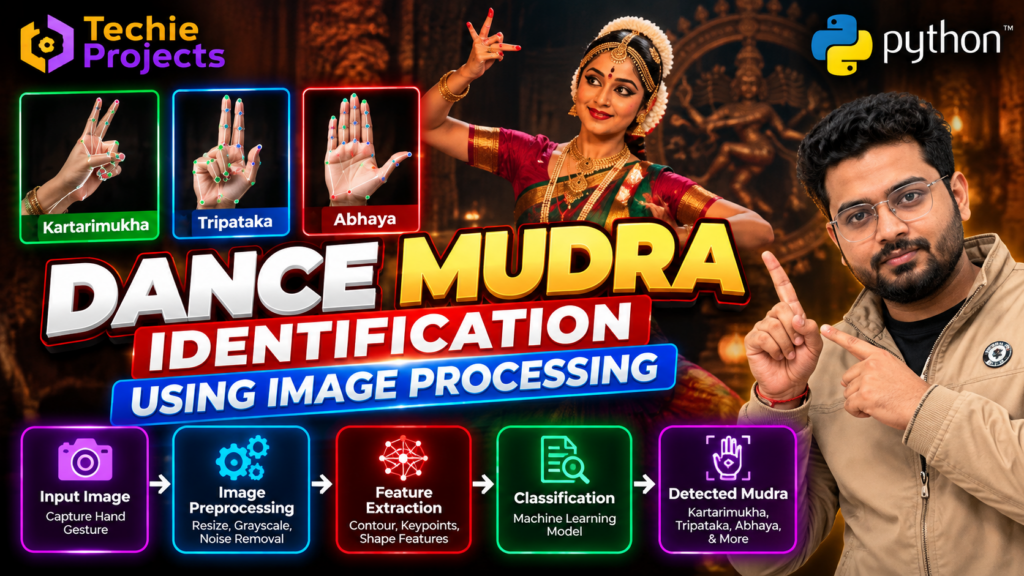
The Dance Mudra Identification Using Image Processing and Machine Learning project is an AI-based application designed to recognize traditional Indian classical dance hand gestures from images or camera input. This project combines computer vision, image processing, and machine learning techniques to identify different mudras and demonstrate how artificial intelligence can support the digital preservation and learning of classical dance.
Traditional Indian dance forms use specific hand gestures, known as mudras, to express emotions, stories, and cultural meanings. Learning to recognize these gestures can take time and practice. An automated mudra recognition system provides an interesting way to explore gesture classification using Python and computer vision.
🎓 Are you looking for a unique final-year engineering project? At Techie Projects, you can explore this Dance Mudra Identification project for academic learning, demonstrations, and further development. Contact us to discuss source code availability, project details, and customization options.
🎬 Dance Mudra Identification – Project Demo Video
Watch the project demonstration to understand how the Dance Mudra Identification system works, how hand gestures are processed, and how the application can classify supported mudra categories.
The demonstration can help students understand the project’s interface, recognition workflow, and potential applications in computer vision and machine learning.
💡 What Is Dance Mudra Identification Using Image Processing?
Dance Mudra Identification Using Image Processing is a computer vision project that analyzes hand gestures and classifies them into predefined categories. Depending on the implementation, the system may use image preprocessing, hand-region detection, feature extraction, and a trained machine learning model.
The system takes an image or camera frame as input, processes the visible hand gesture, and predicts a mudra category supported by its trained dataset.
This project is suitable for students interested in:
- Artificial intelligence and machine learning
- Image processing using Python
- Computer vision applications
- Hand gesture recognition
- Indian classical dance and cultural technology
- Human-computer interaction
🎯 Objectives of the Project
The main objectives of the Dance Mudra Identification project are:
- To develop a computer vision application for recognizing selected dance mudras.
- To preprocess hand gesture images for classification.
- To explore machine learning methods for gesture recognition.
- To build a user-friendly interface for testing supported mudras.
- To demonstrate the practical use of Python in image processing.
- To create a foundation for future work in dance education and digital cultural preservation.
⚙️ How Does the Dance Mudra Recognition System Work?
The system follows a general computer vision workflow. The exact implementation depends on the dataset, model, and features included in the selected project version.
1. 📸 Image or Camera Input
The application receives an image of a hand gesture or captures a frame through a connected camera. Clear images and visible hand positions can help improve recognition quality.
2. 🖼️ Image Preprocessing
The input image is prepared for analysis. Typical preprocessing operations may include resizing, color conversion, background handling, and normalization.
Preprocessing helps standardize the input before feature extraction or classification.
3. ✋ Hand Gesture Analysis
The system identifies useful visual information from the hand. Depending on the approach, this may involve image features, hand landmarks, contours, or other visual representations.
4. 🧠 Feature Extraction and Classification
A machine learning model uses patterns learned from training examples to predict the gesture category. The model’s performance depends on the quality, diversity, and labeling of its training data.
5. ✅ Mudra Prediction
The application displays the predicted category for supported gestures. If the input differs significantly from the training examples, the model may produce an incorrect prediction.
6. 📊 Result Display
The predicted mudra can be shown through the application’s interface. Additional features, such as confidence scores or gesture descriptions, depend on the implementation.
🚀 Key Features of the Dance Mudra Identification Project
The following are potential features of a Dance Mudra Identification application. The exact features available should be confirmed against the project version supplied.
- Hand Gesture Recognition: Classifies supported hand gestures into predefined categories.
- Image Processing: Prepares input images for analysis.
- Machine Learning Classification: Uses a trained model to predict gesture labels.
- Python-Based Development: Provides an opportunity to study a popular language for AI projects.
- Visual Results: Displays predictions through an application interface.
- Educational Demonstration: Helps explain the practical workflow of a computer vision system.
- Customization Potential: Can be extended with additional gesture categories when suitable data and training are available.
🛠️ Technologies Used
A Python-based implementation may use the following technologies. Confirm the actual dependencies in the supplied source code before installation.
- Programming Language: Python
- Image Processing: OpenCV or related image-processing libraries
- Machine Learning: Scikit-learn or another supported model framework
- Numerical Processing: NumPy
- Data Visualization: Matplotlib, if included
- User Interface: A desktop or web interface, depending on the implementation
Not every implementation requires every library listed above. The final dependency list should match the project’s actual code and environment.
💻 Software and Hardware Requirements
Software Requirements
- Operating system: Windows, Linux, or another compatible environment
- Python version compatible with the project’s dependencies
- Required Python packages
- A code editor or IDE, such as Visual Studio Code or PyCharm
- A compatible camera, if live gesture recognition is supported
Hardware Requirements
- Laptop or desktop computer
- Recommended minimum of 4 GB RAM; 8 GB or more may provide a smoother development experience
- Webcam for camera-based input, if required
- Sufficient storage for the source code, dataset, and model files
Actual requirements depend on the implementation and the size of the dataset or model.
🎓 Applications of Dance Mudra Identification
1. Classical Dance Education
A recognition system could be developed as a supplementary learning tool to help learners explore selected hand gestures.
2. Digital Cultural Preservation
Computer vision projects can help document and organize visual examples of traditional gestures for educational or research purposes.
3. Gesture Recognition Research
Students can use the project as a starting point for experiments involving hand pose analysis and image classification.
4. Human-Computer Interaction
Gesture recognition is relevant to interfaces that respond to hand movements rather than conventional keyboard or mouse input.
5. Academic Demonstrations
The project can demonstrate the stages of an AI application, including data preparation, image preprocessing, model training, and prediction.
📈 Advantages of the Project
- Combines cultural relevance with modern AI techniques.
- Provides practical exposure to computer vision.
- Can be adapted to different sets of predefined gestures.
- Supports learning about datasets, model training, and classification.
- Offers opportunities for further research and feature development.
- Can be presented as a demonstration project in computer science and related engineering courses.
⚠️ Limitations to Consider
A responsible project evaluation should also consider its limitations.
- Recognition quality depends on the training dataset and model.
- Lighting, camera angle, background, and hand position can affect predictions.
- Similar-looking gestures may be difficult to distinguish.
- A model trained on a limited number of mudras cannot automatically recognize every traditional gesture.
- The system should not be treated as an authoritative source for cultural or dance interpretation without expert review.
These limitations can become useful discussion points in a project report and viva presentation.
🔮 Future Scope
The Dance Mudra Identification project can be extended in several ways:
- Real-Time Recognition: Add continuous camera-based recognition if it is not already supported.
- More Mudra Categories: Expand the dataset with accurately labeled examples of additional gestures.
- Deep Learning Models: Evaluate suitable convolutional neural networks or other architectures.
- Mobile Application: Develop a mobile interface for compatible models.
- Learning Dashboard: Add gesture descriptions and learning progress features.
- Multilingual Support: Display gesture labels and explanations in multiple languages.
- Improved Robustness: Train and test using diverse lighting conditions, backgrounds, and hand positions.
Any extension requires appropriate data, implementation, and testing.
🛒 Get the Dance Mudra Identification Project from Techie Projects
Are you searching for a Dance Mudra Identification Using Image Processing and Machine Learning project for your final-year engineering submission?
Techie Projects helps students explore Python, AI, machine learning, and computer vision project ideas. Contact us to confirm whether the project version meets your academic requirements and to discuss source code availability, demonstrations, documentation, and customization.
🎓 Why Contact Techie Projects?
- Discuss project suitability for your course.
- Ask about the implementation and required software.
- Confirm available source code and documentation.
- Discuss customization based on your project requirements.
- Get information about pricing and delivery before ordering.
📲 Contact us for project details and purchase inquiries:
- 📲 Call/WhatsApp: +91-9460060699
- 🌎 Website: www.techieprojects.com
- 📺 Instagram: @pythonprojects_
Please confirm the included deliverables, supported features, documentation, and pricing with Techie Projects before purchasing.
🎓 Explore Related Projects
Students interested in image processing and AI may also explore these project areas:
- Hand Gesture Recognition Using Python
- Sign Language Recognition Using Machine Learning
- Human Activity Recognition Using Deep Learning
- Face Recognition Attendance System
- Real-Time Object Detection Using Python
- Image Classification Using Deep Learning
Explore relevant project categories on the Techie Projects website or contact us to find available projects and verified project pages.
❓ Frequently Asked Questions
1. What is a Dance Mudra Identification project?
It is a computer vision application designed to classify selected hand gestures associated with classical dance using image processing and machine learning techniques.
2. Which programming language is used?
Python is a suitable choice for this project because it supports image processing, data analysis, and machine learning libraries. Check the actual project package for its implementation details.
3. Is this project suitable for final-year students?
It can be suitable for computer science, AI, data science, and related engineering students, subject to their institution’s requirements and the project’s actual scope.
4. Does the system support real-time recognition?
Real-time recognition depends on whether camera input and continuous prediction are implemented. Confirm this feature before purchasing.
5. Can additional mudras be added?
Potentially, yes. Additional gesture categories generally require labeled training examples, suitable model updates, and testing.
6. Can I customize the project?
Customization may be possible depending on the available implementation and your requirements. Contact Techie Projects to discuss the scope, cost, and feasibility.
7. How can I purchase the project?
Contact Techie Projects through WhatsApp or visit techieprojects.com to ask about availability, pricing, and included deliverables.
🏁 Conclusion
The Dance Mudra Identification Using Image Processing and Machine Learning project combines computer vision with an application inspired by Indian classical dance. It offers students an opportunity to study image preprocessing, gesture classification, and AI-based application development while exploring a culturally relevant problem.
If you are looking for a project for academic learning or further development, contact Techie Projects to discuss the available implementation, source code, and customization options.
📲 Start your project inquiry today: +91-9460060699