
🚀 Build a Smart Virtual Mouse Using Hand Gesture Recognition – Get the Project from Techie Projects!
Want to develop an innovative final-year engineering project using Python, OpenCV, and Artificial Intelligence? The Virtual Mouse Using Hand Gesture Recognition project is an excellent choice for students interested in computer vision, gesture-based interaction, and touch-free computer control.
Imagine controlling your computer cursor, performing mouse clicks, and interacting with your desktop using simple hand movements instead of a traditional physical mouse. This project demonstrates how computer vision and hand gesture recognition techniques can make human-computer interaction more interactive and convenient.
If you are looking for a ready-to-study Python computer vision project, Techie Projects can help you explore the project package, source code, documentation, and available technical support options. Instead of starting your implementation from scratch, enquire about the project and get details about the available package for your academic requirements.
📞 Contact Techie Projects for Project Enquiries
Interested in purchasing the Virtual Mouse Using Hand Gesture Recognition project? Contact Techie Projects to enquire about pricing, source code, documentation, installation guidance, and available technical support.
- 💬 WhatsApp Enquiry: Chat with Techie Projects
- 📱 Contact Number: +91 94600 60699
- 🌐 Official Website: www.techieprojects.com
- 📸 Instagram: Follow Techie Projects
- 🎓 Project Domains: Python, OpenCV, Computer Vision, Artificial Intelligence, and Machine Learning.
🚀 Ready to get started? Enquire on WhatsApp and mention Virtual Mouse Using Hand Gesture Recognition.
Package contents, pricing, included features, and support availability should be confirmed before purchase.
🎬 Watch the Virtual Mouse Using Hand Gesture Recognition Project Demo
Explore the project demonstration to understand how hand gestures can be used to control mouse operations through Python and computer vision.
The demonstration can help students understand the application’s workflow, hand tracking process, and implemented mouse controls.
🎯 What Is Virtual Mouse Using Hand Gesture Recognition?
A virtual mouse is a computer application that allows users to perform mouse-related operations through hand gestures. Instead of physically moving a mouse, users interact with a camera that captures their hand movements.
The Virtual Mouse Using Hand Gesture Recognition project uses a camera as an input device and applies computer vision techniques to identify hand positions and gestures. Based on the detected hand landmarks or gesture patterns, the application can translate movements into mouse actions.
Python provides a flexible environment for developing this type of application. Libraries such as OpenCV can be used for camera access and image processing, while a hand-tracking framework can help identify hand landmarks.
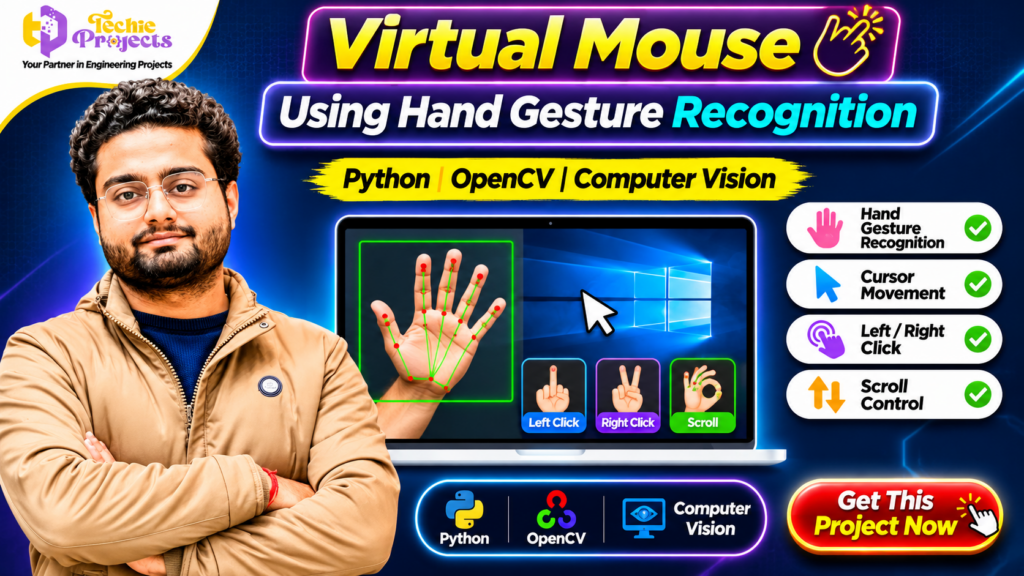
The exact gestures and mouse operations depend on the project’s implementation. A typical demonstration may include cursor movement, left-click, right-click, and scrolling.
💡 Why Choose This Python Computer Vision Project?
Students often look for final-year projects that demonstrate practical applications of programming and emerging technologies. A gesture-controlled mouse is an interesting project because it connects software development with real-time computer vision.
Here are some reasons to consider this project:
- Practical application: Demonstrates an alternative approach to controlling a computer.
- Computer vision experience: Introduces camera input, image processing, and hand tracking.
- Python development: Provides experience with Python libraries and application development.
- Interactive demonstration: Allows students to demonstrate gesture-based controls during project presentations.
- Learning opportunity: Helps students understand how visual information can be converted into computer commands.
This project is suitable for students exploring Artificial Intelligence, Computer Science, Information Technology, and related engineering disciplines.
⚙️ How Does Virtual Mouse Using Hand Gesture Recognition Work?
The working process involves capturing video, identifying hand movements, recognizing gestures, and translating the detected information into mouse commands.
1. 📷 Capturing Live Video
The application uses a webcam or compatible camera to capture video frames. Python and OpenCV can access the camera and continuously receive images.
2. ✋ Hand Detection and Tracking
The captured frames are processed to locate the user’s hand. A hand-tracking framework can identify important points, such as fingertips and finger joints.
These landmarks help the application understand the position and movement of the hand.
3. 🧠 Gesture Recognition
The application analyses the detected hand landmarks to identify specific gestures. For example, finger positions or distances between selected landmarks can be used to distinguish one gesture from another.
The gesture rules depend on the implementation and should be checked in the supplied project.
4. 🖱️ Cursor Movement
When a suitable hand movement is detected, the application can map the hand’s position to the computer screen coordinates.
This allows the cursor to move according to the detected hand movement.
5. 👆 Mouse Click Operations
Specific gestures can be assigned to mouse actions. Depending on the implementation, these may include left-click and right-click operations.
6. 📜 Scrolling and Other Controls
Additional gestures may be configured for scrolling or other interactions. These features depend on the gesture mapping included in the project.
🛠️ Technologies Used in the Project
The project combines Python programming with computer vision techniques.
Python
Python is the primary programming language used to develop the application. Its libraries make it suitable for image processing, camera integration, and application logic.
OpenCV
OpenCV is a computer vision library used for image and video processing. In this project, it can support webcam access, frame processing, and visual output.
Hand Tracking Framework
A hand-tracking framework, such as MediaPipe Hands, can be used to detect hand landmarks and track finger positions. The actual framework depends on the supplied implementation.
Mouse Control Library
A Python mouse-control library can translate recognised gestures into desktop mouse operations. The selected library depends on the project code and supported operating system.
🖥️ Main Features of Virtual Mouse Using Hand Gesture Recognition
The following features describe common capabilities of a gesture-controlled mouse application. Confirm which features are included in the package before purchasing.
1. Real-Time Hand Tracking
The system can process camera frames to detect and track hand landmarks. This provides the input required for gesture-based interaction.
2. Gesture-Based Cursor Movement
Hand position can be mapped to screen coordinates to control cursor movement without directly using a physical mouse.
3. Left-Click Recognition
A predefined hand gesture can be configured to perform a left-click operation.
4. Right-Click Recognition
Another gesture can be assigned to perform a right-click operation, depending on the implementation.
5. Scroll Control
Vertical hand movement or a predefined gesture may be used to control scrolling.
6. Camera-Based Interaction
A webcam provides the visual input needed for hand detection and tracking.
7. Interactive Demonstration
The project can demonstrate how computer vision techniques are used to create a touch-free computer interaction system.
📚 Project Modules and Implementation Overview
Understanding the project modules helps students explain the development process during academic presentations and viva examinations.
1. Camera Input Module
This module captures video frames from the webcam and makes them available for processing.
2. Image Processing Module
The captured frames are processed to prepare the visual information for hand detection.
3. Hand Landmark Detection Module
The hand-tracking component identifies important hand landmarks, including finger positions.
4. Gesture Interpretation Module
This module evaluates the detected landmarks and identifies gestures according to predefined rules.
5. Mouse Action Module
Recognised gestures are converted into mouse commands such as cursor movement, clicking, or scrolling.
6. Application Display Module
The application may display the camera feed, detected hand landmarks, and other processing information for demonstration and debugging.
💻 Software and Hardware Requirements
The following are typical development requirements. Actual requirements may vary depending on the source code, library versions, and computer configuration.
Software Requirements
- Programming Language: Python
- Computer Vision Library: OpenCV
- Hand Tracking: Compatible hand landmark detection framework
- Mouse Control: Compatible Python mouse automation library
- Operating System: Windows 10 or Windows 11
- Development Environment: VS Code, PyCharm, or another Python IDE
Hardware Requirements
- Processor: Modern Intel or AMD processor
- RAM: 4 GB minimum; 8 GB recommended
- Storage: Sufficient space for Python, libraries, and project files
- Camera: Webcam or compatible camera
- Input Devices: Keyboard and display
🧪 Applications of Virtual Mouse Technology
Gesture-controlled mouse applications demonstrate how computer vision can be used in different areas of human-computer interaction.
1. Touch-Free Computer Interaction
Gesture recognition can provide an alternative way to interact with a computer in situations where direct contact with a mouse is inconvenient.
2. Educational Demonstrations
Students can use this project to demonstrate computer vision, hand tracking, and gesture recognition concepts.
3. Human-Computer Interaction Research
The project provides a starting point for exploring new ways for people to communicate with computers through visual input.
4. Interactive Presentations
Gesture-based controls can be explored for presentations and interactive demonstrations, depending on the available gesture mappings.
5. Assistive Technology Exploration
Gesture-based interfaces may inspire assistive interaction concepts. However, this academic demonstration should not be treated as a validated accessibility or medical device.
🌟 Advantages of the Project
- Introduces practical computer vision concepts.
- Demonstrates gesture-based computer interaction.
- Provides experience with Python and OpenCV.
- Helps students understand camera-based hand tracking.
- Offers opportunities to experiment with gesture mapping.
- Can be extended with additional gestures and controls.
- Provides a practical topic for engineering project demonstrations.
🔬 Future Scope and Advanced Project Ideas
Students can extend the basic application with additional features after understanding the existing implementation.
1. Custom Gesture Configuration
Allow users to define or modify gestures for different mouse operations.
2. Improved Gesture Accuracy
Experiment with different hand-tracking approaches, landmark filtering, and gesture classification techniques to improve stability.
3. User-Friendly Interface
Develop a graphical interface for selecting settings, viewing camera input, and controlling the application.
4. Multiple Gesture Commands
Explore additional gestures for operations such as drag-and-drop, window switching, or presentation control.
5. Performance Optimization
Investigate ways to reduce processing delays and improve responsiveness on different computer configurations.
6. Accessibility-Oriented Interaction
Explore how gesture-based controls could support alternative interaction methods. Any real-world accessibility use would require proper usability and reliability testing.
🎓 Why Purchase Your Final-Year Project from Techie Projects?
Developing a project independently can require time for selecting a topic, understanding the libraries, writing code, debugging errors, and preparing documentation.
Techie Projects provides project-related solutions for engineering students across domains such as Python, Artificial Intelligence, Machine Learning, Computer Vision, IoT, Web Development, and Data Science.
By enquiring about the Virtual Mouse Using Hand Gesture Recognition project, students can understand the available package and decide whether it matches their academic requirements.
What Should You Check Before Purchasing?
- Availability of the Python source code.
- Project documentation and explanation.
- Installation instructions and required dependencies.
- Demonstration video, if included.
- List of implemented features.
- Compatibility with your operating system.
- Available technical support options.
- Any additional requirements from your college.
The exact package contents should be confirmed with Techie Projects before placing an order.
💰 Purchase Virtual Mouse Using Hand Gesture Recognition Project
Looking for a Python-based computer vision project for your final-year engineering submission? Enquire about the Virtual Mouse Using Hand Gesture Recognition project from Techie Projects.
Get in touch to discuss the available source code package, documentation, project features, pricing, and technical support options.
Why enquire with Techie Projects?
- Python and OpenCV project solutions.
- Multiple engineering project domains.
- Project information and package details.
- Assistance with installation and implementation, where available.
- Options for students working on academic projects.
📞 Place Your Project Enquiry
- 💬 WhatsApp: https://wa.me/919460060699
- 📱 Call / WhatsApp: +91 94600 60699
- 🌐 Website: www.techieprojects.com
- 📸 Instagram: @pythonprojects_
🚀 Enquire today! Send the project name Virtual Mouse Using Hand Gesture Recognition on WhatsApp to receive the available package details.
❓ Frequently Asked Questions (FAQs)
1. What is Virtual Mouse Using Hand Gesture Recognition?
It is a Python-based computer vision application that uses hand gestures to control mouse operations such as cursor movement and clicking, depending on its implementation.
2. Which programming language is used?
Python is commonly used to develop this project because of its computer vision and automation libraries.
3. Is OpenCV used in this project?
Yes, OpenCV can be used for webcam access and video processing. The exact libraries depend on the supplied source code.
4. Is a webcam required?
A webcam or compatible camera is generally required to capture hand movements for gesture recognition.
5. Can this project perform left-click and right-click operations?
These operations can be implemented by assigning specific hand gestures to mouse commands. Confirm the included functionality in the available package.
6. Is this project suitable for final-year engineering students?
Yes. It is a suitable academic project topic for students interested in Python, computer vision, Artificial Intelligence, and human-computer interaction.
7. Can additional gestures be added?
Yes. Students can explore additional gesture mappings and mouse operations by modifying and extending the application.
8. Where can I purchase this project?
You can contact Techie Projects through WhatsApp at +91 94600 60699 or visit www.techieprojects.com to enquire about availability and package details.
💡 Recommended Related Projects
Explore more computer vision, Python, and Artificial Intelligence projects from Techie Projects:
- Hand Gesture Recognition Using Python – Explore hand detection and gesture classification.
- Virtual Painting Using OpenCV Python – Draw on a digital canvas using hand movements.
- Sign Language Recognition Using Machine Learning – Develop a system for recognizing sign language gestures.
- Finger Counting Using OpenCV – Detect fingers and count them using image processing.
- Face Recognition Attendance System – Explore automated attendance using face recognition.
- Object Detection Using YOLO – Identify and locate objects in images and video.
- Human Activity Recognition Using Machine Learning – Analyze human activities using machine learning techniques.
Visit www.techieprojects.com to explore more final-year engineering projects.
🚀 Benefits of Virtual Mouse Using Hand Gesture Recognition for Students
The Virtual Mouse Using Hand Gesture Recognition project helps students understand how computer vision can be applied to real-world human-computer interaction. It combines Python programming, webcam input, hand tracking, and gesture interpretation in one practical application.
By developing a Virtual Mouse Using Hand Gesture Recognition system, students can explore how hand landmarks are detected and converted into computer commands. This also provides an opportunity to understand image processing, coordinate mapping, and real-time application development.
🔧 How to Develop Virtual Mouse Using Hand Gesture Recognition
Developing a Virtual Mouse Using Hand Gesture Recognition application involves several important steps. First, configure the webcam to capture live video. Next, use a compatible hand-tracking framework to detect hand landmarks. After identifying the required gestures, map their positions to screen coordinates and connect them with mouse-control operations.
Students can further improve the application by experimenting with cursor sensitivity, gesture recognition rules, and tracking stability. These development activities make the project useful for learning Python and practical computer vision concepts.
🎓 Who Should Choose This Project?
The Virtual Mouse Using Hand Gesture Recognition project is suitable for Computer Science, Information Technology, Artificial Intelligence, and related engineering students.
It is a useful academic topic for students who want to demonstrate Python programming, OpenCV, hand tracking, and gesture-based interaction. Enquire with Techie Projects to check the available source code, documentation, implemented features, and project package before purchasing.
🏁 Conclusion
The Virtual Mouse Using Hand Gesture Recognition project is an interesting way to explore the combination of Python, OpenCV, hand tracking, and computer vision. It demonstrates how visual information can be converted into interactive computer commands and provides students with practical experience in gesture-based human-computer interaction.
For engineering students looking to understand real-time computer vision applications, this project offers a useful academic learning opportunity. Students can also explore advanced features such as custom gestures, improved tracking, and additional mouse controls.
If you are interested in purchasing this project, contact Techie Projects to check the available package, source code, documentation, pricing, and support options. Choose a project package that matches your academic requirements and build your understanding of practical computer vision applications.