
Introduction
An Electricity Bill Management System Project in Python is a practical software project designed to manage customer information, electricity consumption, bill generation, payment records, and billing reports digitally.
Instead of maintaining electricity billing information manually, the system can provide a centralized application where administrators can add customers, record meter readings, calculate electricity bills, manage payments, and generate reports.
This project is suitable for B.Tech, BCA, MCA, Computer Science, IT, and final-year engineering students looking for a practical Python project for academic submission, project presentation, resume development, or technical learning.
The project can be developed using Python, MySQL, database management, and a graphical or web-based user interface, depending on the required implementation.
🎥 Watch the Electricity Bill Management System Project Working Demo
Before selecting a final-year project, students can watch the Electricity Bill Management System working video to understand the project interface, billing workflow, customer management, payment tracking, and report generation.
The working demonstration helps students understand how the project operates before discussing project requirements or development.
This Electricity Bill Management System Project in Python can be customized with additional billing, payment, and reporting features.
Students can extend the Electricity Bill Management System Project in Python by adding online payments, analytics, and customer notifications.
What Is an Electricity Bill Management System?
An electricity bill management system is an application that helps manage electricity customers and their billing information digitally.
A typical system can maintain:
- Customer information
- Consumer ID
- Meter readings
- Electricity consumption
- Bill calculation
- Billing history
- Payment information
- Pending bills
- Payment status
- Reports
- User accounts
The system can calculate the bill according to predefined electricity-unit rates and store the generated bill information in a database.
🎓 Objectives of the Project
The main objectives of an electricity bill management system project in Python are:
- Digitize electricity billing operations.
- Store customer information efficiently.
- Manage electricity meter readings.
- Calculate electricity bills automatically.
- Maintain payment records.
- Track pending and paid bills.
- Generate billing reports.
- Reduce manual data-entry work.
- Provide an easy-to-use management interface.
- Demonstrate Python and database development skills.
Key Features of the Electricity Billing System
1. Customer Management
The administrator can add and manage customer information.
Possible customer details include:
- Customer name
- Consumer ID
- Address
- Phone number
- Meter number
- Connection type
- Registration date
Customer information can be stored in the database for future billing operations.
2. Meter Reading Management
The system can maintain electricity meter readings for customers.
For example, the administrator can enter:
- Previous reading
- Current reading
- Reading date
- Consumer ID
- Units consumed
The system can then calculate the electricity consumption.
3. Electricity Consumption Calculation
Electricity consumption can be calculated using:
Units Consumed = Current Meter Reading − Previous Meter Reading
For example:
Previous Reading = 1,250 units
Current Reading = 1,400 units
Therefore:
Units Consumed = 1,400 − 1,250 = 150 units
The calculated units can then be used for bill generation.
4. Automatic Bill Generation
The application can calculate the electricity bill based on the number of units consumed and the configured billing rates.
A bill can include:
- Consumer ID
- Customer name
- Meter number
- Previous reading
- Current reading
- Units consumed
- Rate
- Fixed charges
- Tax or additional charges
- Total amount
- Due date
- Payment status
5. Payment Management
The system can maintain payment information for generated bills.
Payment records can contain:
- Bill ID
- Consumer ID
- Amount
- Payment date
- Payment method
- Transaction/reference number
- Payment status
6. Pending Bill Tracking
The administrator can identify customers who have pending electricity bills.
The dashboard can display:
- Paid bills
- Unpaid bills
- Pending bills
- Total billing amount
- Total collected amount
7. Billing History
The system can store previous billing information so administrators can retrieve historical records.
This can help users review a customer’s billing history over different months.
8. Reports and Analytics
The project can include reports for:
- Monthly bills
- Customer billing
- Payments
- Pending bills
- Electricity consumption
- Revenue
- Customer-wise billing history
These reports can make the system more useful for demonstrations and real-world application scenarios.
How the Electricity Bill Management System Works
The basic workflow can be divided into the following steps.
Step 1: Customer Registration
The administrator enters customer information into the system.
The system assigns or stores a unique consumer ID.
Step 2: Meter Reading Entry
The previous and current meter readings are entered for the customer.
Step 3: Calculate Electricity Consumption
The system calculates the number of units consumed.
Units Consumed = Current Reading − Previous Reading
Step 4: Calculate the Bill
The system applies the configured electricity billing rate to the consumed units.
Additional charges can also be included depending on the project requirements.
Step 5: Generate the Bill
After calculation, the system generates a billing record containing customer and payment information.
Step 6: Store Billing Information
The generated bill is saved in the database.
Step 7: Payment Update
When a customer makes a payment, the administrator can update the payment status.
Step 8: Generate Reports
The administrator can view billing, payment, consumption, and pending-bill reports.
Electricity Bill Calculation Example
A simple academic project can use a predefined unit-rate structure.
For example:
| Units Consumed | Example Rate |
|---|---|
| 0–100 | ₹5/unit |
| 101–200 | ₹6/unit |
| 201–300 | ₹7/unit |
| Above 300 | ₹8/unit |
These rates are example project values only and can be changed according to the requirements of the project.
For example, if a customer consumes 150 units, the application can calculate the bill according to the configured tariff structure.
A real electricity billing application would use the applicable tariff and billing rules of the relevant electricity provider.
Database Design
A database can be used to store customer, meter, billing, and payment information.
Customer Table
Possible fields include:
| Field | Description |
|---|---|
| Customer ID | Unique customer identifier |
| Name | Customer name |
| Consumer ID | Electricity consumer number |
| Phone | Customer contact |
| Address | Customer address |
| Meter Number | Meter identification |
| Connection Type | Domestic/commercial etc. |
Meter Reading Table
Possible fields include:
| Field | Description |
|---|---|
| Reading ID | Unique reading ID |
| Consumer ID | Customer reference |
| Previous Reading | Previous meter value |
| Current Reading | Current meter value |
| Units Consumed | Calculated units |
| Reading Date | Date of reading |
Bill Table
Possible fields include:
| Field | Description |
|---|---|
| Bill ID | Unique bill number |
| Consumer ID | Customer reference |
| Billing Month | Billing period |
| Units | Electricity consumption |
| Amount | Bill amount |
| Due Date | Payment due date |
| Status | Paid/Pending |
Payment Table
Possible fields include:
| Field | Description |
|---|---|
| Payment ID | Unique payment record |
| Bill ID | Related bill |
| Amount | Paid amount |
| Payment Date | Payment date |
| Payment Method | Payment mode |
| Status | Payment status |
Technologies Used
A typical electricity bill management system in Python can use:
- Python
- MySQL
- SQLite
- Tkinter or another GUI framework
- HTML/CSS/JavaScript for a web version
- Database connectivity libraries
- Python IDE such as VS Code or PyCharm
The exact technology stack depends on the version of the project being developed.
Software Requirements
A typical development environment may require:
- Python 3.x
- MySQL or SQLite
- Required Python packages
- VS Code, PyCharm, or another Python IDE
- Windows/Linux operating system
- Web browser if the project uses a web interface
Hardware Requirements
Recommended hardware requirements include:
- Computer or laptop
- Minimum 4 GB RAM
- Dual-core or better processor
- Keyboard and mouse
- Sufficient storage
- Internet connection for downloading dependencies and development resources
The requirements can be adjusted according to the size and implementation of the project.
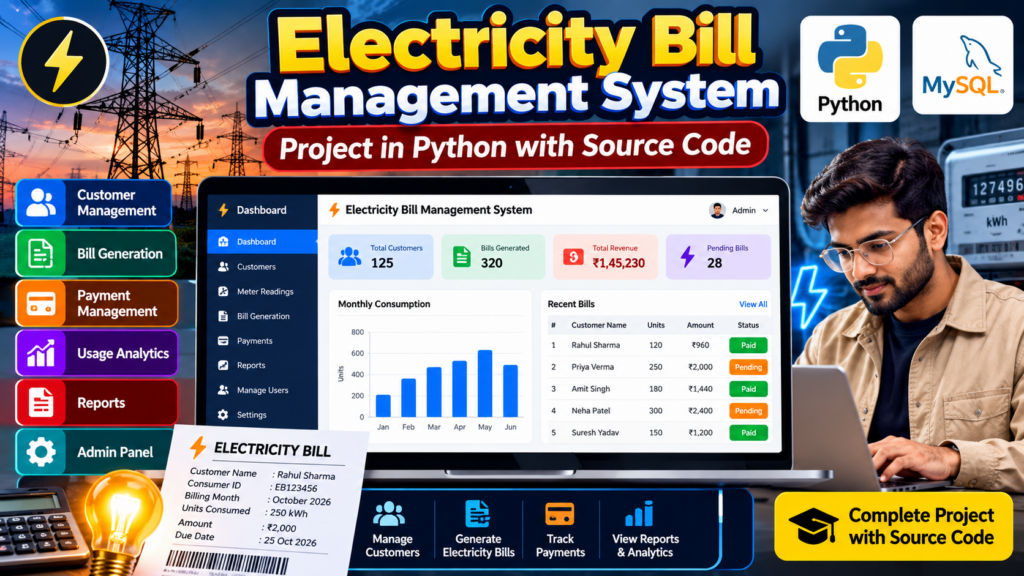
Admin Dashboard
An admin dashboard can provide a centralized view of the billing system.
Possible dashboard information includes:
- Total customers
- Total bills generated
- Total revenue
- Pending bills
- Paid bills
- Monthly consumption
- Recent transactions
- Billing reports
A dashboard makes the project easier to demonstrate during a final-year project presentation.
Advantages of the Project
An electricity bill management system project in Python can provide several benefits:
- Reduces manual record keeping.
- Organizes customer information.
- Simplifies bill generation.
- Provides centralized billing records.
- Makes payment tracking easier.
- Helps identify pending bills.
- Provides billing history.
- Supports report generation.
- Demonstrates practical database development.
Applications
The concept can be adapted for:
- Electricity billing demonstrations
- Utility management applications
- Academic projects
- Database management projects
- Billing software prototypes
- Customer management systems
- Utility consumption tracking systems
For actual utility-provider deployment, additional security, regulatory, billing, authentication, and infrastructure requirements would be necessary.
Limitations
A basic academic electricity billing project may have some limitations:
- It may use predefined billing rates.
- It may not connect to real electricity meters.
- It may not integrate with an actual electricity provider.
- Payment processing may be simulated.
- Security features may need further development.
- Large-scale deployment requires additional infrastructure.
These limitations can also provide opportunities for future project development.
🚀 Future Scope
Students can enhance the project with advanced features such as:
- Online bill payment
- Customer login
- Admin login
- Email notifications
- SMS notifications
- Electricity consumption analytics
- Automatic bill reminders
- PDF bill generation
- QR-code payment integration
- Online customer portal
- Mobile application
- Cloud database
- Real-time meter integration
- Multiple electricity tariff plans
- Advanced analytics dashboard
These features can transform a basic billing application into a more comprehensive utility management project.
💡 Project Ideas You Can Add
Students can customize the project by adding modules such as:
- Electricity Consumption Prediction
- Smart Meter Monitoring
- Electricity Theft Detection
- Electricity Usage Analytics
- Online Electricity Bill Payment
- Energy Consumption Dashboard
- Power Consumption Forecasting
- Customer Complaint Management
- Renewable Energy Monitoring
- Smart Energy Management System
🎓 Is This a Good Final-Year Project?
Yes. This project can be useful for students who want to demonstrate multiple software development concepts in one application.
The project can cover:
- Python programming
- Database management
- CRUD operations
- Billing calculations
- User authentication
- Dashboard development
- Report generation
- Data analytics
- Software development workflow
Students can customize the project according to their college guidelines and project requirements.
Project Customization for Students
Every college can have different project requirements. The system can therefore be customized based on the required:
- Technology
- Database
- Modules
- User roles
- Interface
- Reports
- Documentation
- Project scope
- Additional features
Students can discuss the required features and project scope before development.
🔗 Explore Related Python Projects
If you are looking for similar software and database projects, you can explore:
- Fees Management System Using Python
- Restaurant Management System Project in Python
- Pharmacy Management System Project in Python
- Employee Management System Project in Python
- Hotel Management System Project in Python
- Inventory Management System Using Python
- Billing Software Project in Python
- Electricity Consumption Prediction Using Machine Learning
These projects can help students compare different Python project ideas before selecting a topic.
Frequently Asked Questions
What is an Electricity Bill Management System Project in Python?
It is a Python-based application designed to manage customers, meter readings, electricity consumption, bill generation, payments, and billing reports.
Which programming language is used for this project?
Python is the primary programming language. A database such as MySQL or SQLite can be used for storing project information.
Can MySQL be used in this project?
Yes. MySQL can be used to store customer information, meter readings, bills, payments, and other application data.
Is this project suitable for B.Tech students?
Yes. It can be developed as a mini project, major project, or final-year project depending on the complexity and features implemented.
Can this project have a web interface?
Yes. A web-based version can be developed using a suitable Python web framework along with HTML, CSS, JavaScript, and a database.
Can online payment be added?
Yes. A payment module can be added depending on the project requirements. For an academic demonstration, payment processing can also be simulated.
Can electricity consumption analytics be added?
Yes. Charts and dashboards can be added to analyze monthly consumption, billing trends, and customer usage.
📲 Need Help With Your Final-Year Project?
Looking for a Python, Machine Learning, AI, Computer Vision, Web Development, or Database Management project?
You can discuss your project idea, required features, source-code requirements, documentation, and project scope before development.
WhatsApp: +91-9460060699
Website: Techie Projects
Instagram: @pythonprojects_
Conclusion
An Electricity Bill Management System Project in Python is a practical project that combines Python programming, database management, billing calculations, customer management, payment tracking, and report generation.
The basic system can manage customers and electricity bills, while advanced features such as analytics, online payments, notifications, dashboards, and smart-meter integration can make the project more comprehensive.
For students, this project provides an opportunity to demonstrate practical software development skills while building a project that can be customized according to final-year academic requirements.