
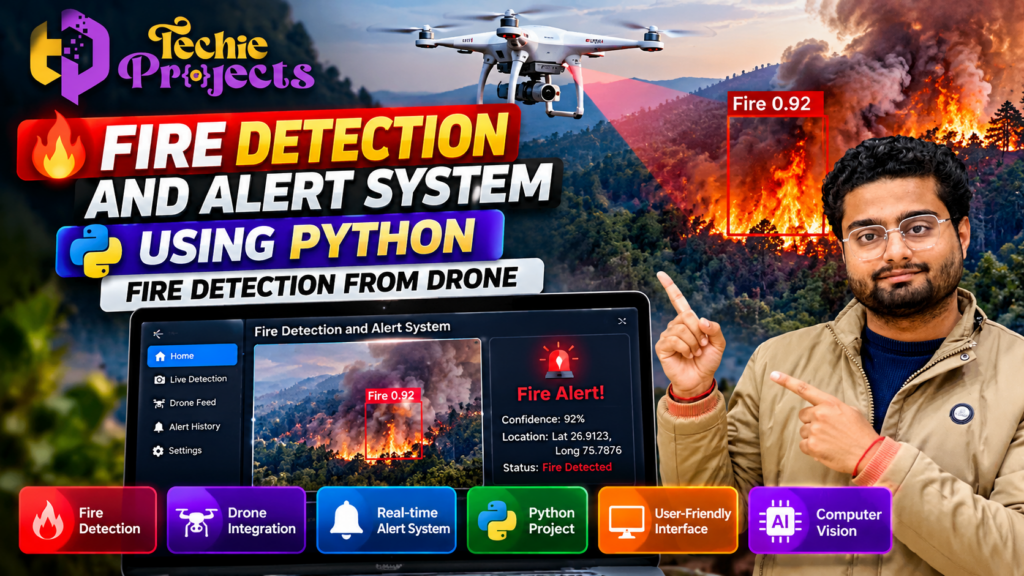
Fire Detection and Alert System Using Python | Fire Detection from Drone
The Fire Detection and Alert System Using Python is an AI-based engineering project that explores how computer vision and image processing can help identify potential fire incidents. By combining fire detection techniques with drone-based monitoring concepts, the system demonstrates how technology can support faster identification of fire-related risks.
This project is suitable for computer science, information technology, artificial intelligence, and machine learning students looking for a practical final-year engineering project. It introduces students to Python programming, image analysis, automated alerts, and the development of intelligent monitoring applications.
🎓 If you are searching for a practical fire detection project with implementation details, Techie Projects can help you explore the project requirements and available deliverables before purchasing.
🎬 Project Demo
Watch the project demonstration to understand the interface, detection workflow, and potential applications of a Python-based fire monitoring system.
The demonstration can help you understand how the application processes visual input, presents detection results, and communicates alerts when supported by the implementation.
🔥 What Is a Fire Detection and Alert System Using Python?
A Fire Detection and Alert System Using Python is a software application designed to analyze visual input and identify patterns that may indicate fire. Depending on the implementation, it may use image processing, machine learning, or a trained computer vision model to classify images or video frames.
Traditional fire safety systems commonly use dedicated smoke, heat, or flame sensors. A vision-based approach offers a different method: analyzing visual information from cameras or recorded footage. When combined with drone-based monitoring, the concept can be explored for locations that are difficult to inspect manually.
The project demonstrates the software side of fire monitoring. Actual performance depends on the dataset, model, camera quality, lighting conditions, and environmental factors. A student prototype should not be treated as a replacement for certified fire alarms or professional emergency systems.
🎯 Objectives of the Project
The primary objectives of this engineering project are:
- To explore fire detection using Python and computer vision.
- To understand image and video processing techniques.
- To study how machine learning models classify visual information.
- To explore drone-based monitoring as a potential input source.
- To display detection results through a user-friendly interface.
- To investigate alert generation when supported by the implementation.
- To evaluate model performance using appropriate test data.
- To document the workflow, limitations, and possible improvements.
These objectives help students connect programming concepts with a practical safety-related application.
⚙️ How Does the Fire Detection System Work?
The workflow depends on the actual project implementation, but a typical vision-based system follows these stages.
1. Image or Video Input
The system receives visual input from a camera, uploaded image, recorded video, or drone camera feed. The input source determines whether the project supports static-image detection, video analysis, or live monitoring.
2. Image Preprocessing
The application prepares the visual data for analysis. Preprocessing may include resizing frames, converting colour formats, normalizing pixel values, or extracting frames from a video.
3. Fire Detection
A computer vision or machine learning model analyzes the prepared input. Depending on the chosen approach, the model may classify an image or identify a possible fire region within a frame.
4. Result Display
The application displays the model’s output. This may include a predicted class, a bounding box, a confidence score, or a detection status, depending on the model and interface.
5. Alert Generation
If alert functionality is implemented, the application can trigger a notification when its configured detection conditions are met. The notification method may vary according to the project’s available features.
6. Testing and Evaluation
The model should be tested using suitable images or video samples. Students can assess false positives, missed detections, processing speed, and the effect of different lighting or environmental conditions.
🧠 Technologies Used
A fire detection project may use the following technologies, depending on its implementation.
- Python: Main programming language for application development.
- OpenCV: Image processing and video handling.
- Machine Learning or Deep Learning: Model training or inference for visual classification and detection.
- NumPy: Numerical operations on image data.
- Flask, Streamlit, or another interface framework: Optional application interface.
- Drone camera or recorded drone footage: Optional source of aerial visual input.
- Notification components: Optional functionality for displaying or sending alerts.
The exact libraries, model architecture, and installation requirements should be confirmed from the project package before purchase.
🛠️ Key Features of the Project
Fire Detection from Visual Input
The system explores how visual data can be analyzed to identify possible fire-related patterns. Its reliability depends on model quality and the conditions in which the input is captured.
Drone-Based Monitoring Concept
Drone footage can provide an aerial view of an area and may help students investigate fire monitoring in large or difficult-to-access locations. Real drone integration requires compatible hardware, a suitable video feed, and appropriate operational permissions.
Detection Result Visualization
A visual interface can make the output easier to understand by displaying labels, detection status, or other model results supported by the application.
Alert Mechanism
Where implemented, an alert mechanism can notify the operator that the model has detected a possible fire event. Alerts should be tested carefully to avoid excessive false alarms.
Python-Based Development
Python offers a practical environment for experimenting with image processing, model inference, and application development.
Educational Testing and Evaluation
Students can evaluate the model on different samples, record its limitations, and suggest improvements as part of their academic documentation.
Benefits of Fire Detection and Alert System Using Python
The Fire Detection and Alert System Using Python helps engineering students understand how computer vision and image processing can be applied to fire monitoring. By exploring visual input, detection models, and alert workflows, students can gain practical experience with Python programming and AI-based application development. The project also introduces important topics such as model evaluation, false alarms, and system limitations.
How to Develop a Fire Detection and Alert System Using Python
To develop a Fire Detection and Alert System Using Python, start by preparing suitable image or video samples and selecting an appropriate computer vision model. Next, process the input data, run the model, display the detection results, and implement an alert mechanism if it is part of the project requirements. Test the application with different scenarios and document its accuracy, limitations, and installation steps.
Get the Fire Detection and Alert System Using Python Project
Looking for a Fire Detection and Alert System Using Python for your final-year engineering project? Techie Projects can help you confirm the available source code, installation instructions, documentation, technical explanations, pricing, and support options before purchase. Check the deliverables against your college requirements before placing an order.
🏫 Applications of Fire Detection Technology
Fire detection technology can be explored in a variety of settings:
- Forest and wildfire monitoring research.
- Industrial safety monitoring prototypes.
- Warehouse and storage-area surveillance concepts.
- Campus and building monitoring research.
- Remote-area visual inspection.
- Computer vision and AI laboratory demonstrations.
- Academic projects involving drone imagery.
These are potential application areas, not a guarantee that the student prototype is suitable for operational deployment. Real-world use requires rigorous testing and appropriate safety systems.
🎓 Why Choose This Project for Your Final Year?
A Fire Detection and Alert System Using Python offers an opportunity to combine several technical topics within one project. Instead of focusing only on basic programming, students can investigate image preprocessing, model predictions, interface development, and system evaluation.
The project can also support a technical presentation because students can explain the problem, demonstrate the application, describe the workflow, and discuss possible improvements.
It may be suitable for students interested in:
- Artificial intelligence and machine learning.
- Computer vision and image processing.
- Python application development.
- Smart monitoring systems.
- Drone technology and aerial imagery.
- Practical engineering demonstrations.
Before selecting the topic, check your department’s requirements, expected project complexity, and whether your guide requires original model training, a hardware component, or a particular technology stack.
📦 Project Requirements and Deliverables
The software and hardware requirements depend on the selected implementation. A typical development environment may include a Windows or Linux computer, Python, compatible libraries, and sufficient memory to run the model.
A dedicated GPU may be helpful for some deep learning workflows, but it is not necessary for every implementation.
Before ordering, contact Techie Projects to confirm which of the following are included:
- Project source code and its usage terms.
- Installation instructions and dependency versions.
- Dataset details or permitted sample inputs.
- Model files and configuration, where applicable.
- Project documentation and technical explanations.
- Demonstration video or execution guidance, if available.
- Hardware requirements and optional drone integration details.
- Technical support, pricing, and delivery terms.
Confirm these items before payment so that the package matches your academic requirements.
🚀 Future Enhancements
Students can explore several possible improvements, subject to time, data availability, and hardware compatibility.
Improved Detection Accuracy
A more diverse dataset containing different fire sizes, smoke conditions, backgrounds, and lighting conditions may help improve model evaluation.
Real-Time Video Processing
The application could be extended to process a live camera stream or recorded video continuously, provided the model and hardware can handle the processing requirements.
Drone Camera Integration
A compatible drone feed could be connected to the application to explore aerial monitoring. This requires additional integration work and suitable hardware.
Location and Event Logging
The system could be extended to record detection timestamps and, where reliable location data is available, associate events with a location.
Dashboard and Reporting
A dashboard could present detection history, model outputs, and evaluation results for easier review.
Model Performance Evaluation
Future work could compare suitable detection models using precision, recall, false-positive rates, inference time, and other relevant metrics.
These enhancements are suggestions for further development, not necessarily features already included in the current project.
❓ Frequently Asked Questions
1. What is a Fire Detection and Alert System Using Python?
It is an educational software project that explores the use of Python and computer vision to identify possible fire-related patterns in images or video and display results.
2. Is this project suitable for final-year engineering students?
It may be suitable for computer science, IT, AI, and machine learning students. Confirm the technical scope with your project guide before selecting it.
3. Does the project support drone-based fire detection?
The project topic includes fire detection from a drone. Contact Techie Projects to confirm whether the available version includes live drone integration, recorded footage processing, or a demonstration of the concept.
4. Which programming language is used?
Python is the primary language specified for this project. Additional libraries depend on the actual implementation.
5. Does the system send automatic alerts?
Alert functionality depends on the included implementation. Confirm the notification method and its requirements before ordering.
6. Can I modify the project?
Modification depends on the source code, package terms, and available technical support. Confirm these details before purchase.
7. How can I purchase this project?
Contact Techie Projects through WhatsApp or the website to ask about availability, pricing, deliverables, installation requirements, and support options.
🎓 Explore Related Projects
- Helmet and Number Plate Detection Using AI
- Accident Detection Using Computer Vision
- Intrusion Detection System Using Machine Learning
- Crop Prediction Using Machine Learning
- Diet Recommendation System Project in Android App
📩 Get the Fire Detection Project from Techie Projects
Looking for a practical AI or Python engineering project? Techie Projects helps students explore project concepts and implementation options for academic learning and demonstrations.
Before purchasing, contact us to confirm the available source code, documentation, installation steps, technical explanations, pricing, and support terms. Choose a package that fits your college requirements and your own learning goals.
Contact Techie Projects:
- 📲 Call/WhatsApp: +91-9460060699
- 🌎 Website: www.techieprojects.com
- 📺 Instagram: @pythonprojects_
Build your understanding of Python, computer vision, and AI through a project that connects programming with a real-world safety challenge.
Disclaimer: This project is intended for educational and demonstration purposes. It is not a certified fire safety system and must not replace approved alarms, emergency procedures, or professional fire detection equipment.