
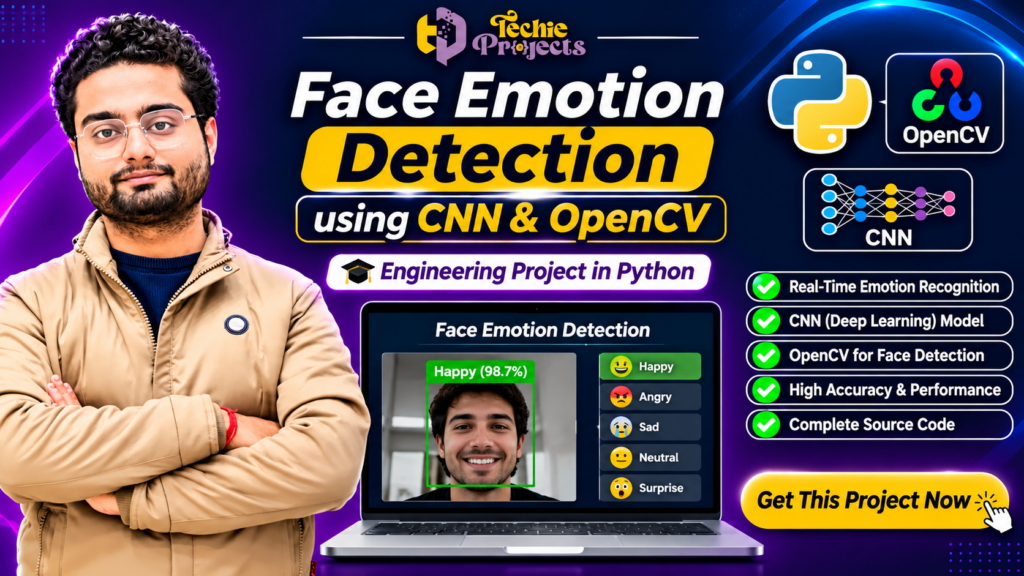
The Face Emotion Detection Using CNN and OpenCV project is designed to demonstrate how Artificial Intelligence can analyse facial images and identify different expression categories. By combining Python programming, deep learning, and computer vision, this project provides students with practical experience in developing an intelligent image classification application. The Face Emotion Detection Using CNN and OpenCV implementation is particularly useful for students exploring real-world machine learning applications.
Looking for a ready-to-study Face Emotion Detection Using CNN and OpenCV project for your final-year engineering submission? Get a practical Artificial Intelligence and Deep Learning project from Techie Projects, designed for students who want to explore real-time facial expression analysis using Python.
Stop spending weeks building everything from scratch! Get professional project assistance, source code availability, implementation guidance, project demonstrations, and documentation details from Techie Projects. This project combines Convolutional Neural Networks (CNN), Computer Vision, Python, and OpenCV to demonstrate how computers can identify facial expressions from images or webcam input.
Whether you are pursuing B.Tech, BCA, MCA, M.Tech, or a Computer Science Engineering degree, this project can help you understand practical machine learning concepts and develop your technical knowledge.
🎓 Get This Project Now! Contact Techie Projects to discuss pricing, source code, project requirements, and available deliverables.
📞 Contact Techie Projects for Project Enquiries
Interested in purchasing the Face Emotion Detection Using CNN and OpenCV Python Project? Contact us to enquire about package availability, pricing, source code, documentation, installation guidance, and technical support options.
💬 WhatsApp Enquiry: Chat with Techie Projects
📱 Contact Number: +91 94600 60699
🌐 Official Website: www.techieprojects.com
📸 Instagram: Follow Techie Projects
🎓 Project Areas: Robotics, Machine Learning, Arduino, Deep Learning, Artificial Intelligence, and Android App.
✅ Request Project Details: Share your engineering branch, preferred features, and technical requirements to enquire about the most suitable available package.
🚀 Ready to get started? Click here to enquire on WhatsApp and mention Face Emotion Detection Using CNN and OpenCV Python Project.
Package contents, prices, hardware availability, and support options should be confirmed before purchase.
🎬 Watch the Face Emotion Detection Project Demo
Explore the project demonstration to understand how the application works, how facial expressions are processed, and how the system displays predicted emotions.
The demonstration gives you an overview of the application interface and its computer vision workflow before you make a purchase enquiry.
🔍 What Is Face Emotion Detection Using CNN and OpenCV?
Face emotion detection is an Artificial Intelligence application that analyses facial features and predicts emotional expression categories from visual input.
The system uses computer vision techniques to locate a face and a trained deep learning model to classify its expression. A webcam or image can provide the input, while the application processes the visual information and displays the predicted category.
Face Emotion Recognition Using Python combines several important technologies:
- Python programming language
- OpenCV for image processing
- Convolutional Neural Networks (CNN)
- Deep Learning techniques
- Facial feature analysis
- Computer vision
- Image classification
For example, an application may classify facial expressions into categories such as:
- Happy
- Sad
- Angry
- Neutral
- Surprise
The available emotion categories depend on the model and training dataset used in the implementation.
The primary objective is to demonstrate how machine learning models can identify visual patterns associated with different facial expressions.
🎯 Objectives of the Face Emotion Detection Project
One of the major objectives of the Face Emotion Detection Using CNN and OpenCV system is to automate facial expression classification. The application processes facial images, extracts relevant visual information, and uses a trained CNN model to predict expression categories. This Face Emotion Detection Using CNN and OpenCV implementation helps students understand how computer vision and deep learning work together.
Important objectives include:
- Detecting human faces from images or webcam input.
- Processing facial images using OpenCV.
- Extracting visual information for classification.
- Applying a trained CNN model to facial image data.
- Predicting facial expression categories.
- Displaying the predicted emotion through an application interface.
- Understanding practical applications of deep learning and computer vision.
The project is especially useful for students interested in implementing Artificial Intelligence concepts through a practical application.
🧠 How Does CNN Based Emotion Detection Work?
CNN Based Emotion Detection uses a Convolutional Neural Network to identify patterns in facial images.
CNN is a deep learning architecture commonly used for image classification and computer vision applications. It automatically learns visual patterns from training images.
The general workflow involves the following stages.
1. Image Acquisition
The system receives an image from a webcam or an existing image file.
The input image contains the facial information that needs to be analysed.
2. Face Detection Using OpenCV
OpenCV is used to process the input image and locate the face region.
Face detection helps isolate the relevant portion of the image before sending it to the emotion classification model.
3. Image Preprocessing
The detected face region is prepared for model prediction.
Preprocessing may include:
- Image resizing
- Grayscale conversion
- Pixel normalization
- Image format conversion
These operations help prepare the image in the format expected by the trained model.
4. CNN Model Processing
The processed facial image is passed to the trained CNN model.
The CNN analyses different visual patterns through convolutional and pooling operations. Its learned features are used by the classification layers to predict an emotion category.
5. Emotion Classification
The model generates prediction scores for the supported emotion classes.
The application selects the predicted class according to the model’s output.
6. Displaying Results
The predicted emotion is displayed through the application interface.
For webcam-based implementations, this process can be repeated across successive video frames to demonstrate Real-Time Emotion Detection.
💻 Technologies Used in This Project
This project combines multiple technologies from Artificial Intelligence, Python programming, and computer vision.
Python
Python is the primary programming language used for application development and machine learning implementation.
It provides a simple development environment and supports several libraries used in Artificial Intelligence.
OpenCV
OpenCV makes the Face Emotion Detection Using CNN and OpenCV application capable of handling image processing operations. It supports webcam access, image reading, face detection, and preprocessing. Integrating OpenCV with a CNN model creates a practical Face Emotion Detection Using CNN and OpenCV solution for demonstrating computer vision concepts.
OpenCV is an open-source computer vision library.
In this project, OpenCV can be used for:
- Capturing webcam input.
- Reading images.
- Face detection.
- Image preprocessing.
- Displaying processed frames.
Convolutional Neural Network
The CNN architecture plays an important role in the Face Emotion Detection Using CNN and OpenCV project. It learns important facial patterns from training images and uses these patterns to classify expressions. The Face Emotion Detection Using CNN and OpenCV approach makes this project a useful example of deep learning-based image classification.
CNN is the main deep learning approach used for facial expression classification.
It learns image features from training data and uses the learned patterns to predict emotion categories.
NumPy
NumPy supports numerical operations and array processing required for image manipulation and machine learning workflows.
Deep Learning Framework
A compatible deep learning framework is used to train or load the CNN model and perform predictions, depending on the project implementation.
📸 What Is Facial Expression Recognition?
Facial Expression Recognition is a computer vision task that identifies visible facial expression patterns from images or video frames.
Human faces contain several visual features, including:
- Eye movements and shape.
- Eyebrow positions.
- Mouth shape.
- Facial muscle patterns.
- Overall facial appearance.
A deep learning model learns patterns from labelled facial image datasets and uses these patterns to classify expressions.
For example, a smiling facial image may be classified into a happy category, while another image may be classified as sad or surprised.
However, facial expression predictions are not definitive measurements of a person’s actual emotional state. Lighting, camera quality, facial variation, occlusion, and dataset limitations can influence predictions.
This makes the project a useful educational demonstration of computer vision rather than a reliable psychological assessment system.
⚡ Real-Time Emotion Detection Using Python
The Face Emotion Detection Using CNN and OpenCV application can demonstrate real-time facial expression classification through webcam input. Each captured frame is processed to detect the face, prepare the image, and generate an emotion prediction. This makes Face Emotion Detection Using CNN and OpenCV an interesting practical project for students interested in real-time Artificial Intelligence applications.
Real-Time Emotion Detection demonstrates how a computer vision application can analyse video frames continuously.
Instead of processing only a stored image, the application can receive frames from a connected webcam.
The general workflow includes:
- Start the webcam.
- Capture a video frame.
- Detect the face.
- Extract the facial region.
- Preprocess the detected image.
- Send the image to the trained CNN model.
- Display the predicted expression.
- Repeat the process for subsequent frames.
The actual processing speed depends on hardware configuration, model architecture, image resolution, and implementation.
This functionality makes the project interesting for students who want to understand real-time computer vision applications.
🤖 Deep Learning Face Recognition vs Face Emotion Detection
Deep Learning Face Recognition and face emotion detection are related computer vision concepts, but they solve different problems.
| Feature | Face Recognition | Emotion Detection |
|---|---|---|
| Main purpose | Identify or verify a person | Classify facial expressions |
| Input | Facial image | Facial image |
| Output | Identity or match result | Expression category |
| Technology | Deep learning and feature embeddings | CNN image classification |
| Application | Authentication | Expression analysis |
This project focuses primarily on emotion classification rather than identifying a person’s identity.
Understanding this difference is important for students preparing their project reports and technical presentations.
🌍 Applications of Facial Expression Recognition
Facial expression analysis has several potential research and demonstration applications.
1. Human-Computer Interaction
Facial expression analysis can be explored as an additional input method for interactive computer applications.
2. Educational Research
Researchers can investigate how expression classification models perform on different facial image datasets.
3. Smart Interactive Applications
Developers can experiment with interfaces that respond to detected expression categories.
4. Computer Vision Research
The project can help students understand image classification, face detection, and deep learning model evaluation.
5. AI-Based Research Projects
Students can extend the implementation by experimenting with different CNN architectures and image datasets.
Any real-world deployment should consider consent, privacy, fairness, and the limitations of automated emotion inference.
🎓 Why Choose This as a Final Year Machine Learning Project?
A Final Year Machine Learning Project should demonstrate practical implementation rather than only theoretical knowledge.
Face Emotion Detection provides an opportunity to explore multiple technical concepts within one application.
Important learning benefits include:
Students looking for a practical machine learning implementation can consider the Face Emotion Detection Using CNN and OpenCV project for their academic learning. It combines Python, CNN, OpenCV, and computer vision in one application. The Face Emotion Detection Using CNN and OpenCV project also provides opportunities to explore model training, image classification, and application development.
- Understanding CNN architecture.
- Learning image preprocessing techniques.
- Implementing OpenCV-based face detection.
- Exploring machine learning classification.
- Understanding webcam-based computer vision.
- Learning how to integrate Python libraries.
- Exploring deep learning applications.
It can also provide a useful foundation for students who want to pursue careers in Artificial Intelligence, Machine Learning, Data Science, or Computer Vision.
⭐ Key Features of the Face Emotion Detection Project
The following features describe the intended capabilities of this type of implementation. Exact functionality depends on the selected project version.
1. Face Detection: Identifies facial regions from supported image or webcam input.
2. Emotion Classification: Uses a trained CNN model to predict supported facial expression categories.
3. Webcam Integration: Demonstrates live video input for continuous analysis.
4. Image Processing: Uses OpenCV for image acquisition and preprocessing.
5. Prediction Display: Presents the predicted expression through the application interface.
6. Python-Based Implementation: Provides an opportunity to understand practical Python development.
7. Machine Learning Integration: Demonstrates the integration of a deep learning model with a computer vision application.
🛠️ Software and Hardware Requirements
The following are general development requirements. Exact versions should be confirmed for the selected implementation.
Software Requirements
- Programming Language: Python
- Computer Vision Library: OpenCV
- Numerical Library: NumPy
- Deep Learning Framework: Compatible CNN framework
- Operating System: Windows 10/11 or compatible environment
- IDE: VS Code, PyCharm, or Jupyter Notebook
Hardware Requirements
- Processor: Intel Core i3 or higher recommended
- RAM: 4 GB minimum; 8 GB or more recommended
- Storage: Sufficient space for the source code and dataset
- Input Device: Webcam for real-time implementation
- GPU: Optional, depending on model size and performance requirements
📂 What Should You Check Before Purchasing This Project?
Before purchasing any engineering project, students should understand what is included in the selected version.
At Techie Projects, contact the team to confirm the available deliverables for this project.
You can enquire about:
- Python source code.
- Project execution instructions.
- Dataset availability and usage details.
- Model files and dependencies.
- Project documentation.
- Installation assistance.
- Demonstration video.
- Customization possibilities.
- Project explanation and implementation guidance.
The exact package, price, and available support should be confirmed before placing your order.
🚀 Why Purchase Your Engineering Project from Techie Projects?
Choosing a suitable project provider is an important step in completing your engineering project.
Techie Projects focuses on technology-based projects across Artificial Intelligence, Machine Learning, Python, Data Science, IoT, Computer Vision, Deep Learning, and Web Development.
Here are some reasons to contact our team:
1. Multiple Technology Domains
Explore projects across different engineering and computer science domains.
2. Practical Project Demonstrations
Watch available project demonstrations to understand the application workflow before making a purchase decision.
3. Source Code Enquiries
Discuss source code availability and implementation requirements with our team.
4. Student-Focused Assistance
Get assistance with understanding project functionality, installation requirements, and technical concepts, subject to the selected support package.
5. Project Customization
Discuss modifications according to your college requirements and project objectives.
6. Direct Communication
Contact our team through WhatsApp to discuss pricing, availability, and project-related queries.
💡 Recommended Projects for Engineering Students
If you are exploring more Artificial Intelligence and Machine Learning projects, consider these related ideas:
- Face Recognition Attendance System: An attendance application using facial recognition techniques.
- AI-Based Exam Proctoring System: A computer vision project for monitoring online examination sessions.
- Fake News Detection Using Machine Learning: A text classification project for identifying potentially misleading news.
- Plant Leaf Disease Detection: A deep learning application for classifying plant leaf conditions.
- Object Detection Using YOLO: A computer vision application for detecting objects in images and videos.
- DeepFake Detection Using Deep Learning: A research-oriented project for identifying manipulated media.
- Human Activity Recognition: A machine learning application for classifying activities from visual or sensor data.
Explore more project ideas at Techie Projects.
📚 Skills You Can Learn from This Project
Working through this implementation can help students develop practical technical skills.
Some important learning areas include:
- Python programming.
- OpenCV image processing.
- CNN architecture.
- Deep learning fundamentals.
- Image classification.
- Computer vision.
- Model prediction.
- Application development.
- Debugging and troubleshooting.
These concepts are useful starting points for students interested in developing more advanced Artificial Intelligence applications.
❓ Frequently Asked Questions (FAQs)
1. What is Face Emotion Detection Using Python?
It is a computer vision application that analyses facial images and uses a trained machine learning model to classify visible facial expressions.
2. Which algorithm is used in this project?
A Convolutional Neural Network (CNN) is used for facial expression classification. OpenCV supports image processing and face detection.
3. Is this project suitable for final-year engineering students?
Yes. It is a suitable educational project idea for students pursuing Computer Science, IT, Artificial Intelligence, and related engineering courses.
4. Can this project detect emotions in real time?
A webcam-based implementation can process video frames continuously and display predicted expression categories. Actual performance depends on the implementation and hardware.
5. Which programming language is used?
Python is the primary programming language used in this project.
6. Is OpenCV required?
OpenCV is used for computer vision operations such as image acquisition, face detection, and preprocessing in the described implementation.
7. Can I purchase the complete project?
Contact Techie Projects to confirm source code availability, project pricing, documentation, and the deliverables included in the selected package.
8. Can the project be customized?
Customization requirements can be discussed with the Techie Projects team before purchasing.
9. Is this a machine learning or deep learning project?
It is a deep learning-based machine learning project that uses CNN for image classification.
10. How can I contact Techie Projects?
You can contact the team through WhatsApp at +91 94600 60699 or visit www.techieprojects.com.
If you want to explore practical Artificial Intelligence development, the Face Emotion Detection Using CNN and OpenCV project is worth considering. Techie Projects provides project-related assistance for students interested in understanding Python-based machine learning implementations. Contact our team to enquire about purchasing the Face Emotion Detection Using CNN and OpenCV project, source code availability, documentation, and implementation support.
🎯 Conclusion – Get Your Face Emotion Detection Project Today!
The Face Emotion Detection Using CNN and OpenCV project combines important concepts of Artificial Intelligence, Deep Learning, and Computer Vision. It offers students an opportunity to understand facial image processing and CNN-based classification through a practical Python application.
If you are searching for a Face Emotion Detection Using CNN and OpenCV project for your final-year engineering submission, contact Techie Projects today. Enquire about project pricing, source code, documentation, and available implementation assistance.
🚀 Ready to purchase your Face Emotion Detection project?
Don’t waste time searching through multiple project resources. Contact Techie Projects to check project availability, pricing, source code, documentation, and implementation assistance.
📞 Contact / WhatsApp: +91 94600 60699
🌐 Website: www.techieprojects.com
📸 Instagram: @pythonprojects_
Get Your Project Now and Start Building Your AI Skills with Techie Projects! 🎓

