
Introduction
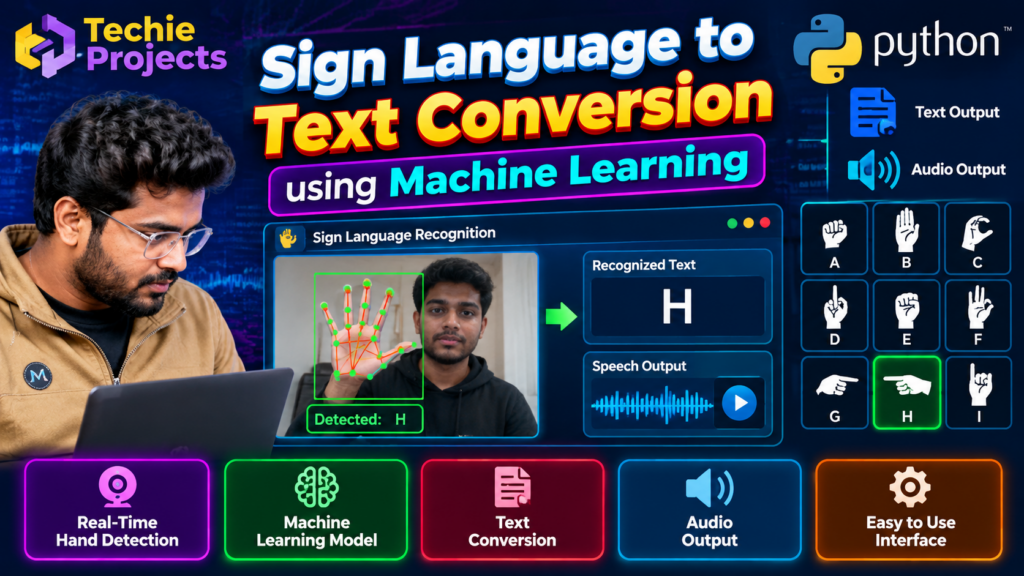
Sign language to text conversion using machine learning is an innovative Python-based project that explores how artificial intelligence can help improve communication between people who use sign language and those who may not understand it. This project uses computer vision, hand gesture recognition, and machine learning techniques to identify selected hand signs and convert recognized gestures into readable text. Depending on the implementation, the system can also provide speech output.
For final-year B.Tech, B.E., BCA, MCA, and computer science students, this project offers practical experience in Python programming, image processing, machine learning, and human-computer interaction. It is a useful choice for students looking for an AI-based final-year project with a visual demonstration and opportunities for further development.
At Techie Projects, we provide project assistance for students who want to explore this concept, understand its workflow, and develop their academic project. You can contact us to enquire about project availability, source code, installation assistance, and customization options.
🎬 Sign Language to Text Conversion Using Machine Learning – Project Demo
Watch the project demonstration to understand how a camera-based application can detect hand gestures and display the corresponding text. The demonstration can help you explore the user interface, recognition workflow, and possible speech-output functionality.
The project demo is useful for understanding how the application works before selecting it for your final-year submission. Actual recognition performance and supported gestures depend on the model, training data, and implementation.
🎯 Project Overview
The sign language recognition system is designed to recognize selected hand gestures from camera input and display their corresponding labels. A machine learning model can be trained using labeled gesture images or extracted hand landmarks to classify the signs.
The basic workflow includes capturing a hand gesture, processing the input, extracting relevant features, predicting the gesture class, and displaying the result. If speech functionality is included, the recognized text can also be passed to a text-to-speech component.
Main Objectives
- Develop a Python-based sign language recognition application.
- Explore hand gesture detection using computer vision.
- Apply machine learning to classify supported gestures.
- Display recognized gestures as readable text.
- Explore optional text-to-speech functionality.
- Build a practical AI project for academic learning and demonstration.
Sign Language to Text Conversion Using Machine Learning – Technical Workflow
The sign language to text conversion using machine learning system processes camera input, extracts hand features, and predicts the corresponding gesture using a trained classification model. Python libraries such as OpenCV and MediaPipe can support image processing and hand landmark detection when included in the implementation.
📊 Model Training and Gesture Recognition
For a sign language to text conversion using machine learning project, the model’s performance depends on the quality of the training dataset, the number of supported gestures, and the testing process. Students can evaluate the model using suitable metrics, such as accuracy and a confusion matrix, to identify gestures that are frequently misclassified.
💡 Customization Opportunities
A sign language to text conversion using machine learning application can be customized by expanding the gesture dataset, improving the user interface, or adding optional speech output. The feasibility of each feature depends on the existing source code, model architecture, and available training data.
🎓 Why Choose This Project for Your Final Year?
Choosing a sign language to text conversion using machine learning project gives students an opportunity to explore computer vision, classification models, and assistive technology in one practical application. Contact Techie Projects to discuss source code availability, project requirements, and possible customization options.
For students seeking a sign language to text conversion using machine learning project with Python, Techie Projects can help explain the available implementation and the technical requirements before purchase.
⚙️ How Does the Project Work?
The sign language to text conversion using machine learning project can be organized into the following stages.
1. Camera Input
The system captures images or video frames using a webcam. The user performs a supported hand gesture in front of the camera.
2. Image Preprocessing
The captured frame is processed to prepare it for recognition. Depending on the implementation, preprocessing may include resizing, color conversion, background handling, normalization, or hand-region detection.
3. Hand Detection and Feature Extraction
The application identifies the hand region or extracts useful hand landmarks. These features help the model distinguish between different gestures.
4. Machine Learning Prediction
A trained classification model analyzes the extracted features and predicts the most likely gesture from the classes it supports.
5. Text Conversion
The predicted gesture label is displayed as text on the application’s interface. For example, a supported gesture may be mapped to a particular letter or predefined word.
6. Optional Audio Output
If text-to-speech functionality is implemented, the recognized text can be converted into spoken output. This feature depends on the selected speech library and the capabilities included in the project.
🚀 Key Features
The following features can be included, depending on the delivered implementation:
- Real-time gesture input: Capture hand movements through a webcam.
- Gesture classification: Recognize supported signs using a trained model.
- Text display: Show the predicted label on the application interface.
- Machine learning integration: Apply classification techniques to gesture data.
- Visual interface: Present the camera feed and prediction results in an accessible format.
- Optional speech output: Read recognized text aloud using a text-to-speech component.
- Expandable gesture classes: Add supported gestures by collecting suitable data and updating the model.
- Educational implementation: Explore the complete workflow from input processing to prediction.
The project should be tested with its actual supported gestures before claiming complete sign language translation or universal recognition.
🛠️ Technologies Used
The technologies depend on the project’s implementation. A typical version may use the following tools:
- Programming language: Python
- Computer vision: OpenCV
- Machine learning: Scikit-learn or a suitable deep learning framework
- Hand tracking: MediaPipe, if used in the implementation
- Numerical processing: NumPy
- User interface: Tkinter, Streamlit, or another supported interface
- Speech output: A compatible text-to-speech library, if included
Not every version requires all these libraries. Confirm the actual software stack before installing dependencies.
💻 Software and Hardware Requirements
Software Requirements
- Python-compatible development environment
- Windows, Linux, or another supported operating system
- Required Python libraries for image processing and model inference
- Trained model and project files
- Webcam access for camera-based recognition
Hardware Requirements
- Laptop or desktop computer
- Webcam or compatible camera
- Keyboard and mouse
- Adequate RAM and storage for the chosen model and dependencies
A GPU is generally not essential for a lightweight gesture classification model, although hardware requirements depend on the model architecture and implementation.
🎓 Applications of Sign Language Recognition
1. Assistive Communication Research
The project demonstrates how computer vision can support communication tools for people who use sign language.
2. Academic Learning
Students can use the project to study machine learning, image processing, gesture recognition, and Python application development.
3. Human-Computer Interaction
Gesture-based interfaces can be explored as an alternative input method for selected applications.
4. Smart Applications
The recognition workflow can be extended into experimental interfaces, interactive learning tools, or gesture-controlled prototypes.
5. Research and Development
The project provides a starting point for investigating larger datasets, improved gesture classification, and more robust camera-based recognition.
📈 Advantages of the Project
- Combines Python programming with practical AI concepts.
- Demonstrates a visual, easy-to-understand prediction workflow.
- Can be adapted to different supported gesture classes.
- Offers opportunities to learn model training and evaluation.
- Can be extended with text-to-speech or additional interface features.
- Provides a useful foundation for a computer science final-year project.
⚠️ Limitations and Future Scope
A basic sign language recognition application may support only a limited set of gestures. Recognition can be affected by lighting, camera quality, hand orientation, background conditions, and differences between users.
Sign languages also contain grammar, movement, facial expressions, and context that cannot be fully represented by recognizing isolated hand poses. Therefore, a system that classifies a small set of gestures should not be described as a complete sign language translator.
Possible future improvements include:
- Expanding the gesture dataset.
- Improving recognition across different lighting conditions.
- Supporting dynamic gestures and movement sequences.
- Evaluating accuracy on users and data not included in training.
- Adding sentence-level processing where appropriate.
- Improving the interface and optional speech output.
🛒 Get the Sign Language to Text Conversion Project
Looking for a sign language to text conversion using machine learning project for your final-year submission? Techie Projects can help you enquire about project availability and the implementation options suitable for your academic requirements.
You can contact us to discuss:
- Project source code availability.
- Installation and execution requirements.
- Explanation of the workflow and modules.
- Customization based on your project requirements.
- Assistance with understanding the implementation and preparing your demonstration.
Availability, included features, and support options should be confirmed before purchase.
Interested in this project? Contact Techie Projects to discuss your requirements.
- 📲 Call/WhatsApp: +91-9460060699
- 🌎 Website: www.techieprojects.com
- 📺 Instagram: @pythonprojects_
🎓 Explore Related Projects
Explore these related project topics for more ideas for your final-year engineering project:
- Sign Language Recognition Using Python
- Hand Gesture Recognition Using Machine Learning
- Real-Time Object Detection Using Python
- Face Recognition Attendance System
- Speech Recognition Using Python
- Human Activity Recognition Using Deep Learning
❓ Frequently Asked Questions
1. What is sign language to text conversion using machine learning?
It is an AI-based approach that uses image or video input to recognize supported hand gestures and map them to text labels using a trained machine learning model.
2. Which programming language is used in this project?
Python is commonly used because it supports computer vision, machine learning, numerical processing, and application development libraries.
3. Does the project work in real time?
A webcam-based implementation can process frames in real time, depending on the model, hardware, and application design.
4. Can the project convert text into speech?
Yes, if a compatible text-to-speech component is included. Speech output is an additional feature and should be verified in the actual implementation.
5. Can the project recognize every sign language?
Not automatically. Recognition depends on the dataset, supported gestures, and model training. A basic gesture classifier does not necessarily understand a complete sign language.
6. Is this project suitable for final-year engineering students?
Yes. It can be a useful academic project for students interested in Python, machine learning, computer vision, and assistive technology.
7. Can I purchase or customize this project through Techie Projects?
You can contact Techie Projects to ask about source code availability, customization, technical requirements, and applicable pricing.
📝 Conclusion
Sign language to text conversion using machine learning is a practical project idea for exploring the connection between computer vision and accessible communication. It introduces students to gesture recognition, image preprocessing, machine learning classification, and optional speech output through a demonstrable Python application.
Students who want to explore this project for academic purposes can contact Techie Projects to discuss availability, implementation details, and customization requirements.
📲 Contact Techie Projects on WhatsApp to discuss your project requirements.