
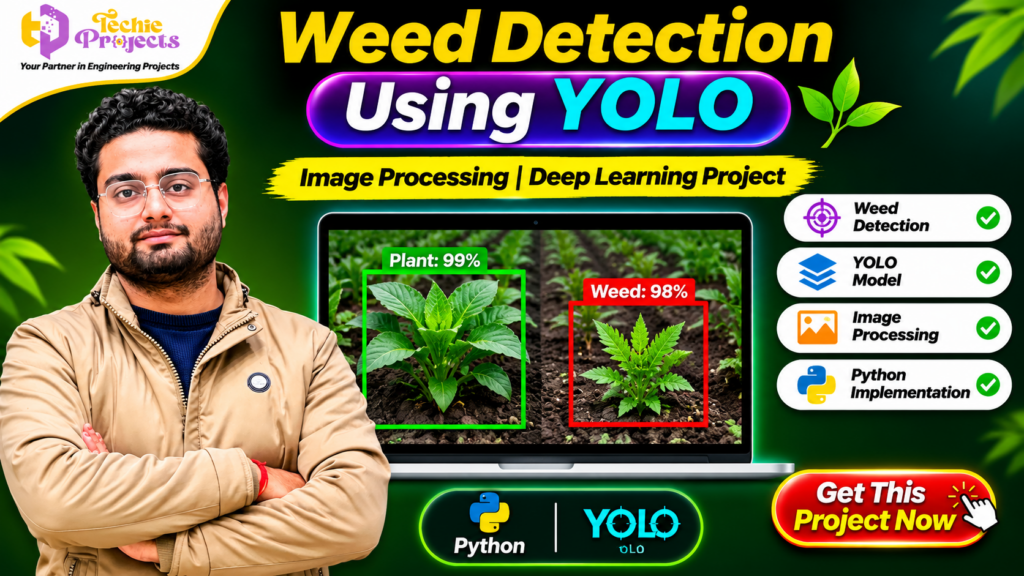
🌱 Looking for a ready-to-explore Weed Detection Using YOLO project for your final-year engineering submission? Techie Projects offers a Python-based computer vision project that demonstrates how deep learning can identify and locate unwanted plants in agricultural images. Instead of spending weeks building an object detection system from scratch, students can explore an existing project implementation, understand its workflow, study the code, and use it as a foundation for their academic learning.
The Weed Detection Using YOLO project combines Python, image processing, computer vision, and deep learning to demonstrate automated weed identification. It is a relevant choice for B.Tech, M.Tech, diploma, computer science, AI, and machine learning students looking for a practical project with real-world agricultural applications.
Get the project from Techie Projects and explore its implementation, source code, and available documentation. Whether you want to understand YOLO object detection or demonstrate an AI-based agricultural solution, this project provides a practical starting point.
📞 Get the Weed Detection Using YOLO Project from Techie Projects
Choosing a suitable final-year project can be challenging, especially when you need a practical implementation along with source code and technical understanding. Techie Projects helps students explore project implementations across Python, Artificial Intelligence, Machine Learning, Deep Learning, Computer Vision, and Image Processing.
The Weed Detection Using YOLO project is designed as an educational implementation that demonstrates object detection techniques for agricultural applications.
- 📞 Call/WhatsApp: +91-9460060699
- 🌎 Website: www.techieprojects.com
- 📺 Instagram: @pythonprojects_
🎬 Watch the Weed Detection Using YOLO Project Demo
Explore the project demonstration to understand how the system processes agricultural images and identifies plant-related objects using an object detection model.
🌱 What Is Weed Detection Using YOLO?
Weed detection is the process of identifying unwanted plants growing among crops. Weeds compete with crops for essential resources such as water, sunlight, nutrients, and growing space. If they are not managed properly, they can affect crop growth and agricultural productivity.
Traditional weed identification often depends on manual inspection. This process can require considerable time and effort, particularly when agricultural fields cover large areas.
Computer vision and deep learning provide another approach. An object detection model can process images, identify objects, and display their approximate locations using bounding boxes.
Weed Detection Using YOLO applies the You Only Look Once (YOLO) object detection approach to agricultural images. Depending on the dataset and model training, the system can be developed to distinguish between crop plants and targeted weed categories.
The project demonstrates how artificial intelligence can be applied to agricultural image analysis and automated visual identification.
🤖 How Does the YOLO Object Detection System Work?
YOLO is a popular family of object detection models used in computer vision applications. Unlike approaches that process different stages separately, YOLO performs object detection through a single neural network inference process.
The model analyzes an input image and predicts object locations and class labels.
A typical weed identification workflow includes the following stages:
1. 📷 Image Acquisition
The first step is collecting agricultural images. These images may contain crop plants, weeds, soil, and other objects found in agricultural environments.
The quality and variety of images influence how effectively a model can learn visual patterns.
2. 🏷️ Dataset Annotation
Images used for supervised object detection need suitable annotations. Bounding boxes are drawn around the objects that the model should identify.
Each annotation includes the object location and its corresponding class label.
For example, a dataset may contain classes such as:
- Crop
- Weed
- Soil or background, depending on the dataset design
Correct annotation is important because the model learns from the labels provided during training.
3. 🧠 Model Training
After preparing the dataset, the YOLO model can be trained using the annotated images.
During training, the model learns visual features that help distinguish the selected object categories. The training process adjusts model parameters to improve its predictions.
Training performance depends on the dataset size, annotation quality, model configuration, hardware, and training settings.
4. 🔍 Object Detection
Once a trained model is available, an image or video frame can be supplied for prediction.
The model processes the input and produces detection results, which may include:
- Predicted object class
- Confidence score
- Bounding box coordinates
- Detected object location
5. 📊 Result Visualization
The final detection results can be displayed using bounding boxes and labels. This makes it easier to understand which objects the model has identified.
The output provides a visual demonstration of how deep learning can support agricultural image analysis.
🚀 Key Features of the Weed Detection Using YOLO Project
The following features describe common capabilities of a YOLO-based agricultural object detection implementation. Actual functionality depends on the supplied project version.
🌿 1. Weed Identification
The system can be developed to identify targeted weed categories in agricultural images using a trained object detection model.
🎯 2. Bounding Box Detection
YOLO can locate detected objects by generating bounding boxes around them. These boxes help visualize the position of predicted weeds.
📈 3. Confidence Score Display
Object detection models can provide confidence scores alongside their predictions. These scores help users understand the model’s estimated confidence in each detection.
🖼️ 4. Image-Based Detection
Users can provide an image as input and view the model’s predictions. This is useful for demonstrating the image processing and object detection workflow.
🎥 5. Video-Based Detection
A suitable implementation can process video frames to demonstrate detection over time. This functionality depends on whether video processing is included in the project package.
🐍 6. Python Implementation
Python provides the programming environment for handling images, loading the model, running predictions, and displaying results.
🧠 7. Deep Learning Integration
The project demonstrates how deep learning models can be applied to computer vision problems involving agricultural images.
🛠️ Technologies Used in Weed Detection Using YOLO
A typical implementation may use the following technologies:
| Technology | Purpose |
|---|---|
| Python | Main programming language |
| YOLO | Object detection |
| OpenCV | Image and video processing |
| NumPy | Numerical operations |
| Deep Learning | Learning visual patterns |
| Dataset Annotation Tools | Preparing object labels |
| Matplotlib | Optional result visualization |
The exact libraries and versions depend on the supplied implementation.
🐍 Python
Python is widely used in machine learning and computer vision because of its accessible syntax and extensive library ecosystem. It can be used to prepare datasets, load trained models, process images, and display detection results.
👁️ OpenCV
OpenCV is an image processing and computer vision library. It can help read images, process video frames, resize inputs, and visualize object detection results.
🧠 YOLO Model
YOLO is responsible for predicting object classes and their locations. A trained model can identify the categories included in its training dataset.
📊 NumPy
NumPy supports numerical operations and array processing, which are commonly required in image processing and machine learning workflows.
🌾 Applications of Weed Detection Using YOLO
Automated weed identification has several potential agricultural applications.
1. 🚜 Smart Agriculture
Computer vision can support smart agriculture by helping analyze crop-field images. Weed identification can be one component of a broader precision agriculture system.
2. 🌱 Precision Weed Management
Identifying the location of unwanted plants may help agricultural systems plan targeted weed management activities. Actual field-level use requires suitable hardware, validated models, and operational testing.
3. 🛰️ Agricultural Image Analysis
Images collected from cameras, drones, or other imaging devices can be analyzed using object detection models, provided the input format and model are compatible.
4. 🤖 Agricultural Robotics
A trained object detection model may be integrated into an agricultural robot or automated platform. Additional navigation, localization, hardware, and safety components would be required.
5. 🎓 Academic Research
Students and researchers can use this project as a starting point for studying object detection, dataset preparation, model evaluation, and agricultural computer vision.
🎓 Why Choose This Project for Your Final Year?
A final-year project should demonstrate practical technical knowledge rather than only theoretical concepts. An agricultural object detection project provides an opportunity to understand how computer vision can be applied to a real-world problem.
Here are some reasons to consider this implementation:
- Practical AI application: Explore how deep learning can be used for agricultural image analysis.
- Computer vision experience: Understand image processing and object detection concepts.
- Python programming: Study how Python libraries work together in an AI application.
- Model understanding: Learn about YOLO predictions, bounding boxes, and confidence scores.
- Project demonstration: Present visual detection outputs during your academic evaluation.
- Further development: Explore possible improvements using additional datasets and model configurations.
This project can be suitable for students from Computer Science Engineering, Information Technology, Artificial Intelligence, Data Science, and related technical branches.
📚 Learning Outcomes
By studying the implementation, students can develop an understanding of several important concepts.
Understanding Object Detection
Learn how object detection differs from image classification. Classification identifies the main category in an image, whereas object detection also estimates the locations of individual objects.
Understanding Dataset Preparation
Explore image collection, annotation formats, class labels, and dataset organization.
Understanding Model Training
Learn the general training workflow, model configuration, validation, and performance evaluation.
Understanding Prediction Results
Study bounding boxes, class predictions, and confidence scores generated by an object detection model.
Understanding Computer Vision Applications
Explore how computer vision techniques can be applied to agricultural problems and other real-world domains.
⚙️ How to Develop a Weed Detection Using YOLO Project
Students interested in understanding the development process can follow these general stages.
Step 1: Collect Agricultural Images
Prepare a dataset containing images of crops and weeds. Include different lighting conditions, backgrounds, plant sizes, and camera angles where possible.
Step 2: Annotate the Dataset
Use an annotation tool to draw bounding boxes around the target objects. Assign the correct class labels to each object.
Step 3: Organize the Dataset
Separate the images into training, validation, and testing sets. Keep the annotation files consistent with the selected YOLO format.
Step 4: Configure the Model
Choose a suitable YOLO model and configure the number of classes, image size, batch size, and other training parameters.
Step 5: Train the Model
Train the model using the prepared dataset. Monitor training and validation results to understand how the model is learning.
Step 6: Test the Model
Evaluate the trained model on images that were not used during training. Check whether it identifies the target categories correctly.
Step 7: Display Detection Results
Use Python and suitable visualization libraries to display bounding boxes, class names, and confidence scores.
Step 8: Evaluate and Improve
Review incorrect predictions and missed detections. Improvements may include better annotations, more varied images, dataset balancing, and model configuration changes.
📊 Challenges in Weed Detection Projects
Developing an effective agricultural object detection system involves several challenges.
Similar Appearance of Crops and Weeds
Some weeds may look similar to crop plants, especially during early growth stages. The model needs representative training images to learn useful differences.
Changing Lighting Conditions
Sunlight, shadows, and weather conditions can change the appearance of agricultural images. A diverse dataset can help improve model robustness.
Background Complexity
Soil, leaves, overlapping plants, and other objects can make identification difficult.
Dataset Quality
Incorrect annotations, limited image variety, and class imbalance can affect model performance.
Model Performance
Detection accuracy and processing speed depend on the selected model, hardware, image resolution, and dataset. Results should be evaluated rather than assumed.
🔬 Future Scope and Project Enhancements
The basic implementation can be used as a foundation for further academic development.
Possible enhancements include:
- Real-Time Camera Detection: Integrate a compatible camera to process live video frames.
- Drone-Based Image Analysis: Explore agricultural image collection using drone cameras.
- Mobile Application Integration: Develop an application to display detection results on a mobile device.
- Detection Statistics: Add a dashboard showing the number of detected objects by category.
- Model Comparison: Compare different YOLO configurations using the same dataset and evaluation metrics.
- Improved Dataset: Collect more diverse images to study the effect of dataset quality on model performance.
- Agricultural Robot Integration: Explore how detection outputs could be used by a robotic platform, with additional hardware and safety systems.
These enhancements can help students explore the broader possibilities of AI-based agriculture.
💼 Why Purchase Your Weed Detection Using YOLO Project from Techie Projects?
If you are looking for a practical Python-based final-year project, Techie Projects can help you explore an implementation without starting every component from scratch.
We provide engineering project solutions across Artificial Intelligence, Machine Learning, Deep Learning, Python, Computer Vision, Image Processing, Android Development, and other technical domains.
When enquiring about this project, you can confirm the available package details, including:
- Project source code
- Documentation, if included
- Demonstration video or output screenshots, if available
- Software requirements and setup guidance
- Available technical support
- Customization possibilities, where applicable
Why choose Techie Projects?
- Project options for different engineering domains
- Practical implementations for academic learning
- Support with project-related enquiries
- Opportunities to explore customization requirements
- Assistance in understanding the selected project package
Before purchasing, contact our team to confirm the exact deliverables, supported software environment, and any additional requirements.
🛒 Purchase Weed Detection Using YOLO Project
Ready to explore this AI-based agricultural project for your academic submission?
Get in touch with Techie Projects to enquire about the Weed Detection Using YOLO project, available source code, documentation, pricing, and implementation details.
📞 Call/WhatsApp: +91-9460060699
🌎 Website: www.techieprojects.com
📺 Instagram: @pythonprojects_
Contact Techie Projects today to discuss your project requirements and get details about purchasing this implementation.
💡 Recommended Projects for AI, Machine Learning and Computer Vision Students
Looking for more practical engineering projects? Explore these related project ideas from Techie Projects to discover applications of Python, deep learning, image processing, and object detection.
🌿 1. Plant Leaf Disease Detection Using Machine Learning
Identify plant leaf diseases from images using image processing and machine learning techniques. Explore how AI can support agricultural image analysis.
🚗 2. Vehicle Detection and Counting Using YOLO
Develop a computer vision system that detects vehicles in images or video streams and counts detected objects.
🪖 3. Helmet Detection Using Machine Learning
Explore object detection techniques to identify motorcycle riders wearing or not wearing helmets.
🕳️ 4. Pothole Detection Using Deep Learning
Analyze road images to identify potholes using computer vision and deep learning techniques.
🔥 5. Fire and Smoke Detection Using YOLO
Build an object detection application that identifies visible fire and smoke in images or video footage.
🗑️ 6. Garbage Detection Using YOLO
Explore automated waste identification using object detection and image processing techniques.
🚘 7. Car Speed Detection Using OpenCV and Python
Study vehicle tracking and speed estimation using computer vision techniques.
🧠 8. Real-Time Object Detection Using YOLO
Develop a general-purpose object detection application that identifies multiple object categories in images or video.
🎓 Explore more: Visit Techie Projects to discover Python, Artificial Intelligence, Machine Learning, Deep Learning, and Computer Vision projects for your academic requirements.
❓ Frequently Asked Questions
1. What is Weed Detection Using YOLO?
It is a computer vision project that uses a trained YOLO object detection model to identify and locate selected weed categories in agricultural images.
2. Which programming language is used?
Python is commonly used for this implementation, along with suitable computer vision and deep learning libraries.
3. What is the role of YOLO in this project?
YOLO processes input images and predicts object classes and bounding box locations for the categories it has learned.
4. Can the project detect weeds in real time?
Real-time detection is possible when the implementation includes video or camera input and the hardware can process frames at a suitable speed. Confirm whether this feature is included in the available package.
5. Is this project suitable for final-year engineering students?
Yes. It can be considered by students studying computer science, information technology, artificial intelligence, data science, and related subjects.
6. Can the model be trained with a custom dataset?
Yes, provided the dataset is properly annotated and compatible with the selected YOLO training configuration.
7. Can this project be extended?
Possible extensions include camera integration, drone-based image analysis, mobile application development, and model comparison.
8. Where can I purchase this project?
You can contact Techie Projects through WhatsApp or visit the official website to enquire about availability, pricing, source code, documentation, and technical support.
🎯 Conclusion
The Weed Detection Using YOLO project demonstrates how Python, deep learning, and computer vision can be combined to explore an important agricultural application. From dataset annotation and model training to object detection and result visualization, the implementation introduces students to key concepts used in modern AI systems.
For engineering students who want to explore practical machine learning and image processing, this project offers a useful academic starting point. It also provides opportunities to investigate advanced applications such as real-time detection, drone-based monitoring, and smart agriculture.
Choose a project that helps you understand the technology behind the solution, not just its final output. Explore the Weed Detection Using YOLO implementation from Techie Projects and take the next step in your AI and computer vision learning journey.