
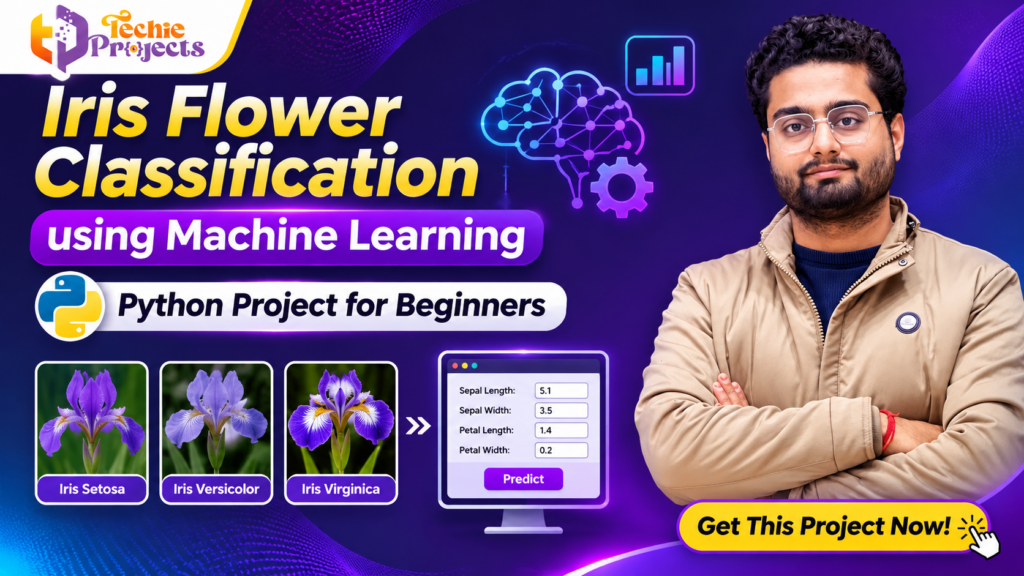
🚀 Purchase a Complete Iris Flower Classification using Machine Learning Project
Are you searching for a practical Iris Flower Classification using Machine Learning project for your final-year engineering submission, college assignment, Python portfolio, or academic demonstration? Get a complete Python-based machine learning project from Techie Projects and explore how artificial intelligence can identify different Iris flower species using their physical measurements.
Instead of spending valuable time searching for scattered source code, resolving implementation errors, and following incomplete tutorials, choose a ready-to-understand project solution that helps you explore machine learning concepts through practical implementation.
The Iris Flower Classification using Machine Learning project is an excellent choice for B.Tech, BCA, MCA, Computer Science, IT, and Data Science students. It uses the popular Iris dataset to predict flower species based on sepal length, sepal width, petal length, and petal width.
🎯 Whether you are a beginner learning Python or an engineering student looking for a machine learning major project, Techie Projects can help you understand the implementation, explore the source code, and prepare for your academic presentation.
📞 Contact Techie Projects for Project Enquiries
Interested in purchasing the Iris Flower Classification using Machine Learning Project? Contact us to enquire about package availability, pricing, source code, documentation, installation guidance, and technical support options.
💬 WhatsApp Enquiry: Chat with Techie Projects
📱 Contact Number: +91 94600 60699
🌐 Official Website: www.techieprojects.com
📸 Instagram: Follow Techie Projects
🎓 Project Areas: Robotics, Machine Learning, Arduino, Deep Learning, Artificial Intelligence, and Android App.
✅ Request Project Details: Share your engineering branch, preferred features, and technical requirements to enquire about the most suitable available package.
🚀 Ready to get started? Click here to enquire on WhatsApp and mention Iris Flower Classification using Machine Learning.
Package contents, prices, hardware availability, and support options should be confirmed before purchase.
🎬 Watch the Iris Flower Classification Project Demo
Explore the working demonstration of the Iris Flower Classification using Machine Learning project to understand how users enter flower measurements and receive a predicted flower species.
The demonstration helps students understand the application’s interface, input parameters, prediction process, and final classification output.
🌸 What Is Iris Flower Classification using Machine Learning?
Iris Flower Classification using Machine Learning is a supervised machine learning application that predicts the species of an Iris flower using numerical measurements.
The project uses four important flower features:
- Sepal Length: Measures the length of the flower’s outer leaf-like structure.
- Sepal Width: Measures the width of the sepal.
- Petal Length: Measures the length of the flower’s petal.
- Petal Width: Measures the width of the flower’s petal.
Based on these four measurements, a trained machine learning model predicts one of three Iris flower species:
- Iris Setosa
- Iris Versicolor
- Iris Virginica
The Iris dataset is one of the most popular beginner datasets in data science and machine learning. It provides a straightforward way to understand classification algorithms, data preprocessing, model training, and prediction.
This Python project demonstrates how numerical input data can be transformed into meaningful predictions using machine learning techniques.
🎯 Objectives of the Iris Flower Classification Project
The primary objective of this project is to develop a Python application that identifies Iris flower species using machine learning algorithms.
Important project objectives include:
- Understanding supervised machine learning concepts.
- Learning how classification algorithms work.
- Exploring the Iris dataset.
- Performing data preprocessing and feature selection.
- Training a machine learning model using Python.
- Predicting flower species using input measurements.
- Developing an interactive graphical user interface.
- Understanding model evaluation and prediction results.
The project is particularly useful for students who want to understand the complete machine learning workflow through a practical implementation.
⚙️ Working Methodology of Iris Flower Classification using Machine Learning
The working methodology of Iris Flower Classification using Machine Learning involves collecting the dataset, preprocessing numerical values, training a classification model, and generating predictions.
The application accepts four flower measurements and passes them to a trained machine learning model. The model analyzes the input features and identifies the most likely Iris species.
Stage 1: Dataset Collection
The first stage involves obtaining the Iris dataset, which contains flower measurements and corresponding species labels.
The dataset includes:
- Sepal length
- Sepal width
- Petal length
- Petal width
- Flower species
Each dataset record represents a flower sample. These measurements are used as input features during model training.
Stage 2: Data Preprocessing
Data preprocessing prepares the dataset for machine learning.
Important preprocessing activities include:
- Loading the dataset using Python.
- Checking missing or invalid values.
- Separating input features and target labels.
- Exploring the distribution of different flower species.
- Preparing the data for model training.
This stage helps maintain consistent data and improves the reliability of the training process.
Stage 3: Feature Selection
Feature selection identifies the important parameters used for predicting the flower species.
For this project, the four primary features are sepal length, sepal width, petal length, and petal width.
These measurements provide the information required by the classification model.
Stage 4: Model Training
The prepared dataset is used to train a supervised machine learning classification algorithm.
Depending on the implementation, algorithms such as the following can be explored:
- Logistic Regression
- Decision Tree Classifier
- K-Nearest Neighbors (KNN)
- Support Vector Machine (SVM)
- Random Forest Classifier
The trained model learns patterns from the flower measurements and their corresponding labels.
Stage 5: Model Evaluation
After training, the model is evaluated using test data.
Common evaluation techniques include:
- Accuracy score
- Confusion matrix
- Precision
- Recall
- F1-score
These evaluation methods help students understand how well the classification model performs on unseen samples.
Stage 6: Flower Species Prediction
Once the model has been trained, users can enter four flower measurements into the application.
The prediction process uses the trained model to classify the input into Iris Setosa, Iris Versicolor, or Iris Virginica.
Stage 7: Graphical User Interface Development
The project can include a graphical user interface developed using Python Tkinter.
Users enter the flower measurements into input fields and click the Predict button to view the classification result.
The interface makes the application easier to demonstrate and understand.
🧠 Technologies Used in Iris Flower Classification using Machine Learning
This project combines Python programming, data analysis, and machine learning technologies.
1. Python Programming
Python is the primary programming language used to develop the application. Its simple syntax and extensive machine learning ecosystem make it suitable for beginners.
2. NumPy
NumPy supports numerical calculations and array operations required during data processing.
3. Pandas
Pandas is used to load, explore, organize, and manipulate the Iris dataset.
4. Scikit-Learn
Scikit-Learn provides machine learning algorithms and utilities for model training, testing, evaluation, and prediction.
5. Matplotlib
Matplotlib can be used to create charts and visualize flower measurements and dataset patterns.
6. Tkinter
Tkinter provides the graphical interface through which users can enter flower measurements and view prediction results.
💻 Key Features of the Iris Flower Classification Project
The Iris Flower Classification using Machine Learning application offers several useful features for learning and demonstrating machine learning concepts.
1. Interactive Flower Prediction
Users can enter flower measurements and obtain a predicted Iris species.
2. Three-Class Classification
The application identifies three different Iris flower species.
3. Python-Based Implementation
The project demonstrates practical Python programming and machine learning implementation.
4. Dataset Processing
Students can understand how structured datasets are loaded, processed, and prepared for model training.
5. Machine Learning Integration
The application demonstrates how trained classification models generate predictions from numerical input features.
6. Graphical User Interface
A Tkinter-based interface can make the project easier to operate and demonstrate.
7. Academic Learning Support
Students can explore the source code, understand the methodology, and prepare explanations for project presentations.
🎓 Benefits of Iris Flower Classification using Machine Learning for Final-Year Students
Choosing the right final-year project is important for engineering students because it provides an opportunity to demonstrate practical technical knowledge.
The Iris Flower Classification using Machine Learning project offers several academic and technical benefits.
1. Understanding Machine Learning Fundamentals
Students learn supervised learning, classification, training, testing, and prediction through a practical example.
2. Practical Python Programming Experience
The implementation provides hands-on experience with Python libraries such as Pandas, NumPy, and Scikit-Learn.
3. Learning Data Preprocessing
Students understand how raw dataset records are organized and prepared before training a machine learning model.
4. Understanding Classification Algorithms
The project provides an opportunity to experiment with different classification algorithms and compare their results.
5. Useful for Academic Presentations
Students can explain dataset collection, model training, evaluation, and prediction during project demonstrations and viva examinations.
6. Portfolio Development
A completed machine learning project can demonstrate practical technical knowledge when building a student portfolio.
7. Beginner-Friendly Implementation
The Iris dataset makes this project suitable for students who are starting their journey in artificial intelligence and data science.
📊 Applications of Iris Flower Classification
Although the Iris dataset is commonly used for educational purposes, its classification workflow demonstrates broader machine learning concepts.
Some relevant learning applications include:
- Botanical Data Analysis: Understanding how numerical plant measurements can be used for classification.
- Educational Machine Learning: Demonstrating supervised learning concepts in classrooms and laboratories.
- Data Science Practice: Exploring feature analysis, visualization, and classification.
- Algorithm Comparison: Comparing different machine learning algorithms using the same dataset.
- Predictive Modeling: Understanding how trained models generate predictions from new input values.
The project is primarily an educational classification application rather than a professional botanical identification system.
🛠️ Software and Hardware Requirements
Software Requirements
- Programming Language: Python
- Machine Learning Library: Scikit-Learn
- Data Processing: Pandas and NumPy
- Visualization: Matplotlib
- GUI Framework: Tkinter
- Operating System: Windows 10/11 or compatible operating system
- Development Environment: VS Code, PyCharm, or Jupyter Notebook
Hardware Requirements
- Processor: Intel Core i3 or equivalent
- RAM: 4 GB minimum
- Storage: 500 MB of available space
- Input Devices: Keyboard and Mouse
- System: Laptop or Desktop Computer
The Iris dataset is relatively small, so the basic implementation can run on an ordinary computer without requiring a dedicated GPU.
🚀 Why Choose Iris Flower Classification using Machine Learning from Techie Projects?
Choosing Iris Flower Classification using Machine Learning from Techie Projects gives students an opportunity to explore a practical Python-based artificial intelligence application. The project demonstrates how machine learning algorithms analyze flower measurements and generate classification predictions.
Our Iris Flower Classification using Machine Learning solution is suitable for students interested in Python programming, data analytics, and supervised learning. It provides an opportunity to understand dataset preparation, model training, testing, and prediction.
📚 What Will You Learn from This Project?
By working with Iris Flower Classification using Machine Learning, students can explore:
- Python programming and machine learning implementation.
- Iris dataset analysis and visualization.
- Classification algorithm development.
- Model training and performance evaluation.
- Predictive analysis using Scikit-Learn.
- Graphical user interface development.
💻 Get Your Python Machine Learning Project
If you are searching for Iris Flower Classification using Machine Learning with source code and a practical demonstration, contact Techie Projects.
Our team can help you understand the available project package, implementation details, documentation, and technical support options.
Get your Iris Flower Classification using Machine Learning project today and strengthen your practical understanding of Python and Artificial Intelligence!
📈 Future Enhancements of the Iris Flower Classification Project
Students can extend the project with additional features to explore more advanced machine learning concepts.
Possible future enhancements include:
- Web-Based Application: Convert the existing application into a web interface using Flask or Streamlit.
- Advanced Visualization: Add interactive charts to display the relationship between flower measurements.
- Algorithm Comparison: Compare Logistic Regression, Random Forest, SVM, and KNN.
- Model Performance Dashboard: Display accuracy, precision, recall, and confusion matrix results.
- Dataset Expansion: Experiment with additional plant classification datasets.
- Model Deployment: Deploy the trained model for online prediction.
- Improved User Interface: Develop a modern interface with better input validation and prediction displays.
These enhancements can help students expand their understanding of machine learning and software development.
💡 Recommended Projects from Techie Projects
If you are interested in Iris Flower Classification using Machine Learning, you can also explore other Python, Data Science, Artificial Intelligence, and Computer Vision projects.
- Face Recognition Attendance System – An AI-based application for automatic attendance using facial recognition.
- Fake News Detection using Machine Learning – Classifies news content using natural language processing techniques.
- Lung Cancer Prediction using Machine Learning – An educational machine learning application for medical image classification.
- Plant Leaf Disease Detection – Uses image processing and deep learning to classify plant leaf conditions.
- Heart Disease Prediction using Machine Learning – Predicts risk categories using medical dataset features.
- Student Placement Prediction – Analyzes academic data to predict student performance.
- House Price Prediction using Python – Uses regression techniques to estimate property prices.
Explore more project ideas at Techie Projects.
💰 Why Purchase Your Machine Learning Project from Techie Projects?
Finding a suitable final-year project can be challenging. Students often spend considerable time searching for compatible source code, understanding implementation steps, preparing documentation, and resolving technical errors.
Techie Projects provides project solutions designed to help engineering students explore practical applications of programming and modern technologies.
What Makes Techie Projects a Useful Choice?
- Python-based academic project solutions.
- Projects across Artificial Intelligence and Machine Learning.
- Practical project demonstrations where available.
- Source code and implementation details according to the selected package.
- Guidance for understanding project functionality.
- Solutions for B.Tech, BCA, MCA, and other technical students.
- Direct communication for project-related enquiries.
Before purchasing, students can contact our team to confirm the exact deliverables, supported software versions, documentation availability, and implementation assistance included in the selected package.
🚀 Purchase Iris Flower Classification using Machine Learning Project Today!
Ready to develop your Python and machine learning skills with a practical academic project?
Get the Iris Flower Classification using Machine Learning project from Techie Projects and explore how supervised learning algorithms classify flower species using numerical measurements.
Whether you need a beginner-friendly Python project, a machine learning assignment, or a final-year engineering project, our team can help you find a suitable project package.
🎯 GET THIS PROJECT NOW AND START YOUR MACHINE LEARNING PROJECT JOURNEY!
📞 Contact / WhatsApp: +91 94600 60699
🌐 Website: www.techieprojects.com
📸 Instagram: @pythonprojects_
Techie Projects – Your Partner in Engineering Projects and Innovative Technology Solutions.
❓ Frequently Asked Questions (FAQs)
1. What is Iris Flower Classification using Machine Learning?
It is a supervised machine learning project that predicts the species of an Iris flower using sepal and petal measurements.
2. Which dataset is used in this project?
The project uses the famous Iris dataset, which contains measurements and species labels for three Iris flower classes.
3. Which flower species can the application predict?
The application predicts Iris Setosa, Iris Versicolor, and Iris Virginica.
4. Which programming language is used?
Python is the primary programming language used for dataset processing, model training, and prediction.
5. Which machine learning algorithms can be used?
Algorithms such as Logistic Regression, Decision Tree, KNN, Support Vector Machine, and Random Forest can be explored.
6. Is this project suitable for beginners?
Yes. The Iris dataset is widely used for learning basic machine learning and classification concepts.
7. Does the project include a graphical user interface?
The project can include a Python Tkinter interface for entering flower measurements and displaying predictions. Confirm the exact interface included in your selected package.
8. Can this project be used for a final-year engineering submission?
Yes. It is a suitable educational machine learning project for students who need to demonstrate dataset processing, classification, model evaluation, and Python implementation.
9. Can the project be extended?
Yes. Students can extend it using Flask, Streamlit, additional visualizations, algorithm comparisons, and model deployment.
10. How can I purchase the project?
Contact Techie Projects through WhatsApp at +91 94600 60699 or visit www.techieprojects.com to discuss project availability, pricing, and deliverables.
🔗 Explore Related Python Projects
Discover more Python programming, artificial intelligence, machine learning, and data science project solutions at Techie Projects.
Visit: www.techieprojects.com
📞 Contact / WhatsApp: +91-9460060699

