
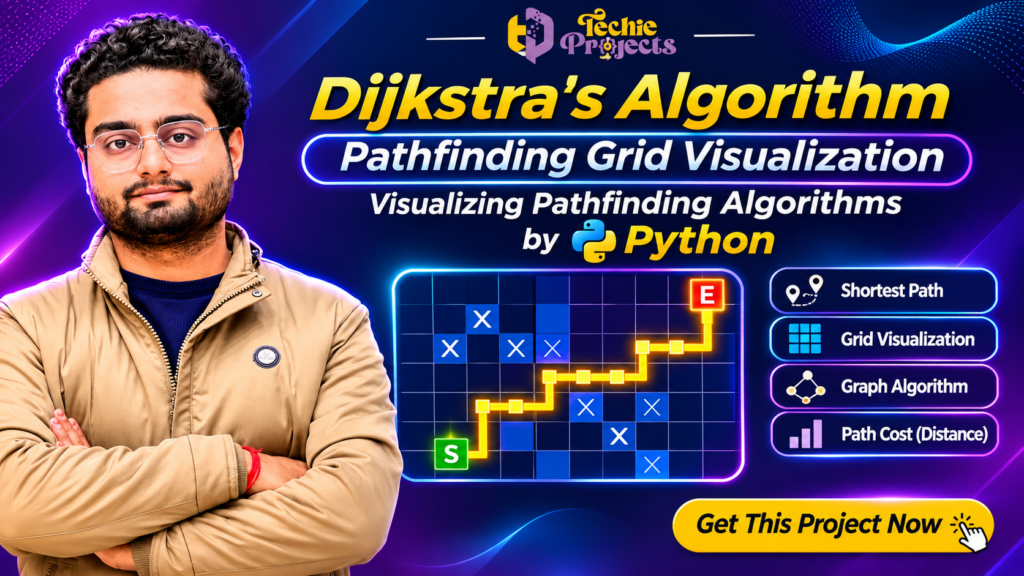
🚀 Looking to purchase a Dijkstra’s Algorithm Pathfinding Visualization Project with Python source code? Get a practical, ready-to-demonstrate project from Techie Projects and save valuable development time on your academic submission. This project demonstrates how intelligent pathfinding works by finding the shortest route between a starting point and a destination while avoiding obstacles on a visual grid.
🎓 Whether you are a B.Tech student, Computer Science Engineering student, IT student, MCA student, or final-year project developer, this Python-based project is an excellent choice for understanding graph algorithms, data structures, artificial intelligence concepts, and interactive visualization.
Instead of spending hours developing the complete application from scratch, you can purchase the Dijkstra’s Algorithm Pathfinding Visualization Project from Techie Projects and get a practical implementation to explore, understand, test, and demonstrate.
📞 Contact Techie Projects for Project Enquiries
Interested in purchasing the Dijkstra’s Algorithm Pathfinding Visualization Project? Contact us to enquire about package availability, pricing, source code, documentation, installation guidance, and technical support options.
💬 WhatsApp Enquiry: Chat with Techie Projects
📱 Contact Number: +91 94600 60699
🌐 Official Website: www.techieprojects.com
📸 Instagram: Follow Techie Projects
🎓 Project Areas: Robotics, Machine Learning, Arduino, Deep Learning, Artificial Intelligence, and Android App.
✅ Request Project Details: Share your engineering branch, preferred features, and technical requirements to enquire about the most suitable available package.
🚀 Ready to get started? Click here to enquire on WhatsApp and mention Dijkstra’s Algorithm Pathfinding Visualization Project .
Package contents, prices, hardware availability, and support options should be confirmed before purchase.
🎬 Watch the Dijkstra’s Algorithm Pathfinding Visualization Project Demo
Explore the working demonstration of the Dijkstra’s Algorithm Pathfinding Visualization Project and understand how the algorithm calculates the shortest path between two points.
Watch the project demonstration to see how the grid works, how obstacles affect route selection, and how the shortest path is identified.
💡 What Is Dijkstra’s Algorithm?
Dijkstra’s Algorithm is a popular graph traversal and shortest-path algorithm used in computer science to calculate the minimum distance between a starting node and other reachable nodes in a weighted graph.
It was developed by computer scientist Edsger W. Dijkstra and is widely used in navigation systems, network routing, robotics, transportation applications, and artificial intelligence.
The Dijkstra’s Algorithm Pathfinding Visualization application provides a graphical way to understand this algorithm instead of learning it only through mathematical explanations or programming theory.
In this project, a grid represents the environment. Each cell represents a node, and the connections between cells represent possible movements.
The algorithm examines available paths, calculates their costs, and identifies the shortest route from the starting position to the destination.
🎯 Project Overview
The Dijkstra’s Algorithm Pathfinding Visualization Project is a Python-based application designed to demonstrate shortest-path searching through an interactive grid environment.
The application helps users understand how a computer explores different possible routes and selects the shortest available path.
The grid contains different elements:
- Starting Point: The initial position from which the algorithm begins searching.
- Destination Point: The target position that the algorithm needs to reach.
- Obstacles: Blocked cells that cannot be crossed.
- Explored Nodes: Cells examined during the searching process.
- Shortest Path: The final route identified by the algorithm.
The Dijkstra’s Algorithm Pathfinding Visualization Project makes these operations easier to understand through graphical representation.
Students can observe how the algorithm explores the grid and how different obstacle arrangements affect the final route.
The Dijkstra’s Algorithm Pathfinding Visualization Project is designed to demonstrate how shortest-path searching works in a practical Python application. Students can explore different grid configurations, understand node exploration, and observe how the algorithm identifies an efficient route.
⭐ Key Features of the Project
One of the major advantages of the Dijkstra’s Algorithm Pathfinding Visualization Project is its interactive approach to algorithm learning. Instead of studying only theoretical concepts, students can observe the pathfinding process and understand how obstacles influence route selection.
The project provides several useful features for learning and demonstrating pathfinding algorithms.
1. Interactive Grid Visualization
The application represents the environment using a grid-based interface. Users can understand the relationship between nodes, obstacles, and possible movement directions.
2. Shortest Path Calculation
The primary feature is shortest-path calculation. Dijkstra’s Algorithm evaluates possible routes and identifies the minimum-cost path from the starting node to the destination.
3. Obstacle Management
Obstacles can be placed between the starting and ending points. These blocked cells prevent the algorithm from selecting invalid routes.
4. Pathfinding Visualization
The application demonstrates the searching process visually. Users can understand how the algorithm explores nodes before identifying the final route.
5. Graph Algorithm Implementation
The project demonstrates important graph concepts, including nodes, edges, distances, weights, and traversal.
6. Educational Demonstration
Students can use the application to understand algorithmic problem-solving, data structures, and shortest-path techniques.
7. Python-Based Development
The application uses Python, making it suitable for students who want to explore algorithm implementation and graphical programming.
⚙️ How Does Dijkstra’s Algorithm Work?
Dijkstra’s Algorithm works by maintaining the shortest known distance from the starting node to every reachable node.
The algorithm follows a systematic process.
Step 1: Initialize the Starting Node
The starting node receives a distance value of zero. All other nodes are initially assigned an infinite distance.
Step 2: Select the Minimum-Distance Node
The algorithm selects the unvisited node having the smallest known distance.
Step 3: Explore Neighbouring Nodes
The algorithm examines the neighbouring nodes connected to the currently selected node.
Step 4: Update Distances
If travelling through the current node provides a shorter route to a neighbouring node, its distance is updated.
Step 5: Mark the Node as Visited
After processing its neighbours, the current node is marked as visited.
Step 6: Continue Searching
The process continues until the destination is reached or no reachable nodes remain.
Step 7: Reconstruct the Shortest Path
The application traces the predecessor information to identify the final shortest route.
This process is demonstrated visually in the Dijkstra’s Algorithm Pathfinding Visualization application.
If you are searching for a Python-based academic project, the Dijkstra’s Algorithm Pathfinding Visualization Project is a useful option for understanding graph traversal, shortest-path calculations, and algorithm implementation.
🧠 Technologies Used in the Project
The project focuses on Python programming and algorithm visualization.
The following technologies and concepts are relevant to its development:
| Technology | Purpose |
|---|---|
| Python | Main programming language |
| Graph Algorithms | Shortest-path calculation |
| Data Structures | Managing nodes and distances |
| Grid Representation | Visualizing the environment |
| GUI Framework | Graphical interaction |
| Pathfinding Logic | Identifying the shortest route |
The exact libraries and framework requirements should be confirmed with Techie Projects before installation.
💻 Software and Hardware Requirements
Software Requirements
- Programming Language: Python
- Operating System: Windows 10 / Windows 11
- Python IDE: Visual Studio Code or PyCharm
- Required Python libraries: As specified in the project package
- Implementation: Graph algorithms and pathfinding visualization
Hardware Requirements
- Processor: Intel Core i3 or equivalent
- RAM: Minimum 4 GB
- Storage: Minimum 500 GB HDD or SSD
- Input Devices: Keyboard and Mouse
These are general development recommendations. Actual requirements depend on the supplied implementation.
📚 Important Concepts Covered in This Project
The Dijkstra’s Algorithm Pathfinding Visualization Project introduces several important computer science concepts.
1. Graph Theory
Graph theory is a mathematical concept used to represent relationships between different objects through vertices and edges.
2. Shortest Path Algorithms
Shortest-path algorithms calculate the minimum-cost route between two or more nodes.
3. Priority Queue
A priority queue is commonly used in efficient implementations of Dijkstra’s Algorithm to select the node with the smallest tentative distance.
4. Greedy Algorithm
Dijkstra’s Algorithm follows a greedy approach by repeatedly selecting the unvisited node with the smallest known distance.
5. Data Structures
The implementation helps students understand how arrays, lists, dictionaries, sets, and priority queues can support algorithmic operations.
6. Algorithm Complexity
Using an adjacency list and a priority queue, a common implementation of Dijkstra’s Algorithm has a time complexity of approximately O((V + E) log V), where V represents vertices and E represents edges.
Understanding these concepts can help students prepare for technical interviews, programming examinations, and academic presentations.
🔍 Applications of Dijkstra’s Algorithm
Dijkstra’s Algorithm is not limited to academic demonstrations. It has practical applications in many industries.
1. GPS Navigation Systems
Navigation applications use shortest-path techniques to calculate routes between different geographical locations.
2. Computer Network Routing
Network routing systems use graph-based algorithms to identify efficient routes for transferring information.
3. Robotics
Robots can use pathfinding algorithms to navigate environments while avoiding obstacles.
4. Game Development
Game developers use pathfinding algorithms to control the movement of characters and objects across maps.
5. Transportation Management
Graph algorithms can help calculate routes between stations, cities, and transportation networks.
6. Artificial Intelligence
Pathfinding is an important concept in intelligent systems that require navigation and decision-making.
Looking to purchase the Dijkstra’s Algorithm Pathfinding Visualization Project? Techie Projects can provide information about the available Python source code, project package, demonstration, and customization options.
🏆 Why Purchase This Project from Techie Projects?
Are you searching for a practical Python project that you can understand, execute, and demonstrate?
Techie Projects provides engineering project development support across several technical domains.
By purchasing the Dijkstra’s Algorithm Pathfinding Visualization Project, students can get a project implementation without having to develop every component independently.
Benefits of Purchasing from Techie Projects
- 🎓 Academic project support for engineering students.
- 💻 Python-based project implementation.
- 📂 Source code availability as per the selected package.
- ⚙️ Practical demonstration of shortest-path algorithms.
- 📖 Technical guidance regarding project implementation.
- 🧪 Opportunity to explore and test the application.
- 🚀 Suitable for learning and project demonstrations.
Our objective is to help students understand practical technology concepts and develop their technical knowledge.
Don’t waste your valuable project-development time. Contact Techie Projects today to discuss purchasing the complete project package.
🛒 Get This Dijkstra’s Algorithm Project Now!
Ready to purchase the Dijkstra’s Algorithm Pathfinding Visualization Project?
Get in touch with Techie Projects to discuss project availability, pricing, source code, documentation, and customization requirements.
Whether you need the project for a college assignment, academic demonstration, or learning purpose, our team can help you understand the available project package.
Purchase Enquiry:
- 📞 Contact / WhatsApp: +91 94600 60699
- 🌐 Website: www.techieprojects.com
- 📸 Instagram: @pythonprojects_
📩 Send us a WhatsApp message with the project name: Dijkstra’s Algorithm Pathfinding Visualization Project.
Our team can share the available package details and purchasing information.
🎓 Who Can Purchase This Project?
This project can be useful for students from different academic backgrounds.
- B.Tech Computer Science Engineering students.
- B.Tech Information Technology students.
- MCA students.
- BCA students.
- Diploma Computer Engineering students.
- Students learning Python programming.
- Students interested in Artificial Intelligence.
- Students studying Data Structures and Algorithms.
The project can also be useful for developers who want to understand how shortest-path algorithms work through practical implementation.
🚀 Recommended Python and Computer Science Projects
Looking for more interesting projects? Explore other practical project ideas available through Techie Projects.
- Vehicle Detection and Counting System: Detect and count vehicles using computer vision.
- Face Recognition Attendance System: Automate attendance using facial recognition.
- AI-Based Exam Proctoring System: Monitor examination activities using artificial intelligence.
- Fake News Detection Using Machine Learning: Classify news articles using NLP techniques.
- Pothole Detection System: Identify road potholes using computer vision.
- Object Detection Using YOLO: Detect multiple objects in images and videos.
- Smart Parking Management System: Automate parking operations using intelligent systems.
These projects can help students explore different areas of Python, Artificial Intelligence, Machine Learning, and Computer Vision.
📖 Frequently Asked Questions (FAQs)
1. What is the Dijkstra’s Algorithm Pathfinding Visualization Project?
It is a Python-based application that demonstrates how Dijkstra’s Algorithm identifies the shortest path between a starting point and a destination using a grid-based environment.
2. Can I purchase this project with Python source code?
Yes. Contact Techie Projects to confirm source code availability, package details, and purchasing options.
3. Is this project suitable for final-year engineering students?
Yes. It is relevant to Computer Science and Information Technology students studying algorithms, graph theory, and Python programming.
4. What programming language is used?
Python is the primary programming language used for implementing the project.
5. What is the main objective of this project?
The main objective is to demonstrate shortest-path searching and explain how graph algorithms identify efficient routes while considering obstacles.
6. Is Dijkstra’s Algorithm an AI algorithm?
Dijkstra’s Algorithm is primarily a graph-based shortest-path algorithm. It is also useful in applications involving artificial intelligence, robotics, and intelligent navigation.
7. How can I get the project price?
You can contact Techie Projects through WhatsApp at +91 94600 60699 to request current pricing and package information.
8. Can the project be customized?
Customization requirements can be discussed with the Techie Projects team before purchasing.
🌟 Explore More Python Projects at Techie Projects
Technology is continuously evolving, and practical implementation is an important part of engineering education.
At Techie Projects, students can explore project ideas and implementations across multiple domains, including:
- Artificial Intelligence and Machine Learning.
- Python Development.
- Data Science and Data Analytics.
- Computer Vision and Image Processing.
- Natural Language Processing.
- Deep Learning.
- Internet of Things (IoT).
- Web Development.
- Android Application Development.
Visit our website to explore more project ideas and discover practical solutions for your academic requirements.
👉 Explore Related Python Projects: www.techieprojects.com
Choose the Dijkstra’s Algorithm Pathfinding Visualization Project to explore practical Python programming, graph theory, and shortest-path algorithms through an interactive implementation.
🎯 Final Conclusion
The Dijkstra’s Algorithm Pathfinding Visualization Project is a practical way to understand shortest-path algorithms, graph theory, and Python programming.
It demonstrates how a computer can identify an efficient route between two points while considering obstacles and movement costs.
For engineering students, this project offers an opportunity to connect theoretical computer science concepts with practical implementation.
If you are looking to purchase a Python-based pathfinding project, contact Techie Projects to get information about the available source code, documentation, demonstration, and customization options.
🚀 Get your Dijkstra’s Algorithm project now!
📞 Contact / WhatsApp: +91 94600 60699
🌐 Website: www.techieprojects.com
📸 Instagram: @pythonprojects_
Techie Projects – Turning Innovative Ideas into Practical Technology Projects!

