
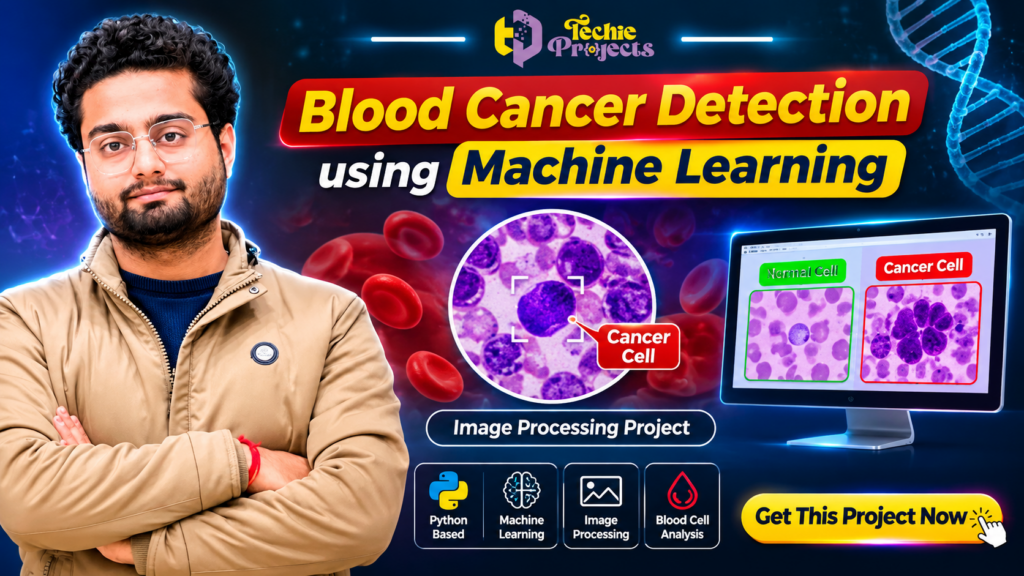
🎓 Are you looking for an advanced Blood Cancer Detection using Machine Learning project for your final-year engineering submission, computer science project, or academic research? Get a practical Python-based machine learning project from Techie Projects and explore how artificial intelligence and image processing techniques can be applied to blood cell image analysis.
🚀 Don’t waste your valuable project development time starting everything from scratch! Techie Projects offers an academic implementation of Blood Cancer Detection using Machine Learning, designed for students interested in Artificial Intelligence, Deep Learning, Python Programming, and Medical Image Processing.
Our project demonstrates how machine learning techniques can analyse microscopic blood cell images and identify image patterns associated with different cell categories. It provides an interesting opportunity to understand how AI-based image analysis works in healthcare-related research.
Whether you are a B.Tech, M.Tech, BCA, MCA, or computer science student, this project can help you explore an important application of artificial intelligence.
📞 Contact Techie Projects for Project Enquiries
Interested in purchasing the Blood Cancer Detection using Machine Learning? Contact us to enquire about package availability, pricing, source code, documentation, installation guidance, and technical support options.
💬 WhatsApp Enquiry: Chat with Techie Projects
📱 Contact Number: +91 94600 60699
🌐 Official Website: www.techieprojects.com
📸 Instagram: Follow Techie Projects
🎓 Project Areas: Robotics, Machine Learning, Arduino, Deep Learning, Artificial Intelligence, and Android App.
✅ Request Project Details: Share your engineering branch, preferred features, and technical requirements to enquire about the most suitable available package.
🚀 Ready to get started? Click here to enquire on WhatsApp and mention Blood Cancer Detection using Machine Learning.
Package contents, prices, hardware availability, and support options should be confirmed before purchase.
🎬 Watch the Blood Cancer Detection using Machine Learning Project Demo
Watch the project demonstration to understand its working process, user interface, image processing workflow, and machine learning implementation.
The demonstration helps students understand the practical application of Python and AI techniques in blood cell image analysis.
Interested in purchasing this project? Contact Techie Projects to discuss the available project package, source code, demonstration, and implementation details.
🩸 What Is Blood Cancer Detection using Machine Learning?
Blood cancer is a group of diseases that affect blood cells, bone marrow, and the lymphatic system. Some types of blood cancer involve abnormal changes in white blood cells, which can be examined through laboratory investigations.
Traditionally, medical professionals examine blood samples and perform laboratory tests to support diagnosis. Microscopic blood cell images can contain important visual information that researchers may study using computer vision and artificial intelligence.
Blood Cancer Detection using Machine Learning is an academic project that explores how computational techniques can analyse blood cell images and classify patterns using trained machine learning or deep learning models.
The system follows an image-based analysis approach. A user provides an image, the application processes it, and the trained model generates a prediction based on the categories used during training.
The main objective is to demonstrate how AI and Python programming can support image classification research.
It is important to understand that an academic prototype is not a clinically validated diagnostic system. Its predictions must not be used to diagnose or treat any medical condition.
🎯 Objectives of the Project
The major objectives of this Blood Cancer Detection using Machine Learning project include:
- To understand the application of artificial intelligence in medical image processing.
- To develop a Python-based image classification application.
- To explore machine learning and deep learning techniques.
- To analyse microscopic blood cell images.
- To perform image preprocessing and feature extraction.
- To understand model training and prediction workflows.
- To create a user-friendly application for image analysis.
- To study the potential applications and limitations of AI in healthcare research.
These objectives make the project relevant to students interested in practical machine learning implementation.
⚙️ How Does the Project Work?
The Blood Cancer Detection using Machine Learning application follows a sequence of image-processing and prediction steps.
1. Image Dataset Collection
The first step involves collecting suitable microscopic blood cell images for academic research and model development.
The dataset should contain appropriately labelled images representing the categories that the model is intended to classify.
Dataset quality is important because inaccurate labels, duplicate images, and insufficient samples can affect model performance.
2. Image Preprocessing
Raw images may have different resolutions, lighting conditions, and colour distributions.
Preprocessing prepares the images for model training and analysis.
Common operations include:
- Image resizing.
- Image normalization.
- Noise reduction.
- Image enhancement.
- Colour adjustment.
- Dataset preparation.
3. Feature Extraction
Image features help machine learning algorithms identify relevant visual patterns.
Depending on the implementation, the system may use traditional image-processing features or deep learning techniques to learn representations directly from images.
4. Model Training
The prepared dataset is used to train a suitable machine learning or deep learning model.
Potential approaches include:
- Convolutional Neural Networks (CNN).
- Support Vector Machine (SVM).
- Random Forest.
- Logistic Regression.
- Transfer Learning.
The selected algorithm depends on the available dataset, implementation requirements, and project design.
5. Image Classification
After training, the model can process an input image and generate a prediction based on the learned categories.
The prediction is displayed through the application interface.
6. Result Visualization
The final stage presents the prediction to the user.
A suitable interface can display the uploaded image, predicted category, and other model outputs supported by the implementation.
🧠 Technologies Used in Blood Cancer Detection using Machine Learning
This project explores several important technologies used in modern artificial intelligence applications.
Python
Python is the primary programming language for developing the application because of its extensive ecosystem of machine learning and image-processing libraries.
Machine Learning
Machine learning algorithms identify patterns in training data and use those patterns to make predictions on new inputs.
Deep Learning
Deep learning models, particularly CNN architectures, are widely used in image classification tasks because they can learn complex visual representations.
OpenCV
OpenCV is a computer vision library that supports image reading, resizing, filtering, colour conversion, and other preprocessing operations.
TensorFlow and Keras
TensorFlow and Keras can be used to develop, train, evaluate, and deploy neural network models.
NumPy
NumPy supports numerical operations and array manipulation required during image processing and model development.
Matplotlib
Matplotlib helps visualize datasets, training performance, and model evaluation results.
The actual libraries and frameworks depend on the supplied project implementation.
💻 Software Requirements
The following are commonly used software requirements for developing a Python-based image classification application.
| Component | Requirement |
|---|---|
| Programming Language | Python |
| Operating System | Windows 10/11 |
| IDE | VS Code / PyCharm |
| Machine Learning | TensorFlow / Scikit-learn |
| Image Processing | OpenCV |
| Numerical Computing | NumPy |
| Visualization | Matplotlib |
| Interface | Tkinter (if implemented) |
Hardware Requirements
- Processor: Intel Core i3 or above.
- RAM: Minimum 4 GB (8 GB recommended).
- Storage: 10 GB or more available space.
- Display: Standard monitor.
- GPU: Optional, depending on model complexity.
🌟 Important Features of the Project
The Blood Cancer Detection using Machine Learning project offers an academic opportunity to explore the following features, depending on the implemented version.
📤 Image Upload
Users can select a microscopic blood cell image from their computer for processing.
🔍 Image Processing
The application can prepare images using preprocessing techniques before passing them to the trained model.
🤖 AI-Based Classification
A trained model analyses the input image and generates a category prediction.
📊 Prediction Display
The application can display the prediction in a readable format.
🖥️ User-Friendly Interface
A graphical interface can make it easier to interact with the image classification application.
🧪 Machine Learning Implementation
Students can study how training data, algorithms, model evaluation, and prediction work together.
📈 Machine Learning Algorithms for Blood Cell Image Classification
Different machine learning algorithms can be explored while developing Blood Cancer Detection using Machine Learning.
Convolutional Neural Network (CNN)
CNN is a deep learning architecture commonly used for image classification.
It uses convolutional layers to learn image features, pooling layers to reduce dimensionality, and fully connected layers to generate predictions.
Support Vector Machine (SVM)
SVM is a supervised learning algorithm that can classify image feature vectors into different categories.
Random Forest
Random Forest combines multiple decision trees to generate predictions. It can be explored when suitable numerical features have been extracted from images.
Transfer Learning
Transfer learning uses previously trained neural network models as a starting point for a new classification task.
It can be useful when the available dataset is relatively small, although proper validation is still necessary.
📊 Model Evaluation and Performance Analysis
Model evaluation is an important part of every machine learning project.
Students should not rely only on overall accuracy when evaluating a classification model.
The following evaluation measures can be included:
- Accuracy: Measures the proportion of correctly classified samples.
- Precision: Measures how many positive predictions are correct.
- Recall: Measures how many actual positive samples are identified.
- F1-Score: Combines precision and recall.
- Confusion Matrix: Shows correct and incorrect predictions across categories.
For Blood Cancer Detection using Machine Learning, evaluation should also consider class imbalance, dataset quality, and the possibility of data leakage.
A model that performs well on training images may not perform equally well on unseen images. Therefore, separate training, validation, and testing datasets are important.
🎓 Why Choose This Project for Your Final Year?
Students often look for final-year projects that combine practical programming with modern technologies.
Blood Cancer Detection using Machine Learning is a suitable academic topic because it combines several important areas of computer science.
1. Artificial Intelligence Experience
Understand how artificial intelligence can be applied to healthcare-related research.
2. Python Programming
Work with Python libraries used in real-world machine learning applications.
3. Image Processing Knowledge
Learn how images are loaded, processed, transformed, and analysed.
4. Deep Learning Concepts
Explore neural networks, CNN architectures, training, and classification.
5. Project Demonstration
Present the application workflow and explain its technical implementation during your academic project demonstration.
6. Resume and Portfolio Value
A properly understood and independently explained project can demonstrate your knowledge of Python, machine learning, and computer vision.
🚀 Why Purchase Blood Cancer Detection using Machine Learning from Techie Projects?
Building a complete machine learning project requires time, technical knowledge, dataset preparation, coding, debugging, and testing.
If you are looking for a ready-to-study academic project implementation, Techie Projects can help you explore an existing solution rather than starting the entire development process independently.
What You Can Enquire About
Contact our team to confirm the availability of the following project resources:
- Python project source code.
- Project execution and setup guidance.
- Dataset information.
- Project demonstration.
- Technical implementation details.
- Installation requirements.
- Documentation and academic support, where available.
The exact package contents, pricing, and delivery details will be confirmed before purchase.
💰 Get Your Project from Techie Projects
Why spend weeks searching for an appropriate implementation when you can directly enquire about a project that matches your academic requirements?
Whether you are working on a B.Tech, M.Tech, BCA, MCA, or final-year computer science submission, our team can help you understand the available project options.
👉 Get This Project Now!
📞 Contact / WhatsApp: +91 94600 60699
🌐 Website: www.techieprojects.com
📸 Instagram: @pythonprojects_
Send us your requirements to receive project availability and pricing information.
🔬 Applications of AI-Based Blood Cell Image Analysis
AI-based image analysis has several potential applications in research and educational environments.
Some examples include:
- Microscopic blood cell image classification.
- Automated image analysis research.
- Cell morphology analysis.
- Medical image processing experiments.
- Deep learning model evaluation.
- Healthcare AI research and development.
These applications demonstrate why Blood Cancer Detection using Machine Learning is an interesting topic for students exploring artificial intelligence.
However, research prototypes must undergo extensive clinical validation, independent testing, and regulatory assessment before they can be considered for medical use.
⚠️ Challenges and Limitations
Developing an accurate image classification model involves several challenges.
Dataset Quality
Incorrectly labelled images can affect model learning and evaluation.
Image Variations
Changes in lighting, microscope settings, staining, and image quality may affect predictions.
Model Overfitting
A model may memorize training samples instead of learning patterns that generalize to new images.
Class Imbalance
If some categories contain significantly more images than others, model predictions may become biased.
Generalization
Performance on one dataset does not guarantee similar performance on images collected from another laboratory or imaging device.
Understanding these limitations is important when developing and presenting a machine learning project.
🚀 Advanced Blood Cancer Detection using Machine Learning Approach
The Blood Cancer Detection using Machine Learning project demonstrates how artificial intelligence can be applied to microscopic blood cell image classification. By combining Python programming, image preprocessing, and deep learning techniques, students can explore how computer systems learn visual patterns from labelled datasets.
One of the important aspects of Blood Cancer Detection using Machine Learning is preparing a reliable dataset. Image quality, accurate labelling, and appropriate preprocessing techniques play an important role in developing a useful classification model.
🔬 Role of Deep Learning in Blood Cancer Detection
Deep learning makes Blood Cancer Detection using Machine Learning an interesting application of computer vision. Convolutional Neural Networks can automatically learn relevant image features, helping the model distinguish between different image categories included in its training dataset.
The implementation of Blood Cancer Detection using Machine Learning also provides practical knowledge of model training, validation, testing, and performance evaluation. Students can experiment with different algorithms and compare their classification results.
🎓 Get the Blood Cancer Detection Project from Techie Projects
Are you searching for a practical Python-based project for your final-year engineering submission? Techie Projects can help you explore the Blood Cancer Detection using Machine Learning implementation.
Our project solutions are designed to help students understand real-world programming concepts through practical demonstrations. Contact our team to enquire about source code availability, project pricing, documentation, and implementation support.
📞 Contact / WhatsApp: +91 94600 60699
🌐 Website: www.techieprojects.com
💡 Recommended Projects from Techie Projects
If you are interested in Blood Cancer Detection using Machine Learning, explore these additional project ideas:
- Breast Cancer Prediction using Machine Learning – Explore classification techniques for academic healthcare datasets.
- Skin Cancer Detection using Deep Learning – Study image classification using CNN architectures.
- Brain Tumor Detection using Machine Learning – Explore medical image processing and classification.
- Lung Cancer Detection using Deep Learning – Understand AI-based medical image analysis.
- Diabetes Prediction using Machine Learning – Develop a predictive model using structured datasets.
- Heart Disease Prediction using Python – Explore supervised learning algorithms.
- Pneumonia Detection using CNN – Study image classification using deep learning.
Visit www.techieprojects.com to explore more Artificial Intelligence, Python, Machine Learning, and Image Processing projects.
❓ Frequently Asked Questions (FAQs)
1. What is Blood Cancer Detection using Machine Learning?
It is an academic AI project that explores the use of machine learning and image processing techniques to classify microscopic blood cell images.
2. Which programming language is used?
Python is commonly used because it provides libraries such as TensorFlow, Keras, OpenCV, NumPy, and Scikit-learn.
3. Is this project suitable for final-year engineering students?
Yes. It is a relevant academic topic for B.Tech, M.Tech, BCA, MCA, and computer science students interested in AI and machine learning.
4. Does the project use deep learning?
Deep learning approaches such as CNN can be used for image classification. The exact architecture depends on the implementation.
5. Can I purchase this project from Techie Projects?
Yes, you can contact Techie Projects to enquire about the available project package, pricing, source code, and demonstration.
6. Is a GPU required?
A GPU is not always necessary. Smaller models can be developed and tested using a CPU, although GPU acceleration can reduce training time.
7. Can this application diagnose blood cancer?
No. An academic prototype is not a clinically validated diagnostic tool and must not replace medical testing or professional medical advice.
📞 Contact Techie Projects for Project Enquiries
Looking for a practical Python, Artificial Intelligence, or Machine Learning project for your academic requirements?
Techie Projects provides technology project solutions across multiple domains, helping students explore practical implementations and understand modern technologies.
We work with project topics in:
- Artificial Intelligence and Machine Learning.
- Data Science and Data Analytics.
- Python Development.
- Deep Learning.
- Computer Vision and Image Processing.
- Natural Language Processing.
- Internet of Things (IoT).
- Web Development.
- Android Application Development.
🎯 Purchase Your Project Today!
Interested in purchasing Blood Cancer Detection using Machine Learning?
Contact our team today to discuss your requirements, project availability, pricing, and implementation details.
📞 Contact / WhatsApp: +91 94600 60699
🌐 Website: www.techieprojects.com
📸 Instagram: @pythonprojects_
🎓 Techie Projects – Turning Innovative Ideas into Practical Technology Projects!
Academic and educational use only. This project is intended for learning and research purposes and is not a substitute for clinical diagnosis.

