
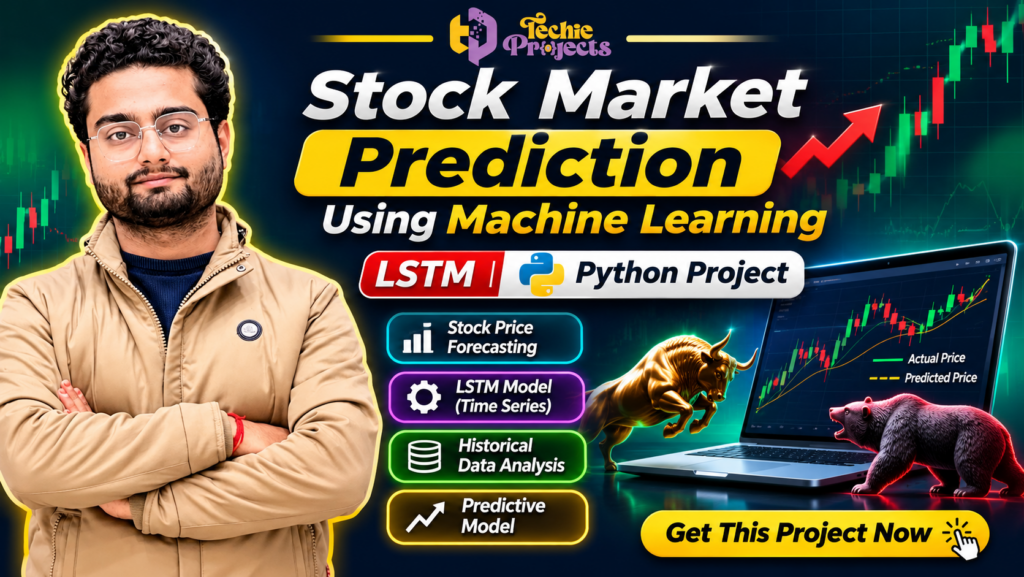
🚀 Get Your Stock Market Prediction Project Today!
The Stock Market Prediction Using Machine Learning project demonstrates how advanced Deep Learning techniques can be applied to financial time-series data. Students can explore historical stock prices, train prediction models, and understand how LSTM networks identify sequential patterns.
Looking for an advanced Stock Market Prediction Using Machine Learning project for your final-year engineering submission? Get this complete Python-based project from Techie Projects and explore how Artificial Intelligence, Deep Learning, and LSTM algorithms can be used to analyze historical stock market data and forecast future stock prices.
Don’t waste weeks struggling with complicated machine learning implementation, model training, data preprocessing, and prediction algorithms. Choose our Stock Market Prediction Using Machine Learning project to understand a practical real-world application of Python and Deep Learning.
This project is designed for B.Tech, BCA, MCA, M.Tech, Computer Science Engineering, Artificial Intelligence, and Data Science students who want to develop an impressive academic project.
🎓 Get professional project guidance, explore the implementation, and contact Techie Projects to purchase this project.
📞 Contact Techie Projects for Project Enquiries
📞 Contact / WhatsApp: +91 94600 60699
🌐 Website: www.techieprojects.com
📸 Instagram: @pythonprojects_
🎬 Watch the Stock Market Prediction Project Demo
Explore the working demonstration of our Stock Market Prediction Using Machine Learning project and understand how Python and LSTM models can analyze stock market information.
Watch the project demonstration to understand the application workflow, prediction process, and practical implementation.
📈 Introduction to Stock Market Prediction Using Machine Learning
The stock market is one of the most dynamic financial environments, where stock prices continuously change because of market demand, company performance, economic conditions, investor sentiment, and other factors.
Predicting stock prices is a challenging task because historical market patterns do not always indicate future market movements. Traditional analysis methods often require extensive manual calculations and market knowledge.
Machine Learning provides an interesting approach to analyzing historical financial data and identifying patterns that may help estimate future price movements.
Stock Market Prediction Using Machine Learning is a Python-based project that applies Deep Learning techniques to historical stock market datasets. It uses Long Short-Term Memory (LSTM), a specialized type of Recurrent Neural Network (RNN), to learn sequential patterns from time-series data.
The primary objective is to develop a predictive model that learns from previous stock prices and generates estimated future values.
This project demonstrates how Python programming, data analysis, visualization, and Deep Learning can work together to solve a real-world prediction problem.
🎯 Objectives of the Project
One of the major advantages of Stock Market Prediction Using Machine Learning is its ability to introduce students to practical financial data analysis. The project combines Python programming, data preprocessing, model development, and predictive analytics in one implementation.
The main objectives of the Stock Market Prediction Using Machine Learning project include:
- Collecting and analyzing historical stock market datasets.
- Understanding stock price movements through data visualization.
- Performing data preprocessing and normalization.
- Developing an LSTM-based Deep Learning model.
- Training the model using historical stock price information.
- Generating stock price predictions.
- Comparing actual and predicted values.
- Visualizing prediction results using graphical representations.
- Understanding the practical applications of Machine Learning in financial data analysis.
The project provides students with practical experience in developing a time-series forecasting application using Python.
🧠 What Is LSTM in Stock Market Prediction?
In this Stock Market Prediction Using Machine Learning implementation, the LSTM architecture learns from historical stock price sequences. The trained model generates estimated values that can be compared with actual stock prices through graphical visualizations.
Long Short-Term Memory (LSTM) is a type of Recurrent Neural Network designed to process sequential data and learn long-term dependencies.
Traditional neural networks do not naturally maintain information about previous time steps. LSTM addresses this limitation through a memory mechanism that helps the network retain and update relevant information.
In stock market analysis, previous price movements can provide useful historical context. LSTM models can learn patterns from sequential stock price observations and use the learned relationships to generate predictions.
Important LSTM Components
1. Forget Gate
The forget gate determines which information from the previous cell state should be retained or discarded.
2. Input Gate
The input gate controls which new information should be added to the cell state.
3. Cell State
The cell state maintains information as it passes through different time steps.
4. Output Gate
The output gate determines which information is used to generate the current output.
These components make LSTM useful for sequential data applications such as stock price forecasting, weather forecasting, demand prediction, and time-series analysis.
⚙️ How Does the Stock Market Prediction Project Work?
The Stock Market Prediction Using Machine Learning project follows a structured workflow.
1. Historical Stock Market Data Collection
The first step involves collecting historical stock market information.
The dataset may contain:
- Date
- Opening price
- Closing price
- Highest price
- Lowest price
- Trading volume
Historical stock prices are important because they provide sequential information that can be used to train the prediction model.
2. Data Preprocessing
Raw financial datasets may contain missing values, inconsistent formats, and numerical values with different ranges.
Data preprocessing prepares the information for model training.
Common preprocessing operations include:
- Loading the dataset.
- Checking missing values.
- Selecting relevant features.
- Converting data into numerical formats.
- Normalizing stock price values.
- Preparing sequential training samples.
Normalization is particularly useful when working with Deep Learning models because it helps bring numerical values into a consistent range.
3. Dataset Splitting
After preprocessing, the dataset is divided into training and testing portions.
The training dataset is used to teach the LSTM model historical patterns.
The testing dataset is used to evaluate how the trained model performs on previously unseen observations.
For time-series prediction, chronological splitting is important to avoid using future information when training a model for past observations.
4. LSTM Model Development
The next step is developing the LSTM architecture using Python and Deep Learning libraries.
The model receives sequential historical price information and learns relationships between previous observations.
The architecture can include:
- Input layer
- LSTM layers
- Dropout layers
- Dense layers
- Output layer
The final output represents the predicted stock price value.
5. Model Training
During training, the LSTM model learns patterns from the training dataset.
The model adjusts its internal parameters to reduce prediction errors.
Training performance can be evaluated using suitable loss functions and optimization algorithms.
6. Stock Price Prediction
After training, the model receives testing or new historical input sequences and generates estimated stock prices.
The predicted values can then be compared with actual stock prices to understand model performance.
7. Result Visualization
Visualization makes it easier to understand the prediction results.
Graphs can display:
- Actual stock prices.
- Predicted stock prices.
- Historical price movements.
- Prediction differences.
- Model performance trends.
These visualizations help students understand how the model behaves during the prediction process.
⭐ Key Features of Stock Market Prediction Using Machine Learning
Our Stock Market Prediction Using Machine Learning project provides an excellent opportunity to explore Deep Learning and financial data analysis.
Important project features include:
📊 1. Historical Stock Data Analysis
Analyze historical stock market information and understand how stock prices change over different periods.
🧠 2. LSTM-Based Prediction
Implement an LSTM model to learn sequential patterns from historical stock price information.
📈 3. Stock Price Forecasting
Generate estimated stock price values based on previously observed market data.
📉 4. Actual vs Predicted Comparison
Visualize actual and predicted values to understand the model’s performance.
💻 5. Python-Based Implementation
Explore Python programming and its applications in Machine Learning and Deep Learning.
📊 6. Data Visualization
Represent historical and predicted stock prices through graphical charts.
🎓 7. Academic Project Application
Use this project as a practical learning resource for engineering students working on Machine Learning, Artificial Intelligence, and Data Science.
🛠️ Technologies Used in the Project
Students interested in Artificial Intelligence can use the Stock Market Prediction Using Machine Learning project to gain practical experience with TensorFlow, Keras, NumPy, Pandas, and Python-based Deep Learning development.
The Stock Market Prediction Using Machine Learning project uses Python-based technologies and Deep Learning concepts.
| Technology | Purpose |
|---|---|
| Python | Main programming language |
| NumPy | Numerical calculations |
| Pandas | Dataset manipulation |
| Matplotlib | Data visualization |
| Scikit-learn | Data preprocessing |
| TensorFlow / Keras | Deep Learning implementation |
| LSTM | Sequential stock price prediction |
These technologies are widely used in modern Artificial Intelligence and Data Science applications.
💻 Software and Hardware Requirements
Software Requirements
- Programming Language: Python
- Operating System: Windows 10 / Windows 11
- Implementation Framework: Python
- Deep Learning Framework: TensorFlow / Keras
- Libraries: NumPy, Pandas, Matplotlib, Scikit-learn
- Development Environment: Jupyter Notebook / Python IDE
Hardware Requirements
- Processor: Intel Core i3 or above
- RAM: Minimum 4 GB (8 GB recommended)
- Hard Disk: Minimum 500 GB
- Input Devices: Keyboard and Mouse
- System: Windows-compatible computer
Actual requirements depend on dataset size, model architecture, and training configuration.
🎓 Applications of Stock Market Prediction
Stock market prediction models have several educational and analytical applications.
1. Financial Data Analysis
Machine Learning models can analyze large volumes of historical financial information and identify patterns.
2. Time-Series Forecasting
LSTM models can be applied to sequential datasets where previous observations may influence future values.
3. Algorithmic Trading Research
Prediction models can be studied as one component of experimental algorithmic trading systems. Additional risk controls and validation are required before any real-world application.
4. Financial Technology
FinTech developers can explore Machine Learning techniques for financial analytics and data-driven applications.
5. Academic Research
Students can experiment with different Deep Learning architectures, datasets, and prediction methods.
📚 Advantages of the Stock Market Prediction Project
Developing the Stock Market Prediction Using Machine Learning project offers several technical and academic benefits.
- Provides practical exposure to Python programming.
- Introduces students to Deep Learning concepts.
- Demonstrates LSTM architecture implementation.
- Improves understanding of time-series datasets.
- Provides experience with data preprocessing.
- Develops skills in graphical data visualization.
- Introduces real-world Machine Learning applications.
- Helps students understand model training and evaluation.
- Provides an excellent foundation for advanced Data Science projects.
🔍 Model Evaluation and Performance Analysis
Model evaluation is an important part of every Machine Learning project.
A prediction model should not be considered successful only because it generates output. Its performance must be evaluated using appropriate metrics.
Common evaluation metrics include:
Mean Absolute Error (MAE): Measures the average absolute difference between actual and predicted values.
Mean Squared Error (MSE): Calculates the average squared prediction error.
Root Mean Squared Error (RMSE): Represents the square root of MSE and expresses prediction error in the original measurement scale.
R-squared (R²): Measures how much variation in the target variable is explained by the model under the evaluation setup.
These metrics help students compare different model configurations and understand prediction performance.
🆚 Why Choose LSTM Instead of Traditional Machine Learning?
Traditional Machine Learning algorithms can be useful for financial prediction, but they may require manual feature engineering to represent sequential relationships.
LSTM models are specifically designed to process sequential information.
| Feature | Traditional ML | LSTM |
|---|---|---|
| Sequential learning | Depends on feature engineering | Designed for sequential data |
| Memory mechanism | Not inherent | Yes |
| Time-series applications | Possible | Suitable |
| Architecture | Algorithm dependent | Neural network |
| Training requirements | Varies | Can require more computation |
LSTM is not guaranteed to outperform traditional algorithms. Model performance depends on data quality, feature selection, architecture, and evaluation methodology.
💡 Future Scope of the Project
The Stock Market Prediction Using Machine Learning project can be extended with several advanced features.
1. Multiple Stock Prediction
Extend the application to analyze and predict multiple stock symbols.
2. Sentiment Analysis
Integrate Natural Language Processing to analyze financial news and market sentiment.
3. Advanced Deep Learning Models
Experiment with GRU, CNN-LSTM, Attention mechanisms, and Transformer-based architectures.
4. Real-Time Data Integration
Connect the application with supported financial data APIs to retrieve updated market information.
5. Interactive Dashboard
Develop a web-based dashboard using Streamlit or Flask to display stock charts and prediction results.
6. Model Comparison
Compare different Machine Learning and Deep Learning algorithms to evaluate their forecasting performance.
7. Technical Indicator Integration
Explore indicators such as Moving Average, RSI, and MACD as additional model features.
These improvements can turn the basic academic implementation into a more advanced financial analytics application.
🛒 Why Purchase Your Stock Market Prediction Project from Techie Projects?
Choose the Stock Market Prediction Using Machine Learning project from Techie Projects to explore LSTM-based forecasting, understand the complete development workflow, and get assistance with your final-year engineering project requirements.
Techie Projects provides engineering project development and learning solutions across multiple technical domains.
We work with students interested in:
- Artificial Intelligence Projects
- Machine Learning Projects
- Deep Learning Projects
- Python Projects
- Data Science Projects
- Computer Vision Projects
- Natural Language Processing Projects
- Web Development Projects
- IoT Projects
By choosing Techie Projects, you can enquire about project availability, implementation details, pricing, and technical guidance.
What Can You Enquire About?
- Project source code availability.
- Project execution and demonstration.
- Software requirements.
- Implementation details.
- Project explanation and guidance.
- Customization possibilities.
- Pricing and delivery details.
Our objective is to help students explore practical technology projects and improve their technical understanding.
🎯 Who Can Purchase This Project?
This Stock Market Prediction Using Machine Learning project is relevant to:
- B.Tech Computer Science Engineering students.
- BCA students.
- MCA students.
- M.Tech students.
- Artificial Intelligence students.
- Data Science students.
- Machine Learning enthusiasts.
- Python developers.
- Students interested in Deep Learning.
Whether you are developing a final-year project, preparing a technical demonstration, or exploring financial forecasting, this project offers an opportunity to understand a practical Machine Learning application.
💡 Recommended Projects
Explore more practical engineering and Python projects from Techie Projects:
- Stock Price Prediction Using Python
- Cryptocurrency Price Prediction Using Machine Learning
- Fake News Detection Using Machine Learning
- Credit Card Fraud Detection Using Python
- Customer Churn Prediction Using Machine Learning
- House Price Prediction Using Machine Learning
- Heart Disease Prediction Using Python
- Loan Approval Prediction Using Machine Learning
- Sales Forecasting Using Deep Learning
- Face Recognition Attendance System
- Human Activity Recognition Using Deep Learning
- Disease Prediction Using Machine Learning
Explore more projects on Techie Projects and find suitable ideas for your academic requirements.
❓ Frequently Asked Questions (FAQs)
1. What is Stock Market Prediction Using Machine Learning?
Stock Market Prediction Using Machine Learning is a project that uses historical stock market data and Machine Learning algorithms to estimate future stock prices.
2. Which algorithm is used in this project?
The project uses Long Short-Term Memory (LSTM), a Deep Learning architecture designed to learn patterns from sequential data.
3. Which programming language is used?
Python is used as the primary programming language.
4. Is this project suitable for final-year engineering students?
Yes. It is suitable for students studying Computer Science, Artificial Intelligence, Machine Learning, and Data Science.
5. Which libraries are required?
Common libraries include NumPy, Pandas, Matplotlib, Scikit-learn, and TensorFlow/Keras.
6. Can beginners understand this project?
Yes. Students with basic Python knowledge can study the implementation and gradually understand the data preprocessing, LSTM architecture, training, and prediction workflow.
7. Can the project be extended?
Yes. It can be extended with real-time data integration, sentiment analysis, interactive dashboards, and advanced Deep Learning architectures.
8. How can I purchase this project?
You can contact Techie Projects through WhatsApp at +91 94600 60699 or visit www.techieprojects.com to enquire about availability and pricing.
🚀 Get Your Stock Market Prediction Project Now!
Ready to work on an advanced Python and Deep Learning project?
Purchase the Stock Market Prediction Using Machine Learning project from Techie Projects and explore the implementation of LSTM-based stock price forecasting.
Whether you are a B.Tech, BCA, MCA, or M.Tech student, this project can help you understand the practical application of Artificial Intelligence and Machine Learning.
📌 Why wait? Contact us today for project details and pricing!
📞 Contact / WhatsApp: +91 94600 60699
🌐 Website: www.techieprojects.com
📸 Instagram: @pythonprojects_
Techie Projects – Practical Projects for Engineering Students.
Disclaimer: This project is intended for educational, research, and experimental purposes. Stock price predictions are uncertain and should not be treated as guaranteed financial forecasts or investment advice.