
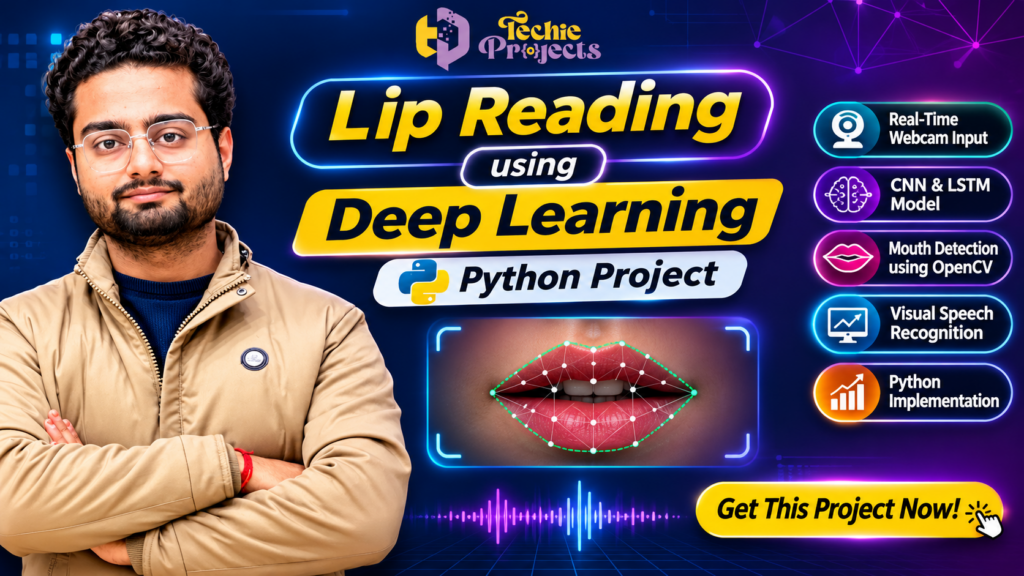
👄 Introduction: Lip Reading using Python
Lip Reading using Python is an advanced artificial intelligence project that demonstrates how computers can recognize speech-related information by analyzing human lip movements. This Lip Reading using Python project combines computer vision, machine learning, and deep learning to process video frames and identify visual speech patterns.
Students interested in developing a Lip Reading using Python application can explore face detection, mouth detection, image preprocessing, CNN, and LSTM architectures. The project demonstrates how Lip Reading using Python can be implemented using OpenCV and deep learning frameworks.
🚀 Looking to purchase a complete Lip Reading using Python project for your final-year engineering submission? Get an exciting AI-based project from Techie Projects that combines Deep Learning, Machine Learning, Computer Vision, OpenCV, and real-time visual speech recognition.
If you are a B.Tech, M.Tech, MCA, or Computer Science Engineering student searching for an innovative final-year major project, this is an excellent opportunity to explore an advanced artificial intelligence application.
The Lip Reading using Python project demonstrates how computers can analyze human lip movements and recognize speech-related patterns using visual information. Unlike conventional speech recognition systems that primarily depend on audio input, this project explores how mouth movements captured through a camera can be processed to identify visual speech patterns.
Instead of wasting valuable academic time searching for incomplete source code, troubleshooting libraries, and developing everything from scratch, contact Techie Projects to enquire about purchasing this project.
🎓 Get a practical implementation, explore its working demonstration, and discuss source code, documentation, and project assistance with our team.
Techie Projects helps engineering students explore practical AI, Deep Learning, Python, and Computer Vision projects.
📞 Contact Techie Projects for Project Enquiries
Interested in purchasing the Lip Reading using Python Project? Contact us to enquire about package availability, pricing, source code, documentation, installation guidance, and technical support options.
💬 WhatsApp Enquiry: Chat with Techie Projects
📱 Contact Number: +91 94600 60699
🌐 Official Website: www.techieprojects.com
📸 Instagram: Follow Techie Projects
🎓 Project Areas: Robotics, Machine Learning, Arduino, Deep Learning, Artificial Intelligence, and Android App.
✅ Request Project Details: Share your engineering branch, preferred features, and technical requirements to enquire about the most suitable available package.
🚀 Ready to get started? Click here to enquire on WhatsApp and mention Lip Reading using Python Project.
Package contents, prices, hardware availability, and support options should be confirmed before purchase.
🎬 Watch the Lip Reading using Python Project Demo
Project Demo: Lip Reading using Deep Learning with Python
Explore the Techie Projects demonstration to understand how mouth movements can be analyzed using computer vision and machine learning techniques.
The demonstration introduces the concept of lip movement detection, visual feature extraction, and deep learning-based speech recognition.
Students can explore the application workflow and understand how the different technologies contribute to the project.
👄 What is Lip Reading using Python?
Lip Reading using Python is an artificial intelligence application that demonstrates how computers can interpret human speech-related information by analyzing the movement of lips.
When a person speaks, their mouth and lips move in different patterns. These movements contain visual information that can be analyzed using computer vision and deep learning techniques.
The objective of this project is to capture mouth movements, extract relevant visual features, and use a trained machine learning model to recognize patterns associated with speech.
Python provides an extensive collection of libraries for developing such applications. OpenCV can be used for video capture and image processing, while deep learning frameworks can support model training and prediction.
The Lip Reading Machine Learning Project introduces students to several important AI concepts:
- Real-time webcam input.
- Face and mouth detection.
- Facial landmark extraction.
- Lip movement analysis.
- Image and video preprocessing.
- Deep learning model development.
- CNN and LSTM architecture.
- Visual speech recognition.
This makes the project an interesting choice for students looking for advanced Computer Vision Projects for their academic submissions.
🎯 Objectives of the Lip Reading Machine Learning Project
The primary objective is to demonstrate how machine learning models can analyze visual speech information without depending entirely on audio signals.
The major objectives include:
- To capture video input through a webcam.
- To detect the human face and mouth region.
- To extract useful features from lip movements.
- To preprocess video frames for model input.
- To explore Deep Learning for Lip Reading.
- To understand CNN and LSTM architectures.
- To recognize visual patterns associated with speech.
- To display the model’s predicted output.
Through these objectives, students can understand the complete workflow of an AI-powered visual speech recognition application.
⚙️ Technologies Used in Lip Reading Project
The project combines Python programming, computer vision, and deep learning technologies.
1. Python Programming Language
Python is the main programming language used for implementing the project. Its extensive ecosystem makes it suitable for computer vision, machine learning, and deep learning applications.
2. OpenCV
OpenCV is an important computer vision library used for capturing video frames, processing images, resizing frames, and performing other visual operations.
3. Machine Learning
Machine learning techniques help develop models that learn patterns from training data and generate predictions from new inputs.
4. Deep Learning
Deep learning architectures can learn complex patterns from sequential visual information, making them useful for exploring lip movement recognition.
5. CNN (Convolutional Neural Network)
CNN is useful for extracting spatial features from images. In a lip reading application, it can help learn visual characteristics associated with mouth shapes and movements.
6. LSTM (Long Short-Term Memory)
LSTM networks are designed to process sequential information. They can learn relationships between consecutive frames and help model temporal patterns in lip movements.
7. NumPy
NumPy supports numerical operations, array manipulation, and data preprocessing.
8. Matplotlib
Matplotlib can be used for visualizing training results, image samples, and model performance.
These technologies provide a strong foundation for implementing a Lip Reading using Python academic project.
🧠 How Does the Lip Reading using Python Project Work?
The system follows a sequence of operations, beginning with video input and ending with a predicted output.
Step 1: Real-Time Webcam Input
The application captures video frames using a webcam.
The captured frames provide visual information about the speaker’s face and mouth movements.
Step 2: Face Detection
The system identifies the face region in the captured video.
Face detection helps locate the relevant area before extracting mouth-related information.
Step 3: Mouth Detection using OpenCV
After detecting the face, the system focuses on the mouth region.
Mouth Detection using OpenCV is an important part of the preprocessing workflow because lip movements contain the visual information required for the classification process.
Step 4: Facial Landmark Extraction
Facial landmarks can be used to identify important points around the mouth.
These points help describe mouth shape, position, and movement across consecutive frames.
Step 5: Video Frame Preprocessing
The captured frames are prepared before being supplied to the trained model.
Common preprocessing operations include:
- Frame resizing.
- Image normalization.
- Mouth-region extraction.
- Frame sequence preparation.
- Data formatting.
Step 6: Feature Extraction using CNN
CNN layers can learn visual features from the processed mouth images.
These features help represent different mouth shapes and visual patterns.
Step 7: Sequential Analysis using LSTM
Lip movements change over time. LSTM can process sequences of extracted features and learn relationships between consecutive video frames.
This is where CNN and LSTM for Lip Reading can work together.
Step 8: Prediction and Output
The trained model processes the visual sequence and generates a predicted output based on the classes or vocabulary represented in the training dataset.
The application can display the recognized output through its interface.
The complete process demonstrates how Visual Speech Recognition can be explored using Python and deep learning.
🔬 Deep Learning for Lip Reading: Understanding CNN and LSTM
Deep learning plays an important role in visual speech recognition because it can learn complex patterns from images and video sequences.
A Lip Reading Machine Learning Project can use a combination of CNN and LSTM architectures to process spatial and temporal information.
Role of CNN
Convolutional Neural Networks are designed to identify patterns in visual data.
In this project, CNN can learn:
- Mouth shape.
- Lip position.
- Visual features.
- Image patterns.
- Spatial relationships.
Role of LSTM
LSTM networks are useful when the input contains sequential information.
For lip reading, individual video frames are not sufficient to represent the entire movement of a spoken word. The sequence of mouth movements is also important.
LSTM can learn temporal relationships between consecutive visual features.
Why Combine CNN and LSTM?
CNN extracts visual information from individual frames, while LSTM processes the sequence of extracted features.
Combining these architectures provides a useful approach for developing visual speech recognition systems.
Students can explore how this architecture works and experiment with different configurations during project development.
🎯 Features of Lip Reading using Python
The Lip Reading using Python project includes several interesting features:
Python-based application development.
Webcam-based video capture for Lip Reading using Python.
Face detection and mouth-region extraction.
Visual feature extraction using CNN.
Sequential movement analysis using LSTM.
Deep Learning for Lip Reading.
Visual speech recognition and prediction.
🎓 Benefits of Lip Reading Project for Final-Year Students
Choosing an advanced project can help engineering students improve their practical knowledge and demonstrate their technical capabilities.
The Lip Reading using Python project combines several important technologies into one implementation.
1. Practical Artificial Intelligence Experience
Students gain exposure to how artificial intelligence can be applied to real-world visual recognition problems.
2. Understanding Computer Vision
The project introduces image processing, face detection, facial landmarks, and mouth movement analysis.
3. Learning Deep Learning Architecture
Students can understand how CNN and LSTM networks work together to process visual information.
4. Practical Python Development
The implementation provides experience with Python libraries and application development.
5. Useful for Academic Presentations
The project provides multiple technical concepts that students can explain during presentations and viva examinations.
6. Resume and Portfolio Development
Knowledge of OpenCV, Python, CNN, LSTM, and deep learning can help students demonstrate their technical interests to potential employers.
7. Exposure to Advanced Research Areas
Visual speech recognition is an interesting research area involving artificial intelligence, human-computer interaction, and computer vision.
⚙️ Working Methodology of Lip Reading using Python
The working methodology of Lip Reading using Python involves capturing video frames, detecting the face, extracting the mouth region, and processing visual information.
First, the Lip Reading using Python application captures video through a webcam. OpenCV processes the frames and identifies the mouth region. CNN extracts important visual features, while LSTM analyzes the sequence of mouth movements.
After processing the input sequence, the Lip Reading using Python model generates a prediction based on its trained vocabulary and dataset.
The methodology explains the development process followed by the Lip Reading using Python application.
Stage 1: Video Dataset Collection
Collect video samples containing different spoken words or phrases. Each sample should have an appropriate label.
Stage 2: Video Frame Extraction
Convert video samples into individual frames for further processing.
Stage 3: Face and Mouth Detection
Identify the face and extract the mouth region from each frame.
Stage 4: Image Preprocessing
Resize and normalize the extracted images to maintain consistent input dimensions.
Stage 5: Feature Extraction
Use CNN layers to extract visual features from mouth images.
Stage 6: Sequential Learning
Supply the extracted features to an LSTM network to learn temporal relationships between frames.
Stage 7: Model Training
Train the model using labeled video sequences.
Stage 8: Model Evaluation
Evaluate the model using suitable metrics such as accuracy, precision, recall, and confusion matrix, depending on the classification setup.
Stage 9: Application Integration
Connect the trained model with the Python application and webcam input.
Stage 10: Prediction and Result Display
Capture new visual input, process the frames, and display the predicted output.
This methodology provides students with an understanding of the complete development lifecycle of a deep learning application.
💻 Software and Hardware Requirements
Software Requirements
- Programming Language: Python.
- Computer Vision Library: OpenCV.
- Deep Learning Framework: TensorFlow / Keras or PyTorch.
- Numerical Library: NumPy.
- Visualization: Matplotlib.
- IDE: VS Code / PyCharm / Jupyter Notebook.
- Operating System: Windows 10/11 or Linux.
Hardware Requirements
- Processor: Intel Core i3 or higher.
- RAM: Minimum 8 GB recommended.
- Storage: 500 GB HDD or SSD.
- Webcam: Required for real-time video input.
- GPU: Recommended for faster deep learning training.
Actual requirements depend on the dataset size, architecture, and implementation.
🚀 Applications of Visual Speech Recognition
Visual speech recognition has several interesting applications in research and technology.
1. Human-Computer Interaction
Visual speech recognition can be explored as an alternative input method for interacting with computer systems.
2. Assistive Technology Research
Researchers can investigate visual communication technologies that may support people in different communication environments.
3. Noisy Environments
Visual speech information can be studied alongside audio signals in environments where audio quality is poor.
4. Smart Communication Systems
Visual speech recognition can be explored as one component of intelligent communication applications.
5. Artificial Intelligence Research
The project provides a foundation for experimenting with deep learning, computer vision, and multimodal learning.
These applications make Visual Speech Recognition an interesting subject for advanced computer science projects.
🛒 Why Purchase the Lip Reading Machine Learning Project from Techie Projects?
Developing a deep learning project from scratch can involve several challenges, including dataset preparation, video preprocessing, model development, library compatibility, and debugging.
Techie Projects provides engineering project solutions across different technical domains to help students explore practical implementations.
When contacting our team, you can enquire about:
- Project source code availability.
- Complete project demonstration.
- Software installation requirements.
- Project documentation availability.
- Implementation guidance.
- Customization requirements.
- Academic presentation assistance.
Our goal is to help students understand the project workflow and gain practical exposure to modern technologies.
Whether you need a Lip Reading Machine Learning Project or another Python-based Computer Vision Project, Techie Projects can help you explore available solutions.
👨🎓 Who Should Purchase This Project?
This project may be suitable for:
- B.Tech Computer Science Engineering students.
- Information Technology students.
- Artificial Intelligence and Data Science students.
- M.Tech students.
- MCA students.
- BCA students.
- Students interested in machine learning.
- Students exploring deep learning and computer vision.
If you are looking for an innovative final-year major project involving CNN, LSTM, OpenCV, and Python, this project is worth considering.
💡 Recommended Projects from Techie Projects
Looking for more AI and machine learning projects?
Explore these related project ideas:
- Sign Language Recognition using Machine Learning.
- Face Recognition Attendance System.
- Real-Time Object Detection using YOLO.
- Hand Gesture Recognition using Python.
- Human Activity Recognition using Deep Learning.
- Emotion Detection using Computer Vision.
- Speech Emotion Recognition using Machine Learning.
- Real-Time Face Mask Detection using CNN.
These projects provide additional opportunities to explore artificial intelligence, deep learning, and computer vision.
📚 Explore Related Python Projects
Techie Projects offers engineering project ideas and development solutions across multiple domains:
- Artificial Intelligence and Machine Learning.
- Deep Learning.
- Python Development.
- Computer Vision.
- Image Processing.
- Natural Language Processing.
- Data Science and Analytics.
- Web Development.
- IoT and Embedded Systems.
Visit www.techieprojects.com to explore more project ideas and find a suitable implementation for your academic requirements.
❓ Frequently Asked Questions (FAQs)
1. What is Lip Reading using Python?
It is an AI-based application that demonstrates how computers can analyze mouth movements and recognize visual speech patterns using Python, computer vision, and deep learning.
2. Which programming language is used?
Python is the primary programming language used in the project.
3. Which algorithms are used for lip reading?
CNN and LSTM architectures can be combined to extract spatial features and learn sequential patterns from video frames.
4. What is the role of OpenCV?
OpenCV supports webcam input, video processing, image manipulation, and mouth-region extraction.
5. What is Visual Speech Recognition?
Visual Speech Recognition is the process of analyzing visual information, particularly mouth movements, to recognize speech-related patterns.
6. Is this project suitable for final-year CSE students?
Yes. It is a suitable academic topic for students interested in artificial intelligence, computer vision, Python, and deep learning.
7. Can I purchase the project source code?
Yes, you can contact Techie Projects to enquire about source code availability, pricing, documentation, and other project deliverables.
8. Does the project support real-time webcam input?
The project demonstration focuses on webcam-based visual input. Contact our team to confirm the exact implementation and supported functionality.
9. Does lip reading work without audio?
Visual speech recognition can analyze mouth movements without relying on audio input. However, recognition performance depends on the training dataset, vocabulary, model architecture, and visual conditions.
10. Does Techie Projects provide project assistance?
You can discuss available implementation guidance, documentation, installation assistance, and other support options with our team.
🔥 Purchase Lip Reading using Python Project Today!
Still searching for an innovative final-year engineering project?
Take your academic project to the next level with the Lip Reading using Python project from Techie Projects.
Explore the practical combination of Python programming, OpenCV, CNN, LSTM, Machine Learning, and Visual Speech Recognition.
Don’t spend valuable time searching for incomplete code and disconnected tutorials. Contact our team to discuss the available project package, pricing, source code, demonstration, documentation, and implementation assistance.
🚀 GET THIS PROJECT NOW!
Build your future with Artificial Intelligence, Deep Learning, and Computer Vision!
📞 Contact / WhatsApp: +91 94600 60699
🌐 Website: www.techieprojects.com
📸 Instagram: @pythonprojects_
Techie Projects – Your Destination for Engineering Projects, Python Development, AI Solutions, and Innovative Technology.

